Comba Telecom is a global leading wireless solutions provider with their own R&D facilities, manufacturing base, and sales and service teams. The company offers a comprehensive suite of products and services including wireless access, wireless enhancement, antenna and subsystems and wireless transmission to its global customers. Comba's core product portfolio includes antennas and subsystems and network products (DAS, Small Cells, Repeater, RRU, etc.), offering turnkey solutions for indoor and outdoor 2G/3G/4G/Wifi/5G to their global customers.
Last year, Comba announced the launch of the industry's first Open RAN multi-RAT, multi-band Remote Radio Unit (“RRU”) that supports 1800MHz and 2100MHz, promoting widespread adoption of emerging open standards in the globe. The announcement says:
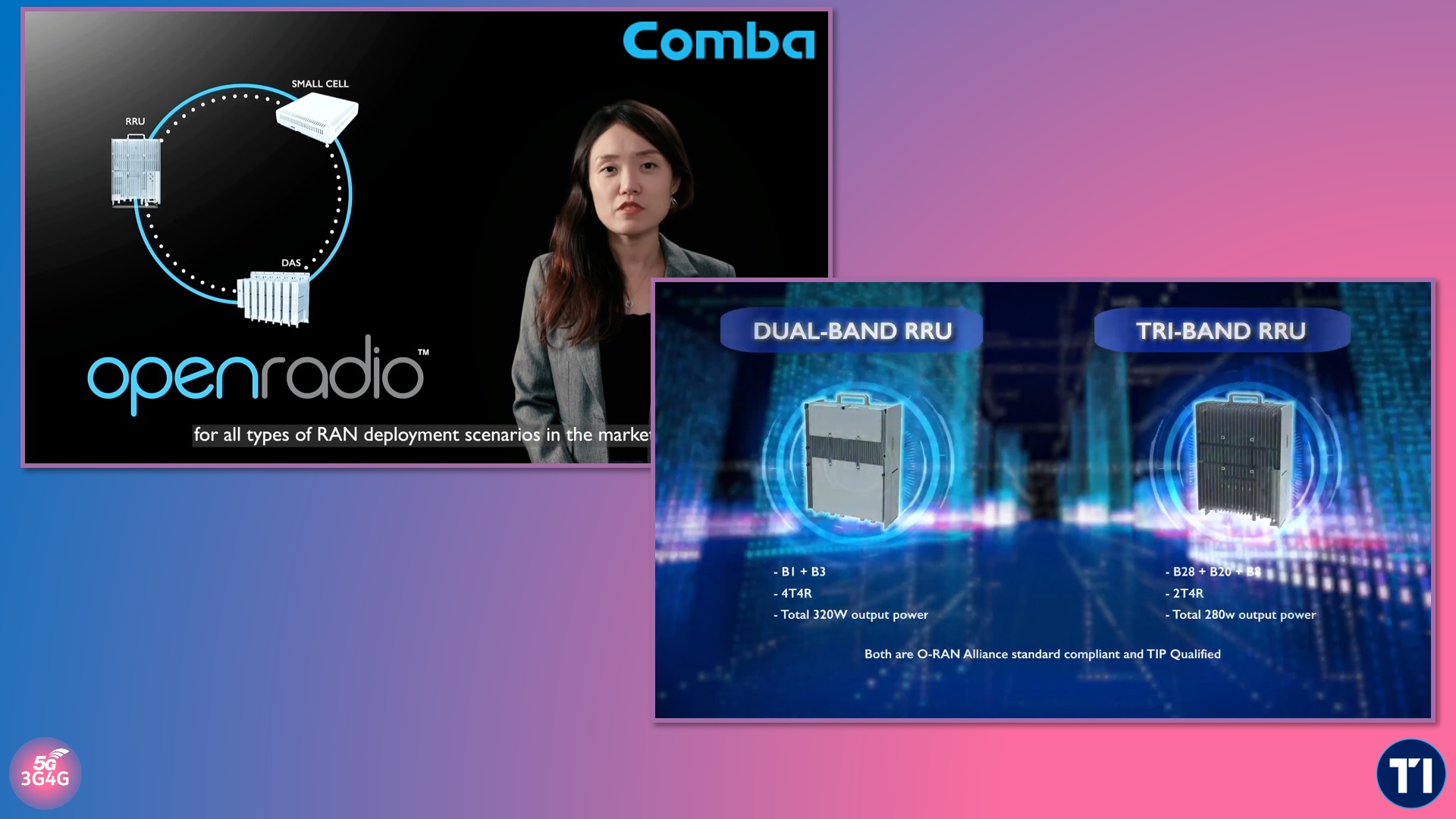
The RRU is designed to minimize the total cost of ownership (“TCO”) for operators and neutral hosts in macro deployments through fast and easy deployment, energy savings, improved coverage and throughput, smaller footprint and easy maintenance. Engineered for efficient high power (320W) operation, the multi-RAT multi-band 4T4R RRU minimizes the environmental footprint and reduces the energy spend for the operator.
As a first in the Open RAN industry the GSM/UMTS/LTE/5G NR multi-mode operation makes it ideal for simple upgrades of legacy sites without compromises. The 4T4R radio supports two LTE/5G NR carriers per band and Dynamic Spectrum Sharing (“DSS”). This enables operators to serve arising 5G traffic demand without additional spectrum or removing LTE service.
Comba has a long-standing collaboration with major industry partners and alliances and has participated in the initial Open RAN trials and lab projects in different regions. With all in-house expertise in interoperability and optimizing radio designs for market specific criteria, Comba enables mobile operators to accelerate time to market, and mitigate the overall technology risk when adopting to Open RAN strategy in their next generation of RAN.
A recent video looks at these Open RAN Multi-band RRUs
While most Open RAN RUs are focused on 4G & 5G, Comba's radios work on 2G & 3G as well. This has allowed them to bring Open RAN solutions to many different parts of the world that may not be ready for 5G yet. Some of these include announcements with their software partner Parallel Wireless in Latin America and Indonesia. Another recent standalone announcement included one with Turkcell in Turkey.
Telefonica also listed them as one of the partners in a presentation at MWC
Operator Watch Blog: Telefonica's Vision of Open RAN from MWC 2022 - https://t.co/iTYJDGx1MQ via Maite Aparicio, Head of Open RAN-Global CTIO#3G4G5G #OperatorWatch #4G #5G #Telefonica #OpenRAN #ORAN #ORANalliance #NEC #Altiostar #Intel #Comba #Airspan #SuperMicro #Dell #RedHat pic.twitter.com/pE4OpsRTmD
— 3G4G (@3g4gUK) April 6, 2022
Telecom Infra Project's TIP Exchange features quite a few radios from Comba which you can see here.
If you are interested in learning more, what the Comba keynote and Panel Discussion on Maturity of Open RAN Adoption at MWC22 Open RAN Summit below:
Related Posts:
- Telecoms Infrastructure Blog: Vodafone Portugal's “streetlamp”
- Operator Watch Blog: Telefonica's Vision of Open RAN from MWC 2022
- The 3G4G Blog: Open RAN Terminology and Players
- Telecoms Infrastructure Blog: Open RAN (O-RAN) RRU (O-RU) and DU (O-DU) Design
- The 3G4G Blog: A quick tutorial on Open RAN, vRAN & White Box RAN
- The 3G4G Blog: Open RAN Explanation, Videos, White papers and Other Resources
- The 3G4G Blog: O-RAN Introduction for Beginners
- Telecoms Infrastructure Blog: NTT Docomo's 5G Network is based on 'Open RAN' Principles
- Telecoms Infrastructure Blog: NTT Docomo's 5G RAN Infrastructure
- The 3G4G Blog: 5G RAN Functional Splits
- The 3G4G Blog: From traditional RAN to Open RAN - O-RAN: Goals and Challenges
- 3G4G: Open RAN, OpenRAN and O-RAN


