Showing posts with label Infrastructure Masts. Show all posts

Tuesday, 20 May 2025

NTT DOCOMO Trialled Japan’s First Self-powered Hydropower Base Station

In a move to advance sustainable telecom infrastructure, NTT DOCOMO launched a trial of Japan’s first self-powered hydropower mobile base station in May 2024. The initiative aimed to explore the viability of using flowing water from irrigation canals and similar sources to generate renewable energy for base stations, particularly in rural locations where power options are limited.

The trial featured a compact hydroelectric system based on a jet turbine co-developed with Professor Yukihiro Shimatani of the Prefectural University of Kumamoto. The turbine design integrated the nozzle and turbine into a single unit, which allowed for simplified manufacturing using 3D printing. This approach reduced both complexity and cost, making it suitable for distributed deployments in hard-to-reach areas.

The hydropower system was designed to generate electricity and convert it into a usable form for powering mobile base stations. It also collected real-time data on power output, water flow and pressure. This data was transmitted to DOCOMO’s Energy Management System platform, which monitored and controlled power distribution while visualising the reduction in CO2 emissions achieved through the system.

DOCOMO had previously relied on solar-powered green base stations to reduce its environmental impact. By March 2024, the company had deployed 286 such sites, equipped with photovoltaic panels and large storage batteries to maintain operations during grid outages. However, in areas where solar energy was not practical, DOCOMO explored alternative renewable sources, with hydropower emerging as a promising candidate.

The hydropower base station trial formed part of DOCOMO’s broader environmental commitment. The company had set out to achieve net-zero greenhouse gas emissions from its operations by 2030 and across its supply chain by 2040. With mobile base stations accounting for approximately seventy percent of DOCOMO’s energy use, the trial addressed a critical aspect of energy sustainability.

Over the one-year demonstration period, DOCOMO aimed to optimise the system’s electrical design and integration with mobile infrastructure. It also assessed which types of base stations could benefit most from hydroelectric power and how the system could be scaled for broader deployment. The company targeted March 2025 as the timeline for evaluating results and considering next steps.

This trial represented more than just an engineering exercise. It reflected a growing focus within the telecoms sector on decarbonisation, resilience and innovation. By experimenting with alternative renewable energy sources, DOCOMO showed how network operators could adapt infrastructure for a lower-carbon future, while improving coverage and reliability in off-grid areas.

As telecom networks continue to expand, projects like this highlighted the importance of flexible, locally sourced power solutions in shaping a sustainable infrastructure roadmap.

Related Posts

Tuesday, 6 May 2025

How Vodafone UK Prepares its Network for Storms and Heatwaves

Extreme weather is a growing concern for mobile network operators, and Vodafone is no exception. Storms and heatwaves can damage infrastructure, interrupt power supply, and delay repair work. To keep people connected during such events, Vodafone has developed a range of technical measures and operational strategies that help it prepare for and respond to disruption.

The most exposed part of the network is the mast, which is usually above ground and can be up to 25 metres tall. While it is not possible to make these completely immune to bad weather, Vodafone designs them with resilience in mind. Many mast sites are equipped with backup batteries and generator connection points, provided there is space to install them safely.

Vodafone operates around 18,000 masts across the UK. Each one is part of the wider Radio Access Network, with traffic routed through dedicated signalling controllers hosted in secure data centres. These centres are equipped to maintain at least one mobile service, even in the event of a power outage, by prioritising the use of backup power.

In rural areas, some masts rely on microwave links instead of fibre or copper connections. These links require a clear line of sight between masts, so engineers carry out preventative maintenance to remove any vegetation that might interfere with signal transmission.

The Network Operations Centre (NOC) monitors the network and directs field engineers. During weather alerts, Vodafone increases staffing levels to improve response times and ensure the right resources are in place. Temperature sensors at mast sites detect heat-related issues and automatically alert the NOC if thresholds are exceeded. This can lead to quick interventions, such as cleaning or replacing clogged air filters in cooling systems.

If a mast repeatedly shows signs of overheating, the NOC flags it for further investigation. Possible solutions include enhanced maintenance schedules or upgrading the cooling technology. Despite all these precautions, access and repair work after storms or floods can still be complicated by damaged roads or infrastructure. Engineers may need to assess fibre cables, antennas or even the structural integrity of masts.

Where power supply is disrupted for extended periods, Vodafone’s network planners must carefully manage the use of batteries and generators. Coordination with external bodies such as the National Grid is often essential.

By investing in resilient infrastructure and ensuring rapid response capabilities, Vodafone aims to keep its mobile network running reliably, even in the face of increasingly unpredictable weather.

Related Posts

Tuesday, 3 December 2024

Deutsche Telekom's Hydrogen-Powered Mini-Masts

Earlier in the year we wrote about Deutsche Telekom's Mini-Mast a.k.a. “Cell Tower To Go”.  Last year, DT set a new benchmark in sustainable technology with the deployment of hydrogen-powered antennas at the Nibirii Festival in Germany. This initiative replaced the traditional diesel generators with hydrogen fuel cells to provide eco-friendly energy for mobile base stations. The hydrogen is sourced in a CO₂-neutral process, marking a significant step towards green innovation.

For anyone who doesn't understand what hydrogen fuel cell is, this video has a good explanation.

At the festival, a hydrogen-powered mast supported 30,000 attendees with seamless LTE and 5G connectivity. The fuel cells, developed by SFC Energy, ensured reliable, uninterrupted service for 28 days, showcasing their potential for large events, emergencies, and remote areas. This shift underscores Deutsche Telekom's commitment to combining sustainability with technological advancements.

Additionally, compact mobile masts and stage-mounted small cells enhanced coverage and user experience. These innovations promise to redefine mobile connectivity, emphasizing rapid deployment and reduced environmental impact.

You can read the full story here.

Related Posts

Thursday, 4 July 2024

Mobile Infrastructure from Hajj 2024 (1445 H)

Hajj, the annual Islamic pilgrimage to Mecca/Makkah in Saudi Arabia is a fantastic example of how to handle huge amounts of people and data. With over 1.8 million pilgrims this year, many of whom go to the holy mosque every day (generally more than once) during the Hajj days, providing reliable connectivity and reasonable data rates is a huge challenge. 

The press release post Hajj, provided some more details on the number of sites and data usage:

CST Governor stated that the unlimited support from the leadership resulted in the recording of exceptional network performance levels across more than (6200) telecom towers, with 5G towers surpassing 4,000 towers, reflecting an impressive 37% increase compared to 2023, while the Wi-Fi points exceeded 10500 points in Makkah Al-Mukarramah and Al-Madina Al-Munawarah and the Holy Sites.

H.E. the Governor also added that the total data consumption reached 65.47 thousand TB, equivalent to watching 26.82millionhours of 1080p HD video clips, with internet download speeds exceeded 341.6 Mbit/s, while the voice calls total exceeded 337 million calls with a success increase of 99%, as a result of the developed network infrastructure and the availability of WiFi networks. 

Here are some high resolutions pictures that show how much infrastructure is needed. Most of these sites in the Haram provided coverage for something like 100 metres as there were other similar sites nearby, some shared for all operators while others were specific to one operator.


Related Posts

Thursday, 20 June 2024

Ecotelligent's Wooden Masts

Ecotelligent is on a mission to enable telecommunication in a more human environment by applying the science of wood construction into building of communication towers and masts. This allows them to significantly reduce the CO2 emissions of building the towers and make the landscape more pleasant for people.

Last year, Vantage Towers announced that it has installed the first wooden structured telecommunication mast in cooperation with the Finnish start-up Ecotelligent: 

The Ecopol tower was erected as one of two wooden masts in Rhineland-Palatinate as part of a pilot project, as announced by Vantage Towers in October 2022. The installation of the second Ecopol tower is expected to take place in Leiwen, Germany, in the third quarter of 2023; further locations in Germany are being considered. With the construction of wooden structured telecommunication infrastructure, Vantage Towers, together with Ecotelligent, is marking the beginning of a more sustainable mobile communications industry and digitalisation. According to the manufacturer, the Ecopol towers, which are built from recyclable wood, have a significantly lower carbon footprint than comparable masts made of steel or concrete. In addition, they have an attractive, modern design and blend in better with their surroundings - which increases the acceptance of telecommunication infrastructure among the population. 

The use of sustainable materials for Vantage Towers' infrastructure is another component of the company’s sustainability strategy, complementing efforts to make its own infrastructure more energy efficient and reduce resource consumption. For example, the company already reached its first major green milestone in 2021: since then, all the electricity Vantage Towers uses to operate its infrastructure has been procured from renewable energy sources such as wind, solar or hydro power. In addition, pilots are underway to produce renewable energy directly at the sites with wind turbines and solar panels, and to replace diesel generators with hydrogen engines.  

You can see some more details of wooden telecommunication masts in the video below:

Glad to see that other countries are also considering deploying these environmentally friendly masts in the near future.

Tuesday, 13 February 2024

Deutsche Telekom's Mini-Mast a.k.a. “Cell Tower To Go”

Last year Deutsche Telekom developed a mini-mast (or as they call it, ultra-mobile mast) prototype called "cell-tower-to-go". Think of this as Cell On Wheel (COW) with no wheels. In a recent press release they indicated that it has already become a customer favourite within a short space of time. 

Around a dozen companies are testing the flexible solution so far. "With our call to test our ultra-mobile cell tower, we have raised great interest among companies from a wide range of industries. This high demand shows: The need for a flexible mobile communications solution is there - also among business customers. This has strengthened our decision to offer this innovation 'made by Telekom' commercially in the future," says Klaus Werner, Managing Director Business Customers at Telekom Deutschland.

One of the first testers is the leading Swiss construction and real estate service provider Implenia. The company will provide its bridge construction site in Bad Lobenstein (Thuringia, Germany) with 5G and 4G/LTE during the two-year construction phase. The construction site in the valley could not be reached by the conventional mobile phone masts in the surrounding area. However, due to the high degree of digitalization of the construction site, a fast and reliable mobile network connection is essential. 

Telekom's cell-tower-to-go provides high-performance coverage at the construction site. Smartphones and computers then use fast mobile connections via frequencies in the 2.6 and 3.6 gigahertz range. For Implenia, this basic mobile communications coverage is also an ideal basis for IoT applications. The company uses them to optimize processes and material flows on the construction site. The easy-to-connect mast is linked to the network on the bridge construction site via fiber optics. However, the connection via satellite will also be tested in a next step. This will provide additional flexibility and an even faster connection to the network. 

The micro-container is also making a big impact at the delivery service flaschenpost SE. The food and beverage delivery service from Münster, Germany, uses the additional 5G supply within a logistics hall. This speeds up its operational processes.

The special feature of the ultra-mobile mast is that it is significantly smaller, lighter and more flexible than previous solutions. The entire radio technology fits into a compact micro-container (length: 1.6 meters, width: 2 meters, height: 2.6 meters). This makes the mobile mast space-saving and easy to transport. It can be set up by one person in less than an hour - and is immediately ready for use. The micro container can be connected to a local power supply or operated using any other mobile power source. It can be connected to the data network via fiber optics or radio relay.  

These advantages make the mobile “dwarf” not only the first choice for fast or temporary coverage for business customers. The use of mobile masts also provides rapid assistance in disaster areas thanks to their enormous flexibility.

Deutsche Telekom will launch a commercial offer for the use of ultra-mobile transmission masts in spring 2024.

Related Posts

Monday, 12 June 2023

Du's Solar Sites in UAE

du mobile telecommunication services, the second largest UAE MNO was launched in February 2007 under Emirates Integrated Telecommunications Company (EITC), a public joint stock company incorporated in Dubai through Ministerial Resolution No. 479 of 2005 issued on 28 December 2005. As of 2021, du has 6.7 million (39%) of UAE mobile subscribers and 236,000 fixed line subscribers.


In their latest sustainability report, du said:

78 sites that run completely on solar panels, helping us save 360 tCO2 during the year

  • Diesel savings of approximately 1.4 million litres/year (a total carbon footprint reduction of 3,714 tCO2/year)
  • Additional 100 solar sites planned for installation in 2023

Surprisingly it is difficult to find how these sites look like. The picture above is from a LinkedIn post by Ibrahim Gedeon. The only other place I have seen these is in this Tweet:

It would be interesting to learn more. If you have more info or know where to find it, please feel free to add the info in the comments below.

Related Posts

Monday, 12 September 2022

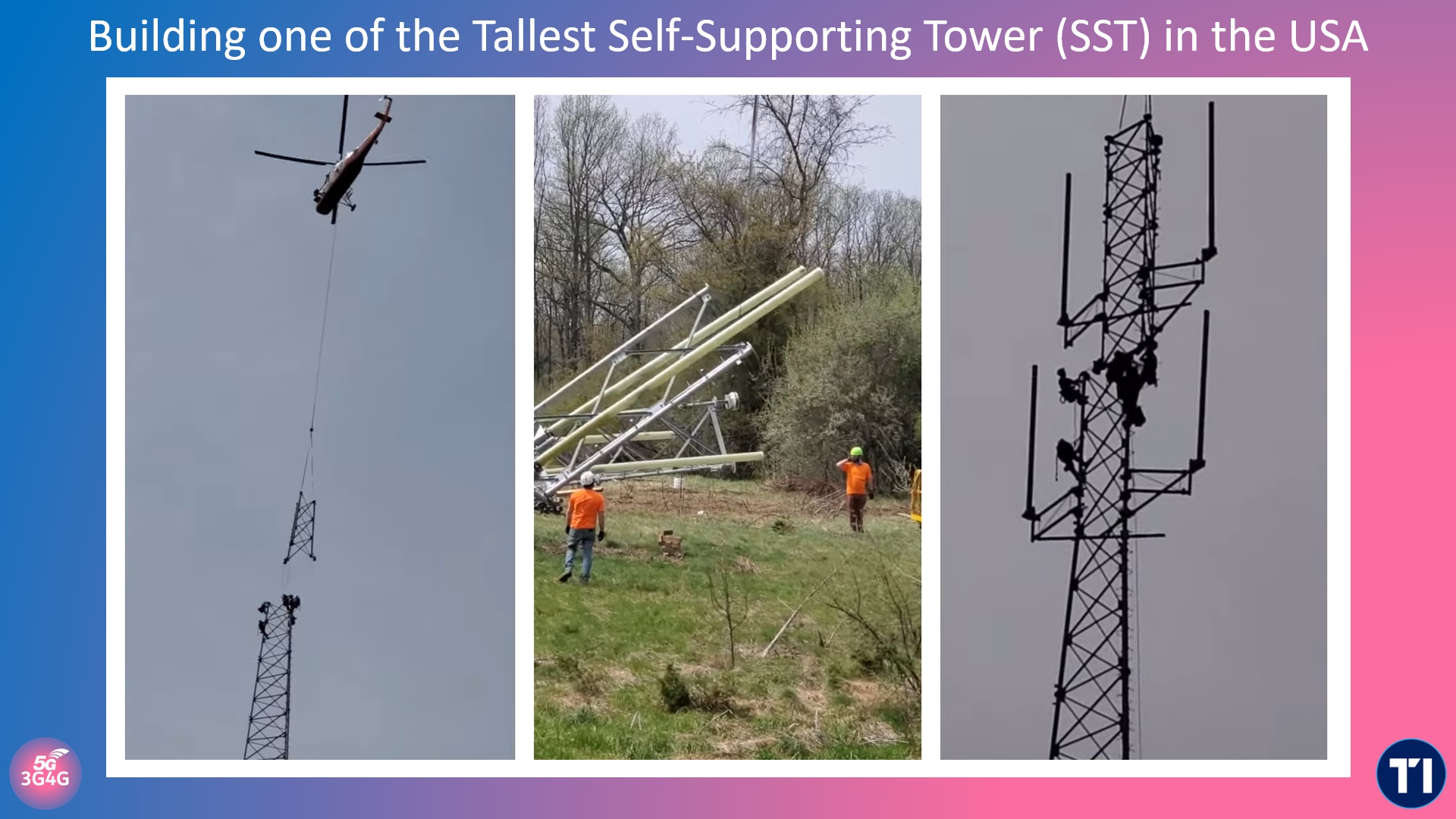
Construction of a Self-Supporting Tower (SST)

Inside Towers shared a video of SST (self-supporting tower) construction on YouTube. According to the article, invited to observe the installation of the last three preassembled sections of a very new, very big SST. Article here and the video as follows:

Related Posts

Sunday, 26 June 2022

Vodafone UK Switches-on First Live 'Self-Powering' Mobile Phone Mast

In a press release last year, Vodafone UK had announced that they have developed self-powered mobile towers and will deploy them across the UK, supporting the company’s target of achieving net zero for its UK operations by 2027. 

Vodafone and Crossflow Energy have been collaborating over the last couple of years on the development of Crossflow Energy’s innovative wind turbine technology, combined with the latest in solar and battery technologies, to create a self-powered mobile network tower. In addition, Vodafone's network partner, Cornerstone, had signed up to run a proof of concept to install Crossflow Turbine technology on rural mobile sites.

These ground-breaking Eco-Towers are expected to enable the deployment of new mobile sites in the most remote locations, without the major challenge and cost of connecting to the electricity grid.

In a press release earlier this month, Vodafone announced that it has switched on the the first live wind- and solar-powered mobile phone mast in Pembrokeshire, Wales. The mast will provide 4G coverage to the community of Eglwyswrw. The PR further says:

The specially designed mast, which potentially removes the need for a connection to the national electricity grid, could provide connectivity to ‘not-spots’ in the UK’s most remote and inaccessible locations – helping the industry achieve 95% of UK landmass coverage by 20253. It will also help Vodafone reduce carbon emissions and support its target of reaching net zero UK operations by 2027.

The ‘self-powering’ mast incorporates a unique Crossflow Energy wind turbine that can generate power even in light winds. The mast can be installed without the need to dig trenches and lay electricity cables, making it faster and easier to install and reducing the impact on the local environment.

It is also extremely quiet, making it viable for sensitive sites such as Areas of Outstanding Natural Beauty. It can also be ‘filtered out’ as a solid object by radar, birds and bats, so it is easily avoided, making it less harmful to wildlife.

The trial, in partnership with wind turbine technology specialists Crossflow Energy and mobile infrastructure partner Cornerstone, is at Home Farm in the village of Eglwyswrw. It will run for two years and data gathered will help Vodafone optimise the technology and determine which sites are most suitable for ‘self-powering’ masts.

Bringing mobile and internet services to rural communities helps boost the local economy, tackle isolation and close the rural digital divide. To date, building masts in coverage ‘not spots’ without an existing electricity connection has been a significant financial and logistical challenge.

The following video has also been shared:

Related Posts

Friday, 20 May 2022

Vodafone Explains Mobile Phone Mast

Questions related to what does a mobile phone mast consist of keeps popping up time and again. I looked at it some years back but it doesn't stop people asking additional questions. 

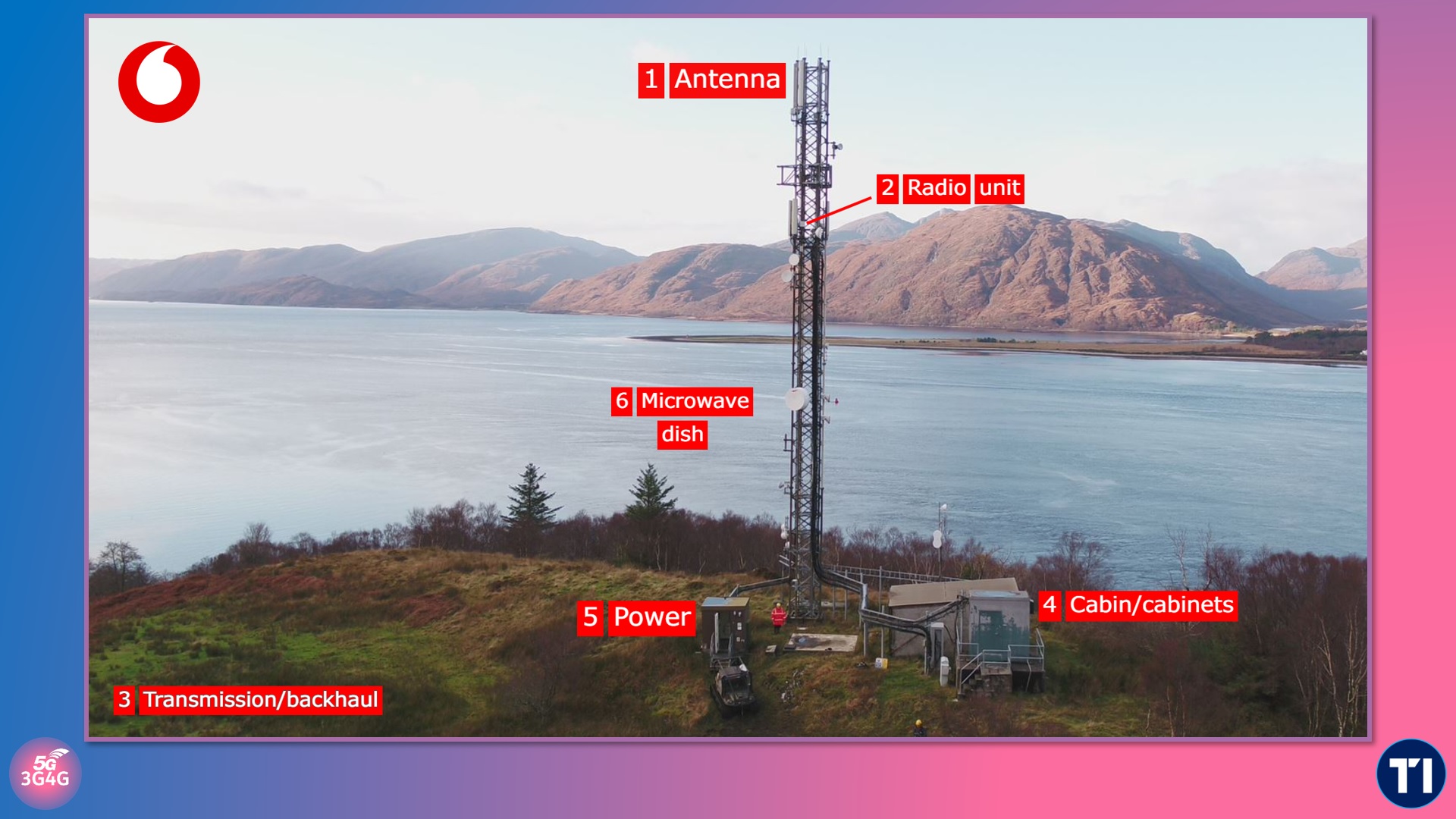
When the UK MNOs started their Shared Rural Network journey, Vodafone put together a nice primer on what does a mobile network mast consist of. Here is an extract from the article:

What do all the bits of a mast actually do?

  1. Antenna: Antennas send calls, texts and internet data to your smartphone using radio waves and in turn receive radio waves from it. The higher up an antenna is, the more likely it is that you’ll get a strong and reliable mobile signal from it. Most masts will have at least three antennas to provide coverage in every direction. Masts that need to serve more people, because they’re located in more heavily populated areas, will have more antennas.
  2. Radio unit: The radio unit generates the radio waves transmitted by the antennas. Traditionally, the radio unit was installed at ground level. Nowadays, they’re more likely to be installed higher up the mast closer to the antenna to help improve performance.
  3. Transmission/backhaul: Cables, traditionally copper but now far more likely to be fibre optic, are used to connect the mast with other masts and the rest of the Vodafone network in the UK. These are usually buried in the ground. In a few cases, a microwave dish is used instead.
  4. Cabin/cabinets: Located at ground level, these contain computers which communicate with other masts in the network. Additional equipment, such as a battery backup in case of power failure and connectors for the transmission/backhaul, are also stored here.
  5. Power: Most masts will draw their power from the National Grid; some will have their own renewable power source on-site. In a handful of cases, such as with temporary masts, power will instead be provided by a diesel generator.
  6. Microwave dish: In some locations, such as remote rural areas, a microwave satellite dish is used instead of fibre optic cables to act as transmission/backhaul, connecting the mast to the rest of Vodafone’s network. To do so, the dish must be within line of sight of a dish on another mast.

Why can’t you build it somewhere else?

Not all sites are suitable. To provide the strongest mobile signal to as wide an area as possible, there can’t be too many neighbouring buildings, trees or other geographical features in the way. These tend to block the mast’s signal.

Masts also need their own power and what’s known as “backhaul” – data connections to the rest of the network. To meet soaring demand for faster speeds, that backhaul often consists of fibre optic cables under the ground – it’s a common misconception that most of Vodafone UK’s masts communicate wirelessly with the rest of the network.

And to run these power and data lines to a mast, we have to negotiate with the owners of the land, and quite often, with the owners of land adjacent to it. Those negotiations aren’t just about how much rent we will pay, but how easily we can access those sites for construction, maintenance and repairs.

These so-called “wayleave” negotiations can take time – and sometimes break down completely – setting back mast construction by several months.

Why can’t you just build a shorter, less conspicuous mast?

The taller the mast, the wider the area it can cover and the more people it can provide with a fast and reliable mobile signal. Under current rules, most UK masts are around 25m (82ft) tall. But in fact 50m masts would provide a better, more far-reaching signal in many areas.

Update April 2021 – the UK Government has proposed rule changes that would allow new and existing masts to be up to five metres taller and two metres wider than they currently can be. This would not only help increase the range of their wireless signal, it would also make it easier for masts to be potentially shared with other mobile network operators, as more equipment can be fitted onto taller masts.

Who decides where masts are built?

Our engineers pick sites that best meet the technical, logistical and economic requirements for hosting a mast, but the local council has to grant planning permission for the building works to go ahead. So councils hold public consultations before making their decision and residents can have their say.

You can read the complete article here.

The old video of cell tower construction site is worth a watch and is embedded below:

Related Posts