Showing posts with label Vendor Huawei. Show all posts

Tuesday, 15 September 2026

Huawei LampSite Evolves to Five Bands in One Box

I first wrote about Huawei's LampSite solution on this blog back in 2014. At the time, digital indoor systems were emerging as an alternative to traditional Distributed Antenna Systems (DAS), with the idea of bringing the radio much closer to indoor users rather than simply distributing RF signals around a building.

Interestingly, Huawei was already talking about a future generation of LampSite capable of delivering 1 Gbps indoor throughput. At the time this looked ambitious, with technologies such as multi-stream aggregation being considered as part of the evolution. More than a decade later, LampSite has evolved considerably.

In June 2026, MTN Zambia and Huawei announced what they described as the world's first commercial deployment of a new five-band LampSite solution, installed at the Mulungushi International Conference Center in Lusaka.

The new system combines 1.8 GHz, 2.1 GHz, 2.3 GHz, TDD 2.6 GHz and 3.5 GHz in a single box, while supporting 2G, 3G, 4G and 5G. Huawei says the deployment uses 3.5 GHz 4T channels together with TDD 2.6 GHz carrier aggregation to provide a single-user downlink peak speed of around 1 Gbps.

So there is an interesting historical symmetry here. In 2014, the roadmap was pointing towards gigabit indoor connectivity. In 2026, Huawei is reporting a commercial LampSite network delivering that figure, although obviously the radio technology, spectrum and architecture used to achieve it are very different from what was envisaged twelve years ago.

The Zambia example also highlights why indoor networks remain challenging even when good outdoor 5G coverage is available.

According to Huawei, Mulungushi had previously relied partly on outdoor 3.5 GHz macro coverage, but building penetration meant that the macro network could not provide sufficiently strong indoor signals. The existing DAS was also unable to support the required multi-band configuration. Adding separate systems for different bands would have increased equipment complexity, deployment time and operational costs.

This is where digital indoor systems such as LampSite differ fundamentally from traditional passive DAS.

Rather than taking a high-power RF signal and distributing it through coaxial cables, splitters and antennas, LampSite distributes baseband or digitised signals towards small remote radio units located throughout the building. Huawei calls these pRRUs, or pico Remote Radio Units.

The principle itself is not new. The original LampSite architecture already used centralised baseband processing connected through rHUBs to distributed pRRUs. What has changed significantly is how much radio capability can now be integrated into those remote units.

When I looked at LampSite 3.0 in 2017, Huawei was already adding concurrent multi-band operation, more flexible carrier aggregation, distributed MIMO and 256-QAM. Huawei was claiming speeds of up to 2 Gbps under suitable configurations. LampSite 3.0 could also accept signals from an external base station, including equipment from another vendor, making the architecture more interesting for multi-operator and neutral-host deployments.

I returned to that subject in 2019 when looking at small cells and neutral-host networks. Huawei was then presenting LampSite Sharing as a digital indoor system in which multiple operators could share common infrastructure rather than each operator installing a completely independent indoor network.

By 2020, 5G LampSite had arrived. Huawei said that the product, originally launched in 2018, integrated 5G NR and LTE and could support both C-band and sub-3 GHz frequencies in a unit of less than two litres.

The latest five-band generation takes that consolidation considerably further.

Huawei says the Zambia pRRU combines all five required frequency bands into a single indoor radio head. This is significant because a multi-band indoor network would otherwise potentially require multiple radios, antennas or separate signal-distribution paths.

Huawei claims its optical multi-band architecture can reduce the number of indoor headends by up to 50% for equivalent coverage, reducing installation requirements and construction time. The solution also incorporates intelligent dormancy and symbol-level power-saving techniques, which Huawei markets as part of its "0 Bit 0 Watt" approach. These are Huawei figures rather than independent measurements from the Zambia deployment, but they illustrate the wider objective: increasing indoor capacity while reducing the amount of physical infrastructure needed to provide it.

There is another important development in 2026 that helps put the five-band solution into context.

At MWC Barcelona, Huawei launched LampSite iSharing, its latest approach to shared indoor networks. The company describes iSharing as a digital-analogue hybrid architecture designed for both single-operator and multi-operator deployments.

Three elements are particularly interesting:

  • The first is the five-band integrated pRRU.
  • The second is what Huawei calls the Multi-mode Extended Hybrid Card, or MEHC, which combines digital, RF and data access.
  • The third is RRU-free BBU digital feed-in. In other words, an operator can potentially feed the shared indoor infrastructure directly from its baseband equipment rather than first needing a dedicated radio unit to generate an RF signal that is then fed into the sharing system.

Independent reporting from MWC adds some useful detail. GlobalData Network Matter reports that the MEHC enables as many as three operators' BBUs to connect directly to a distributed control unit for signal aggregation, allowing a neutral-host deployment to avoid separate radio-end equipment for each participating operator.

This is potentially just as important as putting five bands into one pRRU.

The evolution can therefore be seen at both ends of the indoor network. At the signal-source end, more of the equipment required by multiple operators can be consolidated. At the coverage end, more frequency bands and radio technologies can be combined into fewer physical remote units.

Huawei's current DBS5900 LampSite Sharing portfolio gives an indication of how this architecture fits together. It combines elements including the DCU, rHUB, pRRU and hRRU, and supports both BBU digital feed-in and traditional RF feed-in. Huawei's DCU5910, for example, is specified to support both methods. The rHUB then provides distribution towards the remote indoor radios.

The publicly listed pRRU5755 provides an example of how much radio functionality can now be integrated into a single unit. It supports 900, 1800, 2100, 2600 and 3500 MHz, with 4T operation available at 3.5 GHz. Other pRRU variants support different combinations according to market requirements.

It is worth noting that Huawei has not publicly identified the exact pRRU model used by MTN Zambia, and the published pRRU5755 frequency combination is not the same as the Zambia configuration, which includes 2.3 GHz rather than 900 MHz. It would therefore be wrong to assume that the Zambia installation is simply using the currently published pRRU5755 configuration.

Likewise, although Huawei's LampSite iSharing launch and the Zambia deployment clearly share the same broader direction towards five-band integration and simplified indoor architecture, Huawei's Zambia announcement does not explicitly identify the deployment as LampSite iSharing.

The broader point is that the indoor mobile network is steadily becoming less like a passive extension of the outdoor macro network.

Traditional DAS remains widely used and can be very effective, particularly where multiple operators and frequencies need to share an established antenna system. But adding higher frequencies, wider bandwidths, MIMO, multiple RATs and eventually more advanced 5G-Advanced capabilities makes purely passive distribution increasingly challenging.

Digital indoor systems move more of the radio intelligence towards the edge of the distribution network. They also make capacity easier to manage independently across different parts of a building and provide greater flexibility when new frequencies or technologies need to be introduced.

Huawei is also positioning LampSite for further evolution towards 5G-Advanced, including services such as high-precision positioning, AIoT and immersive applications. The Zambia announcement mentions future use cases such as XR, AR navigation and glasses-free 3D, although these should be seen as potential applications enabled by future network evolution rather than services demonstrated by the current deployment.

Perhaps the most interesting aspect of the latest LampSite evolution is therefore not the headline 1 Gbps speed, or even the fact that five bands fit into one box. It is the continuing consolidation of indoor mobile infrastructure.

What started as a way of replacing long RF distribution paths with digital connections and small indoor radio units has progressively added multi-band operation, MIMO, 5G, neutral-host capabilities, digital sharing and now five-band integrated radios with more flexible multi-operator signal sources.

For large venues, airports, transport hubs, shopping centres and other locations where several generations of mobile technology and multiple spectrum bands need to coexist, reducing that infrastructure complexity may ultimately prove more important than the headline peak speed.

Related Posts: 

Tuesday, 7 April 2026

Huawei’s PanoAAU Aims to Change the Economics of 5G Coverage

As 5G networks continue to expand beyond dense urban centres, the industry has been forced to confront a difficult reality. Traditional deployment models, built around three-sector sites and relatively narrow beam coverage, do not translate well into rural and semi-rural environments. Lower population density, larger coverage areas and tighter budgets mean that operators need to extract far more value from each site.

Huawei’s PanoAAU is one attempt to address this challenge. While it has been in the market for some time, publicly available technical detail remains limited. However, by piecing together information from different announcements and deployments, a clearer picture begins to emerge of what the solution is trying to achieve and why it matters.

At its core, PanoAAU is an evolution of the active antenna unit, designed to extend coverage both horizontally and vertically. The most notable shift is the move from the conventional 120 degree sector to a 180 degree wide-angle coverage. This is enabled through extremely large antenna array technology combined with beamforming and what Huawei describes as a wide-angle beam management approach. The practical implication is that a traditional three-sector site could, in some scenarios, be replaced with a two-sector configuration while still maintaining, or even improving, coverage.

This change is not just about radio performance. It has direct implications for site economics. Reducing the number of sectors means fewer radio units, less equipment on the tower, lower power consumption and potentially reduced site rental costs. In rural deployments, where return on investment is often marginal, these savings can be significant enough to make previously unviable sites commercially feasible.

The antenna design itself appears to rely on a combination of lightweight materials, low-loss feeding structures and metamaterial-based elements. These are intended to address the physical challenges that come with larger antenna arrays, particularly weight and signal loss. The use of such materials is consistent with a broader trend in radio design, where advanced materials are being used to push beyond traditional performance limits without making deployments impractical.

Software plays an equally important role. Wide-angle coverage introduces complexity in beam management, especially when trying to maintain capacity and user experience across a broader footprint. The solution therefore depends heavily on more precise and responsive beamforming algorithms to ensure that users are still served efficiently, even as the coverage area expands. This is particularly relevant for uplink performance, which is becoming increasingly important as networks evolve towards AI-driven applications and more interactive services.

PanoAAU also sits within a wider portfolio of radio solutions that Huawei has been promoting in the context of 5G-Advanced and what it refers to as 5.5G. Alongside products such as MetaAAU and EasyAAU, it reflects a move towards more specialised radio units tailored for different deployment scenarios. In this context, PanoAAU is positioned as a coverage-focused solution, particularly suited to suburban, rural and geographically complex environments.

Early deployments outside China provide some useful context. In Zambia, for example, MTN has worked with Huawei on dual-band active antenna solutions that are part of the same broader radio evolution. These deployments highlight a similar set of challenges, including limited tower space, the need to support both 4G and 5G, and the pressure to reduce both capital and operational expenditure. Solutions that integrate multiple bands and simplify installation are particularly attractive in such markets, where infrastructure constraints are often more pronounced.

There are also indications that the concept extends beyond traditional ground-level coverage. The emphasis on vertical reach suggests potential applications in high-rise urban environments and, increasingly, in low-altitude connectivity scenarios. This is where the discussion begins to overlap with one of the more interesting developments in 5G-Advanced, namely the integration of sensing capabilities into the network.

Recent trials in China have demonstrated how 5G-Advanced base stations can go beyond communication to provide radar-like sensing. Using integrated sensing techniques, networks are able to detect, track and monitor low-altitude objects such as drones in real time. Tests have shown that even very small objects can be identified with high accuracy, with the network able to determine position, speed and trajectory without relying on external systems such as GPS. This creates the possibility of electronic fencing, intrusion detection and broader airspace monitoring using the existing mobile infrastructure.

While this capability is not specific to PanoAAU, the underlying requirement is clear. Wider and more flexible coverage, including improved vertical reach, becomes increasingly important when networks are expected to support both communication and sensing functions. In that sense, technologies like PanoAAU can be seen as part of the enabling layer for these emerging use cases, particularly in scenarios where coverage continuity is critical.

Deployments in markets such as China and trials in other regions suggest that the solution is not purely theoretical. Operators have reportedly used it to reduce the number of required sites or sectors while maintaining service levels. In some cases, it has also been associated with lower energy consumption, aligning with the broader industry push towards greener network infrastructure.

The link to energy efficiency is particularly important. By integrating multiple capabilities into fewer units and enabling both 4G and 5G operation within the same hardware, solutions like PanoAAU can reduce overall network power consumption. This is increasingly becoming a key metric for operators, not just from a sustainability perspective but also in terms of operational expenditure.

It is also worth noting that PanoAAU is part of a broader shift in how radio access networks are being designed. The traditional approach of uniform site design is giving way to a more modular and scenario-driven strategy. Different environments require different solutions, and vendors are responding with increasingly diverse portfolios of radio units. In that sense, PanoAAU is less about a single product and more about a design philosophy focused on flexibility and efficiency.

That said, there are still open questions. Much of the available information comes from vendor-led announcements, with limited independent performance data. The real-world gains in coverage, capacity and cost savings will depend heavily on deployment conditions, spectrum availability and integration with existing networks. As with many new radio innovations, the benefits are likely to vary significantly from one market to another.

Even so, the underlying idea is difficult to ignore. If operators can meaningfully reduce the number of sectors or sites required for wide-area coverage without compromising user experience, it could have a lasting impact on how 5G networks are rolled out, particularly in underserved regions.

In that context, PanoAAU represents an interesting step in the ongoing evolution of radio access technology. It highlights the industry’s efforts to balance performance, cost and sustainability, while also preparing the network for emerging use cases that extend beyond traditional mobile broadband.

Related Posts: 

Tuesday, 22 April 2025

FDD Tri-Band Massive MIMO: Unlocking Sub-3 GHz Potential for 5G Evolution

Huawei has begun commercial deployments of its FDD Tri-Band Massive MIMO solution, focusing on sub-3 GHz spectrum across Africa and several other global markets. Countries such as Nigeria, Angola, and Côte d'Ivoire are among the first to benefit, with deployments also expected across Asia Pacific, Central Asia, and Latin America.

This new technology is being positioned to solve two key challenges for mobile operators. First, it tackles the persistent increase in 4G traffic, which continues to grow year on year. Second, it enhances the user experience for 5G services without demanding vast new spectrum allocations. Huawei claims the solution delivers significant performance improvements over the conventional 4T4R setup, including handling almost twice as much 4G traffic during peak times, tripling user-perceived speeds, and halving the use of physical resource blocks.

Underpinning these benefits are innovations like Real Wide Bandwidth and Compact Dipole technologies. These allow multiple FDD bands such as 1.8 GHz, 2.1 GHz, and 2.6 GHz to be processed using a shared filter, antenna array, and power amplifier. This not only enables efficient spectrum use but also simplifies site deployments. Huawei reports that 5G network capacity can be boosted up to sevenfold with uplink coverage extended by 8 dB, both of which are especially important as mobile AI services increase the demand for higher uplink bandwidth and wider coverage.

The market conditions in Africa illustrate why this approach is timely. Rapid urbanisation and a large population base have created surging demand for mobile data, leading to congestion and degraded user experience. Many sites already host conventional Massive MIMO technology, but with traffic increasing by 50 percent annually, a more efficient capacity solution is urgently needed.

The broader role of sub-3 GHz FDD spectrum in 5G development is also coming into sharper focus. While early 5G investment emphasised the upper mid-band due to its wide contiguous spectrum, the sub-3 GHz FDD bands now represent a crucial part of the coverage and capacity equation. These bands collectively offer around 100 MHz of paired spectrum and are essential for extending 5G services beyond dense urban centres into suburban and rural areas. Their propagation characteristics provide better in-building penetration and a stronger uplink experience.

Operators have traditionally used these bands to complement mid-band deployments, but case studies suggest they can form the backbone of high-performance networks when optimised correctly. In the Netherlands, for example, delays in mid-band spectrum availability led operators to rely heavily on FDD spectrum. Despite these constraints, they achieved strong data rate and latency performance by tightly integrating 4G and 5G technologies.

One persistent issue is the fragmentation of spectrum across multiple bands, which can complicate radio access network design. Physical site constraints and antenna complexity remain challenges, particularly as physical cell site growth slows. This has led to a push for site simplification through wideband and multiband radio solutions. Many equipment vendors now offer radios that can support three FDD bands within a single unit, often using a shared power amplifier and filter. This not only reduces size and weight but also lowers power consumption and speeds up deployment.

Although Massive MIMO is generally seen as more effective with TDD, Huawei believes its latest advancements in intelligent beamforming and multi-band serving cell configurations can change that narrative. By treating multiple FDD bands as a single carrier and applying advanced beamforming, spectral efficiency can be dramatically improved. According to Huawei, this combination can deliver a tenfold gain in throughput and a 10 dB improvement in coverage compared to standard 4T4R systems.

With the shift toward 5G Advanced on the horizon, operators must get the most out of their existing spectrum assets. Sub-3 GHz FDD spectrum may not be new, but with the right technology, it can provide the performance needed to meet modern data demands and support the next wave of mobile services.

Related Posts: 

Tuesday, 29 October 2024

China Deploys 5G-A Synaesthesia in the Tibet Autonomous Region (TAR)

As a non-native English speaker, I had never come across the word synaesthesia (UK)/synesthesia (US). The Cambridge dictionary explains this as a condition in which someone experiences things through their senses in an unusual way, for example by experiencing a colour as a sound, or a number as a position in space. Wikipedia says that it is a perceptual phenomenon in which stimulation of one sensory or cognitive pathway leads to involuntary experiences in a second sensory or cognitive pathway.

Earlier this year Light Reading reported that Tibet's $500M 5G network in Tibet has 2.3 million 5G users and penetration rate of 62%. The Diplomat reported that China has already built 11,719 5G base stations in the Tibet Autonomous Region (TAR). Quoting from the publication:

The 5G-A synaesthesia integrated base stations have been described by Huawei as a new revolutionary technology, along with passive IoT and endogenous intelligence, spurred by the 5G-A era.

China has developed the new 5G-A base stations to overcome the longstanding challenges faced by its traditional radars and cameras in terms of detecting and identifying small-sized drones operating within low-altitude airspace. These 5G-A base stations are equipped with comprehensive sensing capabilities that enable identification, real-time positioning, speed detection, and tracking of low-altitude unmanned aerial vehicles, ground vehicles, and other illegally intrusive targets. Following the completion of the first station, the China Mobile Tibet Company announced that its 5G-A base station has detection capabilities surpassing traditional radars. According to the company, the goal of these base stations in Tibet’s border areas is to build low-altitude sensing networks, thereby fostering the development of drone inspection and early warning systems. 

The low-altitude economy refers to various economic activities occurring within the vertical airspace that extends from 1,000 to 4,000 meters above the ground where civil-manned and unmanned aircraft vehicles operate and promote the integrated development of related fields.

The innovation of synaesthesia integrated technology in 5G-A has garnered great attention in China recently. 5G-A synaesthesia integrated technology combines multiple capabilities such as communications, imaging, and computing power, turning a regular communication network into a supercharged “radar,” with high-precision and resolution perception capabilities.

You can also learn more about the solution here. The MIIT press release emphasises that Redcap is available as part of the solution.

Huawei recently shared a video of them deploying 5G infrastructure in Tibet. The video is embedded below:

Related Posts: 

Wednesday, 22 November 2023

Huawei's RuralLink Solution Proposes to 'Connect the Unconnected'

It's been five years since we first wrote about Huawei's rural network solution. RuralStar was all rage back in 2018 and then the updated RuralStar 3.0 in 2020. Since then, Huawei has been working on updated architecture of RuralLink.

At MWC 2023, RuralLink won GSMA's 'Best Mobile Innovation for Emerging Markets' GLOMO Award. The press release at the RuralLink launch at the Global Mobile Broadband Forum 2022 (MBBF2022) provided some insights into the solution. The following is from the press release: 

Huawei's RuralLink solution uses unique innovative technologies to solve the difficulties associated with communications. In the areas where fiber is difficult and costly to deploy, thanks to unique microwave fronthaul capabilities, RuralLink uses microwave to replace optical fibers to extend RRUs far away, which reduces network construction costs. By co-using BBU with existing macro site, RuralLink does not require a BBU to be deployed, which helps reduce site power consumption. By allowing a site to operate with just four to five solar panels, RuralLink is also easily adaptable to the areas that lack stable mains supplies. The solution features a simplified design that enables all devices to be mounted on to a pole, and its site deployment does not require fencing or concrete construction. As such, site construction is so easy in fact that it be completed in just three days. RuralLink supports 2G to 5G services, laying the foundation for network experience upgrade.

RuralLink has already been deployed by China Unicom Inner Mongolia in rural areas. This operator has seen significant improvement in the proportion of areas with good coverage and notable increase in area traffic and average user-perceived speeds. While fulfilling the communication needs of the local people, the RuralLink site deployment also lays a solid foundation for the development of local e-commerce, tourism, and smart agriculture.

A recent press release highlighted that RuralLink is being used to boost rural network coverage and promote digital inclusion in Brazil.

Huawei supported Brazil’s leading telecommunications operator, to successfully complete the commercial use of the RuralLink solution. This solution utilizes a “1 RRU + 1 antenna” to form three LTE sectors, simplifying site deployment with the aim of improving wireless network coverage in rural areas and providing broader internet access.

RuralLink utilizes innovative three-sector shaping technology, requiring only one antenna and one RRU to form three sectors. Compared to traditional three-sector macro site solutions, this solution reduces 60% of devices on the tower, 50% of power consumption, and 50% of supporting devices, resulting in a 60% cost saving from end to end. Additionally, the simplified architecture enables faster TTM (time to market) and allows one person to complete site deployment and activation in one day, achieving good signal coverage within a range of 3.5 km.

The following video explains the RuralLink solution and deployment scenario:

I am looking forward to seeing an updated solution at MWC 2024.

Related Posts: 

Monday, 29 November 2021

Huawei MetaAAU Promises Improvement in 5G Network Performance and Energy Efficiency


Huawei's latest Active Antenna Unit, MetaAAU is billed as having loads of improvement and potential. A sponsored article on Light Reading says:

Speaking at the recent Mobile Broadband Forum event in Dubai, Yang Chaobin, president of Huawei Wireless Solution, flagged numerous technology innovations and advances that take the traditional AAU (active antenna unit) found in Massive MIMO onto another level.

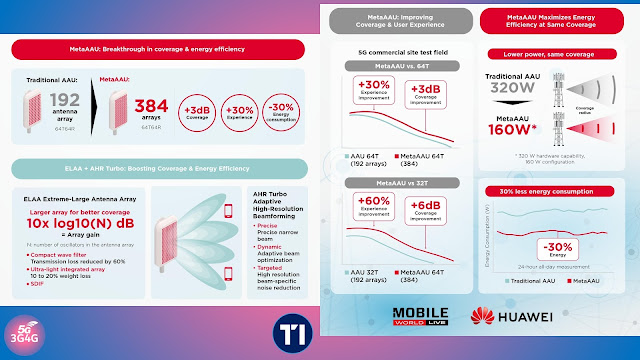
MetaAAU, developed by Huawei, incorporates ELAA (extreme large antenna array) technology supporting 384 antenna elements. It’s double the number of a traditional AAU.

“By introducing 384 antennas in the AAU, coverage can be improved by 3dB on both the downlink and the uplink, and the user experience can also be improved by 30%,” said Chaobin, “Energy savings of 30% can also be achieved.”

The Official Huawei press release points out: 

Released in October this year, Huawei's 64T64R MetaAAU is the ideal solution to improve both network performance and energy efficiency using innovative hardware and software. For hardware, MetaAAU introduces the extremely large antenna array (ELAA) which enables 384 antenna elements, double that of a conventional AAU (192). ELAA is combined with ultra-light integrated array and signal direct injection feeding (SDIF) to improve both coverage and integration. For software, MetaAAU utilizes the Adaptive High Resolution (AHR) Turbo algorithm to enable precise, dynamic, and targeted beamforming, significantly improving user experience and cell capacity. This hardware/software combo marks a new breakthrough in Massive MIMO coverage and energy efficiency.

In comparison with conventional 64T64R AAU and 32T32R AAU, MetaAAU improves coverage by 3 dB and 6 dB and user experience metrics by 30% and 60%, respectively. For example, in one of its flagship projects — 5G Capital that brings 5G to every corner of Beijing — China Unicom Beijing is using MetaAAU to add 30% in both uplink and downlink coverage along with 25% better experience among cell edge users.

MetaAAU is also a powerful energy-saving tool. It allows base stations to achieve the same level of coverage for cell edge users but with a lower transmit power, reducing energy consumption by approximately 30% over conventional AAUs. This has also been tested in the 5G Capital project.

With its advantages in energy efficiency and coverage, MetaAAU is slated for success. Going green is now a global objective — for example, 26 CEOs of European ICT companies have committed to combat climate change with the European Green Digital Coalition (EGDC). At the same time, 5G network coverage requirements will only continue to grow, rolling out 5G in rural and urban, outdoor and indoor contexts. Leading next-gen ICTs will be key in delivering on both demands; and Huawei's MetaAAU stands to be part of the innovation portfolio.

Going back to the Light Reading article:

If traditional materials found in antenna dipoles were applied to ELAA, for example, the weight would drastically increase, making it more difficult and expensive to install on cell sites.

Moreover, without miniaturized filters, ELAA dimensions necessarily become much bulkier compared with traditional massive MIMO antenna. Cell-site space is already constrained and operators don’t want to go through the lengthy process of gaining permission to occupy more tower space, which, in turn, increases maintenance costs.

Another challenge is that antenna elements in a traditional RF feeding network architecture are normally connected by cables, which are an inefficient way to transfer signals. If the antenna array doubles to 384 elements, the length of cable – along with the extent of inefficiencies – increases.

Through a series of hardware innovations, however, MetaAAU makes the transition to ELAA feasible and attractive. Using ultra-lite metamaterials, MetaAAU is around the same weight as the original 64T64R massive MIMO AAU. Adoption of Huawei’s compact wave filter also means MetaAAU dimensions do not require more space.

To address hardware energy inefficiencies, Huawei has adopted SDIF (signal direct injection feeding) technology. SDIF replaces cables with a more energy-efficient metal-type structure.

Aside from hardware innovation, MetaAAU introduces an adaptive high-resolution beamforming algorithm, dubbed AHR (Adaptive High Resolution) Turbo. It has various features, which, when combined, not only reduces wasted radiation energy but also cuts down on ‘noise’ that can degrade network performance.

Among the benefits of AHR Turbo is that it enables MetaAAU to generate extremely narrow beams that can precisely latch onto user equipment, as well as boost air-interface efficiencies by allowing beams to dynamically adapt to radio channel

Here is an official video of MetaAAU

Mobile World Live also has an infographic, which is the source for the image on the top. It's available here.

Related Posts: 

Friday, 4 June 2021

Three UK's Gigabit 5G Poles Explained


Peter Clarke does a great service to the mobile industry, especially in UK, with his detailed look at the mobile network's infrastructure. 

Three UK was Huawei shop but after the limitations imposed on them, they moved to Ericsson and announced with a big bang.

When they said in December that they will have 1000 5G sites, many were left wondering how many of those would be Huawei and Ericsson

But they did make a fantastic progress transitioning to E///

Now Peter has made a video detailing the Ericsson Three UK sites. It has a lot of useful information and is embedded below.

Let us know what do you think.

Related Posts:

Friday, 26 March 2021

Huawei Explains Antennas and Radomes


In the last few months Huawei have produced some short videos explaining how antennas work and what innovations they are doing which is allowing them to have an edge over their competitors. The videos are embedded as playlist below.

There was a separate video explaining Radome, the antenna shell that needs to be weather-proof and withstand temperature fluctuations from -40˚C to 55˚C while still being ultra-light and signal-penetrable. Here is a video on that

Let us know if you know of other interesting videos on these topics.

Related Posts: 

Tuesday, 14 July 2020

Huawei 5G Lampsite wins awards and speed tests

I have talked about Huawei Lampsite since early days, the first being nearly 6 years back. Recently I talked about them with regards to Neutral Host networks and as an Indoor digital network vision.
Back in Feb this year, Huawei's 5G LampSite won the iF DESIGN AWARD at the 2020 iF International Industrial Design Forum due to its consistent high-quality design, high level of integration, and simplified, intuitive installation experience. A press release on their website said: 

Launched in March 2018, 5G LampSite is the industry's first multiband integrated solution that provides digital indoor coverage through both 5G NR and 4G LTE technology.

The all-new 5G LampSite series product continues the tradition of the family's "morning-dew" styling, featuring a sleek, smooth arc surface that ensures an extraordinary user-friendly layout. On top of a perfected appearance and curved visual style, the tensile design allows for excellent flexibility and adaptability, enabling it to perfectly blend in with modern urban environments.


Less than 2 liters in dimension, 5G LampSite supports 5G NR and LTE modules integrated in one box on both C-band and all sub-3 GHz bands, while also allowing for both CAT6A Ethernet and fiber-optic transmission. At a result, both eMBB and IoT services are implemented with a single box, achieving a superb balance between product performance and aesthetics.


As with all 5G rollouts, there are loads of speetests on Sunrise, Switzerland network to prove their in-building effectiveness. Here is a short promo video by Huawei from the Sunrise network.


A presentation from last year is embedded below and can be downloaded from techUK here.


Related Posts:

Monday, 27 April 2020

Huawei's 5G Book RRUs Start Delivering On Their Promises

We have blogged about Huawei's Book RRUs last year here. Now, Huawei and China Telecom Shenzhen (a.k.a. Telecom Shenzhen) have taken the lead in achieving the global ultra-large scale 3D networking that involves macro and pole base stations in China. Hundreds of 5G C-Band (3.4 - 4.2 GHz) Book RRUs were used to help the operator deliver an undifferentiated experience in 5G-covered areas.

Huawei announced in a press release:

Book RRU is an innovative product that is small in size, lightweight, and easy to deploy. This offers an effective approach of addressing challenges associated with insufficient site resources. 5G Book RRUs enable significant improvements in 5G in-depth coverage and user experience in residential areas while increasing network capacity.

In-depth coverage in residential areas, urban villages, upscale communities, and backstreet alleys is a long-standing challenge which has faced operators. Insufficient resources and difficult acquisition lead to difficult and time-consuming site deployment.

Lightweight 5G Book RRUs enable quick 5G deployment in residential areas by using walls, lamp poles, monitoring poles, and electricity poles as sites. This offers a quick solution to achieving quick deployment, helping eliminate coverage holes and offload network traffic.

In December 2019, China Telecom Shenzhen completed the deployment and verification of the first 5G Book RRU. 4T4R 5G Book RRUs were used in the project.

After the recent 5G Book RRU deployment, tests show showed that the downlink speed exceeds 1.2Gbps on commercial mobile devices (Mate30 Pro) when the network spectrum is 100 MHz. With Book RRU deployment, coverage holes 150 to 200 m away from streets are eliminated and indoor in-depth coverage of low-rise buildings standing 50 m to 100 m above the ground is achieved.

This places the operator in a unique position to meet the capacity requirements in value hotspots in Shenzhen, such as school campuses, office buildings, business districts, and scenic parks. Book RRUs supplement macro base stations with in-depth coverage and hotspot capacity absorption. This improves user experience and releases suppressed traffic while also increasing ROI.

Shenzhen Telecom is the pioneer of digital construction. Under the overall construction plan of the new infrastructure construction China Telecom Shenzhen will continue to collaborate with Huawei to complete quick 3D networking based on 5G standalone (SA) technologies through combined deployment of macro, pole, and indoor products, enabling optimal user experience while securing 5G leadership.
Picture Source: Susan Welsh de Grimaldo

Last year, Huawei gave a tour to analysts in Zurich, Switzerland to show their kit on Sunrise's network. This tweet from analyst Kester Mann, shows two examples of Book RRU deployments for Sunrise network in 3.7 GHz spectrum with local coverage up to 200 metres and speeds recorded above 700 Mbps with 9 milliseconds of latency.


With operators have to provide dense coverage to meet the 5G expectations, we won't be surprised to see more products like these in the near future.

Related Posts:

Thursday, 12 December 2019

Huawei RuralStar 3.0, successor of RuralStar 2.0 Lite, coming in 2020


At MWC 2019, Huawei announced RuralStar Lite, the successor or RuralStar 2.0. The press release says:

At the Mobile World Congress 2019, Huawei released an innovative rural network solution, RuralStar Lite. This solution is specialized to cost-efficiently bring voice and mobile broadband (MBB) services to rural villages with a population of 500 to 1000 people while keeping the return on investment (ROI) period within three years for operators.

Huawei released the RuralStar solution in an effort to bring mobile connections to these unconnected rural areas. This solution has reached more than 90 networks worldwide, serving to provide mobile access for hundreds of millions of people. For most of them, it's the first time in their lives they have ever enjoyed access to the mobile world thanks to this solution.

Picture source: maxwireless on Twitter

Boasting three significant innovations, RuralStar successfully addresses a number of long-standing issues of network development in rural areas where transmission is difficult to reach, infrastructure is costly to build, the power supply is unstable, and deployment requires a long time to complete. For operators, the ROI period can be within three years for a rural network that covers more than 1000 users. To expand connections to unconnected villages having a population of 500 to 1000 people, Huawei released the RuralStar Lite solution to accommodate the local service characteristics of few connections and small coverage areas.

RuralStar Lite features a power consumption of as low as 200 watts. Fitted with four solar panels, this solution greatly simplifies power supply. It allows all related equipment to be installed on poles with a height of 6 m to 9 m, without the need to install supporting rods and build fences. With these advantages added together, project costs are significantly reduced and the total cost of ownership (TCO) decreases markedly.

RuralStar Lite has so far been successfully deployed in Zambia. The deployment demonstrates that RuralStar Lite is able to extend voice and data services to 500 to 1000 users in a village covering a radius of 1 km to 2 km. In addition, the ROI period is expected to be less than three years for operators.

Interestingly, there isn't much information available on the solution even after all this time. While this is a good solution and has been promoted by operators like MTN, there isn't much information about the specifications either. Looking at the slide from MTN above, RuralStar is being deployed at Rural sites. As the requirement is to deploy GSM, UMTS and LTE, one assumption would be that the RuralStar can handle all of these. Whether this would keep the radio head as it is or not, I am not sure.


The above picture shows an example RuralStar site deployed by MTN. The deployment uses LTE backhaul so works as a relay. The small problem with this is that a Macro site from Huawei is required for this approach to work. Without a Huawei macro, this site would need another backhaul solution.

There are also other vendors looking at the same market like AMN, IP.Access, Airspan, Parallel Wireless, Mavenir, etc.also looking at providing alternative solutions for the same problem.

MTN is also looking at OpenRAN to improve it's rural coverage footprint. In a recent press release, it announced:

MTN is projecting to deploy more than 5,000 sites in rural areas across its 21 operations, bringing 2G, 3G and 4G connectivity to areas that were previously unconnected. In order to realise this goal, MTN will rely on an ecosystem of partners who will bring their expertise to build and maintain the sites, utilising a full turnkey approach.

MTN operations in Uganda and Guinea Conakry are already benefiting from this technology, as MTN has also partnered with the likes of VANU, Parallel Wireless and NuRAN Wireless to deliver the technology.

As one of the foremost members of the Telecom Infrastructure Project (TIP), MTN carries out solution testing on all hardware and software elements at its state-of-the-art head office in Johannesburg, South Africa. The TIP initiative aims to define 2G, 3G and 4G RAN solutions based on general-purpose, vendor-neutral hardware and software-defined technology.

By continuing to accelerate innovation through initiatives such as OpenRAN, MTN continues to lead the delivery of a bold new digital world, solidifying its position as a leading mobile operator in the market.

Regardless of the approach, mobile users in Africa will ultimately be the winners!

Related Posts:

Wednesday, 2 October 2019

4G LTE Man In The Middle Attacks With A Hacked Small Cells


Here is an interesting talk from recent HITBSecConf by Xiaodong Zou. HITBSecConf or the Hack In The Box Security Conference is an annual must attend event in the calendars of security researchers and professionals around the world. Held annually in Kuala Lumpur, Malaysia and Amsterdam in The Netherlands, HITBSecConf is a platform for the discussion and dissemination of next generation computer security issues.

From the talk narrative:

Femtocells offer a user the ability to have a small base station located within their house or other area. These small base stations provide access to the core telecom network where poor reception from an eNodeB would normally prevent consistent coverage. Femtocells has been standardized in LTE since release 8, and is referred as Home eNodeB, or HeNB. HeNBs are mandated to have an IPsec connection back to a security gateway (SeGW) to protect traffic flowing into and out of a Mobile Network Operator (MNO)’s core network.

If the HeNB is within the physical possession of an attacker, this provides unlimited time to identify a flaw on the HeNB. A compromised HeNB can be used in a manner similar to a rogue base station, but will also provide the attacker access to clear text traffic before it is sent back to the core network. There are more than ten different types of HeNBs deployed in China. Ericsson ENC-nRBS01B40 is one of them – a TD-LTE base station working on band B40.

In this talk, we will cover:

1.) How to root a 4G LTE femtocell.
2.) How to make the femtocell portable.
3.) How to perform man-in-the-middle attack with the femtocell.
4.) Show the prototype of Hacking Box of S1 Interface (HBoS)

Slides and video embedded below:


Related Posts:

Thursday, 15 August 2019

Small Cells and Neutral Host Networks

Back in January, techUK hosted a conference titled, 'Neutral Host Networks: Vision and Reality'. There were quite a few interesting presentations and they are available freely on their website. Here are some slides I found interesting. 

The first one was from Huawei where they talked about 'Neutral Host Models in 4G & 5G Architecture' and covered the Lampsite neutral hosting in detail. If you don't know about Lampsite, check out this earlier post on Huawei Lampsite 3.0 here.

Duncan Wall, Business Development Director, Arqiva talked about 'The benefits of neutral host networks in urban and rural environments - Progress toward that vision'. There were quite a few details on what Infrastructure could be shared and benefits of sharing, new tower proposition, street trends, etc.

I like the simple site design picture shown above. The shared cabinet can host 4 small cells (from 4 operators) and that can feed the shared antenna on top of the lamp post.

In addition, there are presentations from Real Wireless, LS Telecom, BAI Communications, LS Telecom, Disruptive Analysis & Opencell. All presentations available here.

Related Posts:


Sunday, 16 June 2019

Turkcell's Small Cell Strategy

Turkcell is one of the industry’s leaders in extending the traditional MNO model into new services, illustrated how the business case is strengthened by diversity, with small cell roadmaps which span multiple spectrum bands, form factors, vendors and deployment environments.

During Small Cells World Summit, Turkcell presented their Small cell strategy and case study.


As the tweet above says, they have 3 separate use cases for small cells:

  • VIP/business complaints & retention
  • General in building / enterprise
  • Outdoor capacity & coverage enhancement


Their strategy is to work with multiple vendors for different use cases. The strategy has clearly paid off as different small cells are working seamlessly with the macrocells indoors and outdoors.


Indoor Femtocell Trials with Airspan and Nokia has significantly improved user experience and throughput indoors.


Various deployments with Huawei Micro has been done to improve coverage and capacity outdoors, for voice and data.


Related Posts: