Showing posts with label Open RAN. Show all posts

Tuesday, 30 September 2025

O-Cloud Driving the Future of Open RAN

For mobile operators, O-Cloud provides the cloud-native platform needed to automate RAN functions, integrate multi-vendor solutions, and optimise network performance at scale.

The Open Cloud, or O-Cloud, is the physical and software foundation that lets operators deploy open RAN in a cloud-native way. At its core an O-Cloud node bundles CPUs, memory, storage, network interfaces, board management controllers and optionally accelerators such as FPGAs to offload computationally heavy tasks. An O-Cloud is not a single machine but a set of resource pools that may be distributed across a centralised site and multiple edge locations. Together those pools provide the compute, storage and timing environments required to host O-RAN central units and distributed units, the management and orchestration layers, and observability and lifecycle services that keep everything running reliably.

Technically oriented operators will want to think of O-Cloud as an integrated stack of requirements rather than a single product. It must support bare metal deployment and tight integration with container orchestration for cloud-native network functions. It needs multi-cluster lifecycle management with automated scaling, network isolation primitives and deterministic CPU and memory control for real-time workloads. Features such as SR-IOV, PCI pass-through, DPDK support, huge pages and device plugins for FPGA or GPU enable low-latency packet I/O and hardware acceleration where needed. Time synchronisation is another non-negotiable; GNSS, PTP and SyncE support are all necessary for distributed scenarios that demand precise phase and timing alignment. On the management side the O-Cloud must provide board and host management, configuration and fault management, secure software update mechanisms and an infrastructure inventory that reports capabilities and resource availability to the orchestrator.

Why O-Cloud matters is best understood by mapping those technical building blocks to operational problems that operators face today. Mobile networks are now a mesh of legacy architectures, virtualised elements and new cloud-native components. Manual processes and basic automation are no longer sufficient to optimise service quality, scale to demand, or keep costs under control. The O-RAN Service Management and Orchestration framework, coupled with the O-Cloud, enables standards-based infrastructure management and cross-organisational data collection. That combination is the prerequisite for sophisticated automation and the application of AI techniques across the RAN.

A concrete operational capability driven by O-Cloud is application homing. When the orchestrator has an accurate inventory of O-Cloud resources and real-time telemetry, it can place workloads on the cloud instance that best meets the latency, throughput and cost profile required by an application. In practice this means low-latency services can be hosted on edge clusters with real-time OS and hardware acceleration while less-sensitive workloads run in centralised clusters that maximise cost efficiency. The O2 interface between the SMO and O-Cloud is what makes this possible by allowing registration and continuous inventory updates so the orchestrator always has an up-to-date picture of available resources.

Multi-cloud orchestration is another operational lever. In a disaggregated ecosystem operators can choose cloud providers or on-prem platforms based on geography, performance, pricing or regulatory requirements. Effective orchestration distributes workloads across these environments to optimise resource usage and resilience. For example, automatic lifecycle management and rolling updates let operators patch and upgrade clusters with minimal service disruption, while integrated observability ensures fast detection and remediation of performance degradations. These capabilities not only improve quality of experience for subscribers but also reduce operational effort and human error.

Security, isolation and regulatory compliance are built into the O-Cloud requirements. A Zero Trust approach that hardens host operating systems, enforces strict service-to-service authentication and integrates automated security testing into CI/CD pipelines is essential. Multi-tenancy and isolation at compute, network and storage layers are critical where regulators demand separation for emergency services, hospitals or public safety. Managing hardware accelerators and firmware securely is also part of the platform responsibilities.

Deutsche Telekom’s independent O-Cloud proof of concept demonstrates how these technical concepts translate into reality. Working with Red Hat and IBM, Deutsche Telekom used Red Hat OpenShift as the CaaS (container-as-a-service) layer to provide the container runtime, cluster lifecycle tools and GitOps-based operations. Red Hat’s automation tooling was used to implement zero-touch provisioning so hardware could be rapidly onboarded and configured. IBM Consulting supported the integration, system design and lifecycle automation that enabled rapid deployment, monitoring and observability across the lab environment. The trial, completed within six months, validated automated lifecycle management, observability and the integration of hardware and software with open interfaces.

The trial’s outcomes reinforce the argument that a properly engineered O-Cloud enables multi-vendor interoperability and operational freedom. Automation and monitoring requirements were met with minimal human intervention. Flexible infrastructure and vendor independence give operators choice and the ability to continuously select best-in-class components. Crucially, the PoC showed that inventory and capability reporting combined with orchestration can enable application homing and cross-cloud resource optimisation in practice, not just in theory.

Looking ahead, real-world O-Cloud deployments will need to balance competing priorities. Operators must plan migration paths that preserve legacy services while incrementally introducing cloud-native elements. They must invest in platform automation, observability and security, and build operational processes that exploit rather than fight cloud-native lifecycle paradigms. Energy and cost management must be considered at the infrastructure layer so that scaling decisions also reflect carbon and capex/opex objectives. Finally, industry collaboration and lab-to-field testing will remain important to refine standards, validate interoperability and mature the tooling around SMO, the O2 interface and multi-cluster management.

O-Cloud is therefore both a technical specification set and an operational philosophy. It ties precise platform requirements to the automation, orchestration and vendor independence that open RAN promises. Deutsche Telekom’s PoC shows that the blueprint works in practice and that the path to cloudified, multi-vendor RANs is feasible when infrastructure, orchestration and automation are designed together. For operators seeking to deliver programmable, resilient and cost-effective 5G and beyond, investing in O-Cloud capabilities will be a defining step on the road to modern RAN operations.

Related Posts

Tuesday, 12 August 2025

Transforming Stadium Connectivity with SOLiD’s GENESIS DAS at Dortmund’s Signal Iduna Park

SOLiD is a global leader in innovative RF Amplifier, RF Radio and Optical Transport solutions that support some of the world’s most demanding wireless environments. The company’s Distributed Antenna Systems (DAS) power reliable cellular coverage and capacity in hospitals, sports and entertainment venues, airports, metro systems, government and corporate buildings, and other high-profile locations. From early 2G systems to 5G-ready and cloud-based solutions, SOLiD has a track record of delivering robust, scalable infrastructure that meets the growing demands of mobile users while reducing complexity, risk and energy consumption.

Signal Iduna Park in Dortmund, home of Borussia Dortmund and the iconic Yellow Wall of supporters, has become the first stadium in the world to feature a fully operational Open Radio Access Network (O-RAN) solution. In partnership with 1&1 and Rakuten, SOLiD has delivered a state-of-the-art Distributed Antenna System (DAS) that combines cutting-edge 4G and 5G capabilities with the benefits of open standards and advanced radio technology.

With a capacity of more than 81,000, the stadium is the largest in Germany and one of the most famous in European football. It is celebrated for its atmosphere, high attendance figures and the vast standing terrace on the south bank that can hold more than 24,000 fans. The venue has hosted matches during the 1974 and 2006 FIFA World Cups, the 2001 UEFA Cup Final, and was part of the 2024 European Championships. A stadium of such scale and reputation demands a mobile connectivity solution capable of delivering a seamless experience to tens of thousands of users simultaneously.

Large sports venues present unique challenges for mobile coverage. The system must deliver consistent connectivity across vast seating areas, indoor hospitality and operational zones, and high-traffic access points, all while managing peak usage during major events. The solution at Signal Iduna Park meets these demands through 30 network sectors in the stands, four more in indoor areas, and two covering the north and west entrances and parking zones.

The deployment includes 48 radio units and 128 antennas in the stands, complemented by 60 radio units and 21 antennas indoors. More than 10 kilometres of fibre optic cable and 30 kilometres of additional cabling underpin the network’s performance. This infrastructure ensures that not only 1&1 customers, but also those on other German mobile networks, benefit from the improved coverage and capacity.

At the heart of the project is SOLiD’s GENESIS DAS, a fully digital system that supports simultaneous transmission from all major mobile operators. More than 150 slimline, low power radio units are strategically placed throughout the stadium to deliver robust 4G and 5G coverage. By integrating O-RAN technology, the system enables hardware and software from different vendors to work seamlessly together while reducing power consumption and minimising physical space requirements.

This landmark project, completed ahead of the stadium’s 50th anniversary in 2024, is an example of how next-generation network solutions can transform the fan experience. For SOLiD, it is further proof of their role in advancing wireless densification in high-profile venues around the world. By bringing together O-RAN, mMIMO and advanced DAS capabilities, the Signal Iduna Park installation sets a benchmark for stadium connectivity and points towards the future of mobile infrastructure in large-scale sporting and entertainment environments.

Related Posts

Tuesday, 29 July 2025

NGMN’s Common Language for Antennas Lays the Foundation for Future-Proof Infrastructure

Base station antennas are critical components of mobile networks, serving as the final link between radio systems and the air interface. Despite their importance, there has long been a lack of consistency in how antenna systems are specified, validated and integrated into networks. This inconsistency has led to inefficiencies in procurement, difficulties in multi-vendor environments, and challenges in scaling network performance. The latest publication from the NGMN Alliance, “Recommendations for Base Station Antennas”, aims to change this by introducing a harmonised framework for describing passive, active and hybrid antenna systems.

The updated document combines the previously separate guidance on passive and active antenna systems into a single, unified publication. Developed under the BASTA (Base Station Antenna) project, it defines a comprehensive set of electrical, mechanical and environmental parameters relevant to base station antennas. These include radiation characteristics such as gain, beamwidth, front-to-back ratio and sidelobe suppression, as well as practical aspects like dimensions, weight, connector type, wind load and ingress protection. For active antennas, it also defines parameters for beamforming capability, scanning range, traffic beam configuration and power control.

One of the key motivations behind the updated recommendations is the growing use of hybrid antenna systems. These combine passive elements, such as the antenna array and remote electrical tilt, with integrated active components like transceivers and digital beamforming units. Hybrid configurations are especially relevant in 5G networks, which rely on advanced techniques like massive MIMO and dynamic beam steering to deliver high capacity and spectral efficiency. However, deploying such systems at scale, particularly in disaggregated or Open RAN architectures, requires a standardised way to describe and compare antenna products from different vendors.

The NGMN publication addresses this need by introducing a structured methodology for presenting antenna parameters, including definitions, recommended test practices and digital exchange formats. Notably, it supports XML-based datasheets aligned with an agreed schema, enabling machine-readable processing of antenna data. This is particularly useful for operators seeking to automate parts of the network planning and procurement lifecycle, including performance comparison, site design and integration testing.

The framework also incorporates coordinate system conventions, including multiple spherical and Cartesian reference models, to provide flexibility in how antenna orientation and beam direction are described. This is essential for accurate modelling of antenna coverage and interference in radio planning tools. The document additionally covers Remote Electrical Tilt (RET) systems, including configuration management, software upgradeability and compliance with AISG protocols.

Importantly, the NGMN recommendations are designed to be implementation-agnostic. Rather than enforcing performance thresholds or mandating design practices, the focus is on standardising the language used to describe antenna characteristics. This approach ensures that innovative antenna designs, including those supporting new form factors or frequency bands, can still be accommodated as long as they conform to the descriptive framework.

A further advantage of the framework is its extensibility. While the current version focuses on antennas operating below 6 GHz, it is expected that future versions will include extensions for higher frequency bands and additional attributes such as energy consumption, carbon footprint and circularity. These sustainability metrics will become increasingly important as networks aim to reduce their environmental impact while delivering ever-higher performance.

The importance of this work becomes clear in the context of multi-vendor and disaggregated networks, where interoperability depends not only on open interfaces but also on consistent component descriptions. A shared vocabulary for base station antennas enables smoother integration, better lifecycle management and more effective use of network resources. It also reduces vendor lock-in and improves supply chain flexibility, which is especially valuable for operators pursuing Open RAN strategies.

As antenna systems continue to evolve, the ability to describe their behaviour and capabilities with precision will be vital. NGMN’s BASTA recommendations offer a practical and forward-looking solution, supporting both current deployment models and the transition toward future architectures such as 6G. By promoting transparency, repeatability and interoperability, this common language for antennas strengthens the foundation of mobile network infrastructure and contributes to a more efficient, open and sustainable ecosystem.

Related Posts

Tuesday, 3 June 2025

Viettel’s Growing Influence in 5G, Private Networks and Open RAN

Back in 2020, we wrote about Viettel's ambition to launch 5G using homegrown technology. Fast forward to 2025 and the Vietnamese operator has significantly advanced those ambitions. At MWC 2025, Viettel showcased its latest Private 5G Network solutions, and has since taken major steps in deploying commercial Open RAN networks, developing international partnerships, and building its own end-to-end 5G ecosystem.

Viettel’s commercial Open RAN 5G network is now live in Vietnam, marking a major milestone in the operator’s journey from national champion to global contender. Powered by Qualcomm’s X100 platform for distributed units and QRU100 for Massive MIMO radio units, the network delivers high capacity and energy efficiency across multiple provinces. Viettel is using inline accelerators to offload baseband processing, lowering cost and power usage while enhancing performance. These O-RAN-compliant radio units support 32T32R Massive MIMO and form part of Viettel’s strategy to provide public and private 5G services with full network automation and orchestration capabilities.

This deployment is not just a local success story. Over 300 sites were deployed in the first quarter of 2025, with thousands more planned both within Vietnam and internationally. The scale of the effort makes Viettel one of the largest carriers to launch a commercial Open RAN network. In addition to the network infrastructure, Viettel High Tech (VHT), the group’s R&D and equipment manufacturing arm, has contributed a substantial portion of the RAN software, positioning itself as a serious technology supplier in its own right.

The software stack developed by Viettel replaces what operators would traditionally source from vendors like Ericsson or Nokia. Viettel High Tech's in-house team is responsible for critical software components that run on central and distributed units, while Qualcomm supplies the Layer 1 functions on dedicated inline accelerator cards. These accelerators bypass the need for general-purpose CPUs in handling time-sensitive RAN tasks, offering improved performance without compromising on the virtualisation or cloud-native aspects of the deployment. Qualcomm’s Layer 1 is containerised and compatible with cloud platforms from AWS and Red Hat, underlining its open architecture credentials.

Viettel’s use of inline accelerators on this scale is unprecedented. Each site includes an X100 card, making it one of the largest global deployments of this architecture. Outside Vietnam, most virtual RAN deployments rely on Intel’s lookaside model, where the CPU handles much of the processing. Viettel’s decision to go with inline accelerators marks a departure from this norm and showcases a different approach to RAN virtualisation.

The partnership between Viettel and Qualcomm is also expanding beyond Vietnam’s borders. At MWC Barcelona 2025, Viettel High Tech signed a memorandum of understanding (MoU) with Emirates Integrated Telecommunications (du) and its partner High Cloud Technologies. This agreement covers testing and future deployment of both 5G Open RAN and Private Network solutions in the UAE. The initial focus is on evaluating these technologies on du’s network, with potential applications in smart cities, industrial IoT and immersive technologies like AR and VR. This represents the first time Vietnamese-developed 5G equipment is being tested for commercial use outside the country.

The collaboration aligns with the UAE’s digital infrastructure strategy and could open the door to large-scale commercial deployments in the Middle East. Successful trials with du are a key step in Viettel’s broader plan to become a global supplier of advanced telecom infrastructure. Viettel is already present in markets such as Myanmar, Cambodia and Peru, where the 5G rollout is still in early stages. These regions offer opportunities for Viettel to replicate its success at home and extend its influence.

While Viettel’s 5G rollout includes other major vendors, with Ericsson and Nokia reportedly securing two-thirds of the deployment share, the remaining share, driven by Viettel High Tech and Qualcomm, is significant in scale and innovation. The collaboration showcases an alternative model where operators develop critical network software in-house and pair it with silicon from a specialised vendor.

Qualcomm’s contribution is not limited to the distributed units. The company also provides critical components for radio units, including beamforming and signal processing via its QRU and QTR chips. These are integrated into Viettel’s Massive MIMO units, each equipped with 32 transmitters and receivers, enhancing both coverage and capacity. Although the solution appears vertically integrated, Qualcomm continues to validate its Open RAN credentials through efforts such as interoperability work with NEC under the OREX programme in Japan.

Viettel’s approach demonstrates a vertically integrated yet standards-compliant model that leverages in-house development, strategic partnerships, and cloud-native design. It is building a scalable and sustainable 5G infrastructure that supports both domestic and international ambitions. As it rolls out thousands more sites and extends its presence into new markets, Viettel is proving that national champions can innovate at a global level.

Vietnam’s investment in indigenous telecom technology and its collaboration with global partners like Qualcomm is reshaping perceptions of where cutting-edge 5G innovation can originate. With continued momentum in Open RAN, Private Networks, and global expansion, Viettel is now firmly established as a telecoms infrastructure player to watch.

Tuesday, 17 December 2024

How Samsung is Leveraging vRAN to Match Traditional RAN (T-RAN) Performance

As mobile networks evolve, virtualized RAN (vRAN) and Open RAN architectures are gaining traction. Even operators who were initially sceptical are increasingly exploring and deploying these innovative solutions to meet the growing demands for flexibility, efficiency, and sustainability. Samsung, among other key players, has been at the forefront of large-scale vRAN and Open RAN rollouts across North America, Europe, and Asia.

The adoption of O-RAN-compliant, Open vRAN architectures has demonstrated the potential to deliver performance on par with—or even superior to—traditional RAN systems. While trials and commercial deployments have validated their capabilities, scaling these solutions introduces challenges, such as integration complexities, security concerns, and organizational disruptions. To address these hurdles, operators and vendors alike are focusing on building robust ecosystems, fostering collaboration, and driving continuous innovation.

As adoption expands, operators are reaping an array of benefits from vRAN and Open RAN architectures:

  • Faster site activations: Accelerated deployment timelines facilitate quicker service rollouts.
  • Enhanced resource utilization: Flexible resource sharing improves overall network efficiency.
  • Energy savings: AI-driven solutions enable dynamic power management, reducing energy consumption.
  • Operational agility: Advanced monitoring and adaptive systems boost performance and responsiveness.

Vendors and partners are tackling the complexities of scaling vRAN and Open RAN through collaborative efforts, with Samsung introducing several solutions to improve performance and address integration challenges:

  • Containerized Virtual Cell Site Router (vCSR): The integration of vCSR within the virtual Distributed Unit (vDU) minimizes hardware requirements by utilizing server processing power more efficiently.
  • Energy-saving features: AI-powered tools like Samsung’s Energy Saving Manager (ESM) enable traffic-aware adjustments, such as dynamic power amplifier (DPA) levels, sleep modes for radio units, and CPU power optimization, demonstrating significant energy reductions in large-scale deployments.
  • AI/ML-powered automation: Comprehensive platforms, such as Samsung’s CognitiV Network Operations Suite (NOS), incorporate advanced analytics and automation, enhancing network optimization, troubleshooting, and reducing total cost of ownership (TCO).

The transition to Open vRAN is not just a technological evolution but a paradigm shift in network architecture. These systems prioritize flexibility and programmability, empowering operators to achieve business objectives that extend beyond cost savings, including faster service rollouts, better customer experiences, and improved energy efficiency.

While Samsung’s contributions in this domain are notable, the larger industry trend toward open and virtualized networks reflects a collective push to shape the future of mobile connectivity. Collaboration across the ecosystem is essential to address challenges and unlock the full potential of these transformative technologies.

Embedded below are some nice explainers and presentations on Open vRAN from Samsung:

As the industry continues to evolve, vRAN and Open RAN are set to play a pivotal role in driving the next wave of 5G innovation and growth.

Related Posts

Saturday, 16 December 2023

Testing Vodafone UK's Open RAN Deployment Performance

It's been a while since Vodafone selected their UK Open RAN partners. The good news is that according to the press release from Samsung as well as Vodafone UK the rollout has already started. According to the press release, the following partners are involved:

  • Samsung: 4G and 5G radio, including 64T64R Massive MIMO, as well as the software platform.
  • Intel: General Purpose Processor (GPP), acceleration hardware and network interface cards.
  • Keysight: Drive test services using Keysight Nemo Solutions to assure the OpenRAN end-to-end live network performance. Pre-deployment OpenRAN functional and interoperability testing using Keysight Open RAN Architect (KORA) solutions.
  • Dell Technologies: Dell PowerEdge servers designed for cloud-based OpenRAN workloads.
  • Capgemini: Testing partner in Vodafone labs.
  • Wind River: Cloud network platforms (also known as abstraction layer software).

Dr. Peter Clarke, who is an actual medical doctor rather than a PhD, and also a mobile network infrastructure hobbyist, has been featured across our blogs on a regular basis. Recently he took a trip to the coastal town of Torquay, Devon, to see for himself how these Samsung Open RAN networks were performing. Quoting from his LinkedIn post

Vodafone UK's Samsung Networks based Open RAN 5G delivers capability and performance to the coastal town of Torquay, Devon, providing a compelling window into the future of radio access architecture. 

The Vodafone spectrum deployed is impressive, illustrating the capability of the Samsung Radios and serving the town well: 90MHz n78 with Massive MIMO on Samsung Active Antenna Units and quad 4G band through Commscope passives.

Throughputs with EN-DC utilising 50MHz n78 carrier were consistently around 500mbps, which for an umbrella site serving a town was pleasing. Field testing video below, in comments, please watch for on the scene testing.

Here is a video from his testing:

I am looking forward to the official results that will hopefully be shared around MWC 2024.

Related Posts

Monday, 28 November 2022

NTT Docomo Expands Open vRAN Options in its 5G OREC

We have done quite a few blog posts on NTT Docomo on our blogs (see related posts at the bottom) as they always share a lot of latest useful and relevant information. In a blog post last year, we talked about their 5G Open RAN Ecosystem (OREC). 

Back in September, NTT Docomo announced that it will be adding a fourth type of flexible and highly scalable virtualized base station (vRAN) to its verification environment for Open RAN that will allow equipment and components of various vendors to integrate via standardized specifications. The press release said:

The new virtualized base station will combine NEC Corporation's open virtualized RAN software, Red Hat Openshift, Qualcomm Technologies, Inc.'s inline accelerator cards and Hewlett Packard Enterprise's servers. This will be DOCOMO's first time to use the Qualcomm® X100 5G RAN Accelerator Card and the HPE ProLiant DL110 Telco server, the latter optimized specifically for Open RAN workloads to improve system performance and power efficiency.

Since February, DOCOMO has been providing global carriers with access to its Shared Open Lab environment to allow them to mix and match the equipment and components of various vendors in order to verify performance with virtualized base stations. In addition to three types of virtualized base station equipment/system configurations that carriers have been accessing so far, the new configuration will become available for verification in the Shared Open Lab starting in 2023.

As the increasing global availability of 5G continues to raise interest in Open RAN, DOCOMO has been a leader in helping telecoms worldwide to prepare to introduce this highly versatile new technology. In February 2021, DOCOMO was joined by 12 global equipment vendors in establishing the 5G Open RAN Ecosystem (OREC) to promote Open RAN, which supported the development of the virtualized base station being announced today.

DOCOMO and its OREC partners plan to continue adding new equipment/system combinations before and after commercializing virtualized base stations, which is expected within the current fiscal year ending in March 2023.

Through the promotion of Open RAN, DOCOMO looks forward to continuing to enhance the efficiency and flexibility mobile communication networks around the world.

In fact their OREC page has this and a lot more details here.

At Telecom Infra Project's Fyuz 22 conference, NTT Docomo and other operators shared their vision, progress and approach to Open RAN. You can watch the panel discussion here.

Related Posts:

Friday, 6 May 2022

Comba Telecom Helps Bring Open RAN to New Markets

Comba Telecom is a global leading wireless solutions provider with their own R&D facilities, manufacturing base, and sales and service teams. The company offers a comprehensive suite of products and services including wireless access, wireless enhancement, antenna and subsystems and wireless transmission to its global customers. Comba's core product portfolio includes antennas and subsystems and network products (DAS, Small Cells, Repeater, RRU, etc.), offering turnkey solutions for indoor and outdoor 2G/3G/4G/Wifi/5G to their global customers.

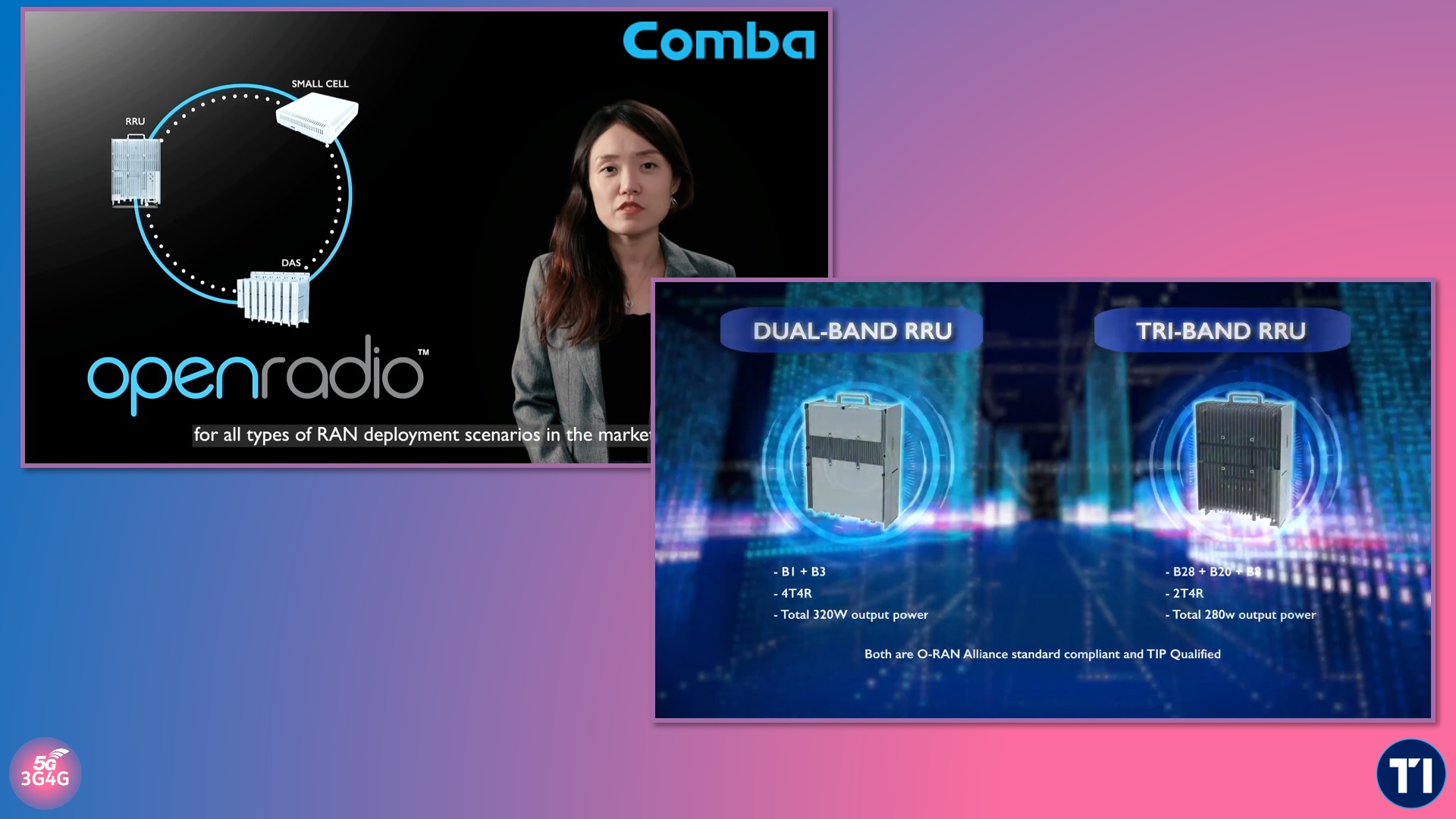
Last year, Comba announced the launch of the industry's first Open RAN multi-RAT, multi-band Remote Radio Unit (“RRU”) that supports 1800MHz and 2100MHz, promoting widespread adoption of emerging open standards in the globe. The announcement says:

The RRU is designed to minimize the total cost of ownership (“TCO”) for operators and neutral hosts in macro deployments through fast and easy deployment, energy savings, improved coverage and throughput, smaller footprint and easy maintenance. Engineered for efficient high power (320W) operation, the multi-RAT multi-band 4T4R RRU minimizes the environmental footprint and reduces the energy spend for the operator. 

As a first in the Open RAN industry the GSM/UMTS/LTE/5G NR multi-mode operation makes it ideal for simple upgrades of legacy sites without compromises. The 4T4R radio supports two LTE/5G NR carriers per band and Dynamic Spectrum Sharing (“DSS”). This enables operators to serve arising 5G traffic demand without additional spectrum or removing LTE service.

Comba has a long-standing collaboration with major industry partners and alliances and has participated in the initial Open RAN trials and lab projects in different regions. With all in-house expertise in interoperability and optimizing radio designs for market specific criteria, Comba enables mobile operators to accelerate time to market, and mitigate the overall technology risk when adopting to Open RAN strategy in their next generation of RAN. 

A recent video looks at these Open RAN Multi-band RRUs

While most Open RAN RUs are focused on 4G & 5G, Comba's radios work on 2G & 3G as well. This has allowed them to bring Open RAN solutions to many different parts of the world that may not be ready for 5G yet. Some of these include announcements with their software partner Parallel Wireless in Latin America and Indonesia. Another recent standalone announcement included one with Turkcell in Turkey.

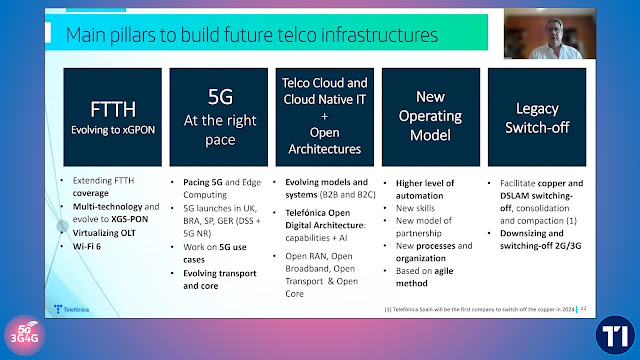
Telefonica also listed them as one of the partners in a presentation at MWC

Telecom Infra Project's TIP Exchange features quite a few radios from Comba which you can see here.

If you are interested in learning more, what the Comba keynote and Panel Discussion on Maturity of Open RAN Adoption at MWC22 Open RAN Summit below:

Related Posts:

Sunday, 13 March 2022

Benetel shows their Open RAN RU Progress

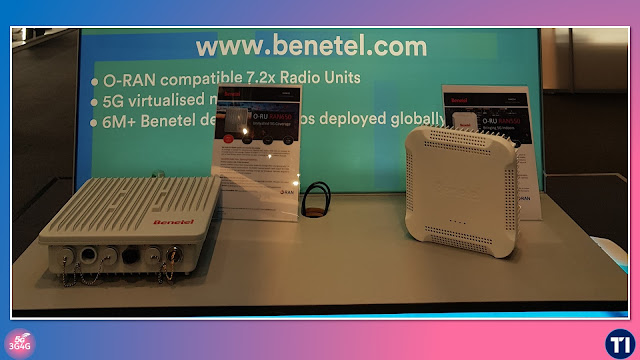
Benetel, headquartered in Dublin, Ireland, has a 20 year history with over 6 million Benetel designed radios deployed around the world. We caught up with them at Mobile World Congress 2022 to find out what they have been up to. 

We first heard of Benetel when they announced the launch of its flagship BNTL-RAN550 High-Performance 5G O-RAN radio unit (O-RU) back in 2020. Their MWC 2022 press release provides details on their latest RAN650 RU :

This is intended to bring 5G capacity to private, campus and industrial networks, as well as rural networks and public hotspots. A 4T4R antenna arrangement is featured with up to 5W of output power being delivered per antenna port (equating to 20W in total). The 7.2x functional split employed will help minimize the costs associated with fronthaul network implementations, while support for 100MHz of instantaneous bandwidth will allow maximum coverage to be attained.

Benetel’s new RAN650 RU can be deployed in either a Cat A or Cat B based configuration (using selected distributed units), thereby providing flexibility to address radio access network architectures. Key to its elevated performance and versatility is the cutting-edge semiconductor technology that has been designed into it. Each RU incorporates an Intel Arria 10 FPGA along with an Analog Devices’ ADRV9029 4T4R transceiver with integrated Digital Pre-Distortion (DPD). The initial version of the RAN650 covers the n77u (3.7GHz to 4.2GHz) frequency range. An n78 variant (3.3GHz to 3.8GHz) will be made available in the second quarter of 2022.

The RAN650 RU runs off a 48V supply. It has a maximum power consumption of 110W. The robust IP65-rated enclosure use means that even the most challenging of outdoor conditions can be coped with. An operational temperature range spanning from -33°C to +45°C is supported.

The RAN650 complements Benetel’s existing OpenRAN portfolio, including the RAN550 indoor 5G RU that the company announced back in late 2020. Active network trials are already being conducted on the Benetel RAN650 by several pilot customers.

TMN reported last year that, Benetel said it has integrated its Radio Unit (RU) with Radisys’ 5G NR Open RAN CU-DU software and has also licensed Radisys’ LTE software for its eNodeB radio platforms. The official announcement comes after Benetel told TMN last month that it was working with both Radisys and Altran on DU-CU integration.

If you are interested in learning more about Benetel then watch Olli Andersson, Benetel's senior VP for the Americas, discussing the O-RAN architecture's climb into market relevance here.

Related Posts:

Sunday, 27 February 2022

Rakuten Mobile shows off their Open RAN Portfolio

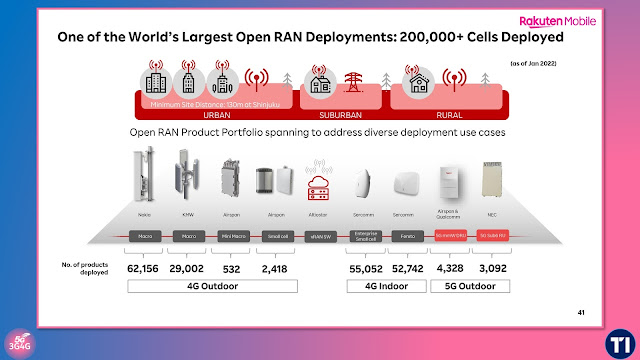
(Click on image to enlarge)

During the Full Year and Fourth Quarter 2021 earning call, President of Rakuten Mobile, Yoshihisa Yamada gave a short summary of the progress of the mobile network. During that, he also showed the Open RAN product portfolio spanning to address diverse deployment use cases.

The portfolio can be seen in the picture above and you can listen to his part of the talk in the video below: 

You can download the slides from here.

Related Posts

Friday, 21 January 2022

Telefónica Deutschland Activates Germany's First Open RAN Small Cells with Airspan Networks

O2 / Telefónica is a technological pioneer in the use of Open RAN. Since December 2020, it has successfully integrated four base stations in Landsberg am Lech into its mobile network. At present, they are testing the technology, gaining experience and planning further expansion at other locations once all tests have been successfully completed. 

In an announcement this week, it said that it is the first German mobile network operator to have activated the first mini-radio cells with innovative Open RAN technology (ORAN) in Munich. They are intended to provide all O2 Germany customers with even more capacity and higher bandwidths at busy locations in the future. 

While the press release doesn't mention the vendor, Airspan Networks Tweeted that the ORAN Small Cell is supplied by them

Selected extract from the press release as follows:

With the compact, flexibly deployable latest-generation mini mobile cells, the company is able to increase 5G/4G capacities in the O2 network at high-traffic locations in urban areas faster than before. The mini-radio cells, attached to a building facade on Klenzestraße in Munich's Gärtnerplatz district, supplement the 4G/5G mobile network installed on rooftops in the city center, but do not replace it.

Small Cells directly enhance the network experience for local customers. The new technology, which is not much bigger than a shoebox, provides customers in very close proximity with 4G and bandwidths of up to 100 Mbps. In the near future, O2 / Telefónica will also use the small cells for targeted, selective 5G coverage. Here, too, the focus will primarily be on particularly busy locations in German city centers, such as very busy squares, shopping streets or public transport stops.

In addition to a power supply, the small cells required a connection via fiber optics. In Munich, this is provided by the fiber optic infrastructure of Stadtwerke München and the local telecommunications provider M-net.

In the coming weeks, further installations will follow in Munich's city center: First, two 4G radio cells at Gärtnerplatz and later this year, O2 / Telefónica will also install pure 5G Open RAN mini radio cells ("5G Standalone") for the first time in the area of Kaufinger Straße in the Bavarian capital. In the course of these expansions, it is also conceivable to use existing infrastructures of Stadtwerke München - such as bus stops or power distributors.

Related Posts

Friday, 24 December 2021

Nokia back in 5G Game and Vying for Open RAN & 6G Success

Nokia announced their 5G progress at Global Analyst Forum 2021. In a blog post, Tommi Uitto, President of Mobile Networks at Nokia wrote:

“We bet on the right horse choosing Nokia” a customer shared his feedback in a recent meeting after my update on Nokia’s 5G portfolio. We’ve received similar recognition from other customers too: “Congratulations on the catch-up in 5G,” “We of course monitor our customers’ experience and in Nokia-supplied networks it has been excellent,” “Nokia is back in 5G.”

The new 5G portfolio we’ve launched this year continues our promise to deliver and further improve the performance of our networks:

  • We’ve launched our new AirScale radios, including the industry’s lightest high-power, 400MHz 32TRX Massive MIMO. These radios contribute to our 50 percent reduction in power consumption of Massive MIMO radios from 2019 to 2023.
  • Our AirScale baseband is the industry benchmark for flexibility and capacity. It also comes with significantly improved energy efficiency, reducing the baseband power consumption by up to 75 percent. This also contributes to our commitment to halve base station power consumption by 2023.
  • We’re on track to power our full portfolio with latest ReefShark System-on-Chips by the end of 2022.
  • And this year, we brought together our software to a common development trunk, meaning updates to software from 2G to 5G in a single release, bringing our customers the speed and quality they need.

Where we are now is the result of hard, focused execution on our strategic priority to build 5G technology leadership and improve our portfolio competitiveness over the past three years. Coupled with industry-leading SON and network management, as well as digitalized services boosting the speed and quality of deployments, we have a good racehorse now.

Here is a short video from Tommi:

One of the other interesting area that he covered was on Open RAN, or O-RAN as Nokia prefers to use  it. Quoting from the blog post:

Preparing for the future opportunities starts now. Undoubtedly, one key focus area continues to be Open RAN. Nokia is the leading contributor in the O-RAN Alliance and our new AirScale portfolio is already O-RAN ready, supporting our efforts to develop cloud-based, open approaches to building networks. This is all happening in tight cooperation with our customers like NTT Docomo, or Deutsche Telecom with whom we just announced opening a new open lab "i14y" to accelerate network disaggregation and Open RAN. There are many steps to build the O-RAN ecosystem, and we expect this to develop over the coming years but would not expect real commercial deployments before 2023 (perhaps earlier for some trials).

And of course, no discussion is complete nowadays without mentioning 6G:

Network efficiency and optimization utilizing 4G/5G slicing, AI/ML and continuously improving energy efficiency are also key focus areas as we continue to enhance our offering, on the runway to 5G Advanced and ultimately 6G towards the end of the decade. Although it’s early stages on the 6G journey, we envision it to bring massively more capacity, adaptive AI interfaces and deep learning techniques. But when the time of 6G comes, we should not assume we’ll get to start from a “clean slate”. Our customers will want to ensure a seamless evolution of architectures, chipsets, software and 5G/6G platforms. It’s going to be an exciting evolution from 5G to 6G.

The slides from the Analyst Forum is available here.

Matthew Baker, Head of Radio Physical Layer and Co-existence Standardisation at Nokia recently spoke about Nokia's vision of 5G-Advanced. Here is his talk:

Related Posts

Friday, 10 December 2021

Telefonica on the Impact of 5G so far

Enrique Blanco, Global CTIO, Telefónica presented a Keynote at Telecoms Europe 5G 2021 virtual event on 9 Nov 2021. The title of his presentation was What’s the impact of 5G so far? and it discussed how the unprecedented speed is just the start of how 5G is changing the face of connectivity. What has been the impact so far on how people live, work, and play, all over the world? 

The video of his talk is embedded below.

Related Posts:

Friday, 9 July 2021

NEC's O-RAN Compliant Massive MIMO Radios


NEC has recently started receiving recognition and the attention is deserves for its massive MIMO radio units and other 5G infrastructure. Back at MWC 2019, they was already showing showing their O-RAN compliant Open RAN radio units (see tweet below)

Just in time for MWC 2021, NEC announced the launch of new radio units (RU) for 5G base stations that are geared for global markets and are scheduled to be available in 2022. Their press release said:

In terms of functionality, the new RUs will be compatible with the n77, n78 and C-Band 3.7GHz frequency band (3.3-4.2GHz), which is globally used as a 5G frequency. In addition, ultra-multi-element antennas utilizing Massive MIMO (*) and digital beamforming for high-precision beams will help to provide high-speed, high-capacity communications between a wider range of terminals. Also, the new RUs will feature higher output and wider bandwidth when compared to conventional products, thereby expanding the communications area and providing high-speed transmission. NEC's proprietary high-density mounting technology, power saving technology, and fanless design will also enable a compact format that is lightweight and power efficient.

The RUs will conform to O-RAN fronthaul interface specifications defined by the O-RAN Alliance and will be compatible with base station equipment from different vendors, making it possible to realize open, flexible and optimized networks according to a wide range of use cases.

At the MWC 2021 Virtual Stand, NEC was boldly showing off their O-RAN Compliant 5G Radio Units. Their product features include:


  • Full Digital Beamforming to Improve Customer Experience: AAS(Active Antenna System) improves the radio quality and realizes stable quality of service by Full Digital Beamforming
  • Sub6GHz Massive MIMO AAS for Macro Cells: Best suited for optimizing coverage and capacity in dense population areas. Can also be utilized as an “in-building” solution by horizontally penetrating the beam into buildings.
  • mmWave Massive MIMO AAS for Small Cells: Designed to be compact and light weight easing installation and expanding site options, and also reducing operational cost with its low power consumption feature.

With so many new hardware players emerging as a result of Open Networks, it remains to be seen if NEC is able to make most of its Massive MIMO leadership.

Related Posts: