Showing posts with label Operator Rakuten. Show all posts

Friday, 26 August 2022

Rakuten Mobile and TEPCO Power Grid establish 'Rakuten Mobile Infra Solution'

Back in 2019, I wrote about how TEPCO (Tokyo Electric Power COmpany) Power Grid was trying to utilize their utility poles and other electric power infrastructure for mobile network infrastructure sharing. They managed to get KDDI, Softbank and Rakuten Mobile onboard with their approach. 

Japan is vying to be a global leader in 5G and that has been one of the main drivers to encourage active and passive mobile network sharing. We covered some of these in the blog post here.

In their annual report for last year, TEPCO said: 

We shall coordinate with other operators and leverage the assets of TEPCO Power Grid to provide support for the efficient installation of base stations and eliminate landscape issues by clustering facilities together. We aim to further improve convenience in your daily lives by building infrastructure that meets diverse needs.

Our base station sharing service will integrate location, fiberoptics, and co-location services for configuring base stations. Sharing base stations with multiple companies will contribute to reducing the facility investment of communications operators.

In 2020, TEPCO also carried out trials with NTT Docomo and Rakuten Mobile where they deployed 5G smart poles and digital signage on their power distribution ground equipment. 

In the most recent announcement, Rakuten Mobile and TEPCO Power Grid announced the establishment of a new company for base station construction solutions. "Rakuten Mobile Infra Solution, Inc.," started business on 01 July 2022. The press release said:

Rakuten Mobile Infra Solution will further improve the efficiency of base station construction by effectively utilizing public assets to expand Rakuten Mobile's network, developing installation specifications for Rakuten Mobile's base station equipment and managing installation work. Through this work, the company aims to contribute to the provision of a stable communications environment.

In the construction of its network, Rakuten Mobile is already utilizing some power assets to enable rapid network construction. This has contributed to Rakuten Mobile achieving its target for 4G population coverage on its network about four years ahead of schedule. With the establishment of the new company, Rakuten Mobile will further expand its 4G and 5G coverage, increase the densification of its base stations and strengthen the development of communications infrastructure to provide a stable service. In addition, utilizing existing power assets will improve the cost efficiency of base station construction.

TEPCO PG is actively engaged in infrastructure sharing that utilizes electric power assets such as distribution ground equipment, and has been considering the possibility of new social contributions through its electric power assets. Through the establishment of this new company, TEPCO PG will contribute to the realization of a stable communications environment by supporting the efficient installation of base stations and reducing capital investment, through utilization of the assets, construction capabilities and know-how of the TEPCO PG Group.

We are looking forward to the companies sharing details about the operation in the future.

Related Posts: 

Sunday, 27 February 2022

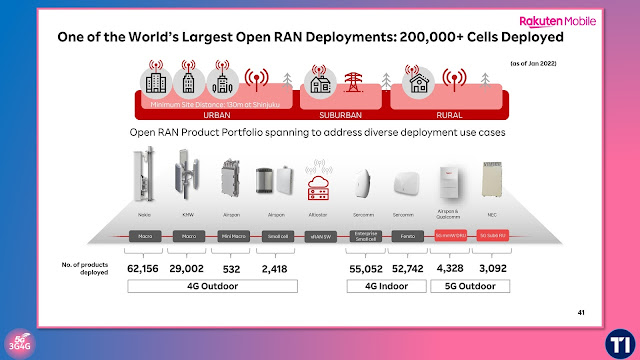
Rakuten Mobile shows off their Open RAN Portfolio

(Click on image to enlarge)

During the Full Year and Fourth Quarter 2021 earning call, President of Rakuten Mobile, Yoshihisa Yamada gave a short summary of the progress of the mobile network. During that, he also showed the Open RAN product portfolio spanning to address diverse deployment use cases.

The portfolio can be seen in the picture above and you can listen to his part of the talk in the video below: 

You can download the slides from here.

Related Posts: 

Friday, 11 June 2021

AWS for Public and Private 5G Networks

I wrote about AWS Edge being used to power Private Networks and Industry 4.0 back in March. Since then we had this big announcement from DISH and AWS about formation of 'Strategic Collaboration to Reinvent 5G Connectivity and Innovation'.

It talks about how the new US operator, DISH, will leverage AWS infrastructure and services to build a cloud-based, 5G Open Radio Access Network (O-RAN) that delivers consistent, cost-effective performance from core to the edge. 

Netmanias has done an awesome job of explaining how AWS will be used in the Dish network and compares it with the Rakuten Virtualised network. Reproducing the original from them below.


In addition, they have also done a fantastic job of explaining how different operators are planning to use AWS in their Networks. 


You can read more details for each of the operators below:

  • AWS and Verizon Expand 5G Collaboration with Private MEC Solution
  • AWS and Vodafone Business Bring Edge Computing Closer to Organizations in Europe
  • Announcing the first AWS Wavelength Zone in South Korea on SK Telecom (SKT)’s 5G network
  • KDDI To Launch "AWS Wavelength" On December 16, Offering Ultra Low Latency on the 5G Network Edge
  • Singtel and Optus expand 5G ecosystems with AWS for 5G edge computing
  • Telefónica Germany / O2 builds new 5G core network in the cloud
  • DISH and AWS Form Strategic Collaboration to Reinvent 5G Connectivity and Innovation
  • Bell Canada teams up with AWS for edge computing

Let us know what you think about the operator strategy of moving to AWS for something or other.

Related Posts: 

Tuesday, 4 August 2020

Some Pictures of Macrocells (and Small Cells) from Rakuten, Japan

If you have been following the Japanese operator Rakuten's progress, you will already know that they use variety of radio hardware vendors. Some of these we have covered in this blog. For example, Airspan's macros and small cells that I blogged here is used in quite a few locations. Similarly, I blogged about NEC O-RAN radios here that are being used in the live network too.

Here are some pictures from Twitter.

Rakuten mobile base station in Akiba (source)

Rakuten Mobile 5G base station, Komazawa Dori from Kanhachi (source)

Rakuten Mobile's 5G n77 base station. (source)

Indoor Rakuten mobile base station at the Haneda Airport International Terminal (source)

Antenna for high-rise buildings (source)

NEC on Rakuten Mobile 5G (source)


Airspan Air5G RDU 46, 28GHz (n257) (source)

You can't have a post on base stations without a speed test, so here we go

Speedtest on Rakuten 4G network (source)

Related Posts:

Thursday, 9 July 2020

Drones for Tower Inspections and Optimization


With the advancements in drone design, technology and automation, over the last couple of years I have noticed quite a few announcements about drones for tower inspections and optimisation. It would not be possible to cover all the companies here that have a solution but here are three big well known names in our industry that we are going to look in this post.


Back in March 2019, NTT Docomo announced that they have agreed to test docomo sky(TM) for Tower Inspection with PT Solusi Tunas Pratama Tbk. (STP), a company that leases out telecommunication towers in Indonesia. 

The service uses drones to photograph base stations and telecom towers and transmit the information to a command center in real time. The partners hope to expand the scope of the test to include other locations and facilities prior to launching a full-scale commercial service in the first half of this year.

The system being tested is based on an operational drone-based tower inspection system developed by DOCOMO for its commercial network throughout Japan, and supports the "docomo sky" ground control station (GCS) app for assistance in inspection tasks, enabling drone operators to input flight data with ease. For the test, DOCOMO will provide its cloud-based platform for operational support and data analysis. The drones fly automatically, take photos and transmit the images via the platform in real time, enabling technicians to inspect the towers via the docomo sky web browser immediately.

Indonesia is undergoing rapid urban development, including the construction of tall buildings and transportation infrastructure, which has resulted in large structures occasionally interfering with radio propagation from telecom towers. STP, which manages such facilities, must dispatch technicians to visually check conditions by climbing the towers. The new service will enable remote inspections to be conducted much more quickly and safely than at present, thereby allowing STP to achieve greater customer satisfaction with its service to mobile network operators.

In addition, the service is expected to support efforts to speed up procedures for inspecting and restoring telecom facilities in Indonesia whenever a natural disaster occurs.

Going forward, DOCOMO will continue to develop and upgrade its advanced drone services, one of the many ways the company is serving society by leveraging its diverse technical assets and know-how, including mobile network technology and platform businesses.

This week Docomo announced new features of drone platform "docomo sky" and new tariff. Details (in Japanese) available here.


Back in April this year, Rakuten Mobile announced that it will collaborate with Rakuten Group company Rakuten AirMap, Inc., which provides solutions supporting safe and compliant drone operations to enterprises, airspace authorities and drone operators in Japan, in using drones to conduct completion inspections of base stations for its mobile network.

As Rakuten Mobile expands its base station network across Japan, drones will take multi-angle photographs of the newly constructed base stations. In typical completion inspections, an engineer climbs the antenna tower on which the base station is installed and visually inspects the equipment. However, these inspections raise a number of concerns regarding safety, the time required to carry out the inspections and personnel costs. By carrying out the work with drones, completion inspections can be conducted in a shorter amount of time, more efficiently and with a higher degree of safety. Completion inspections will be conducted using AirMap’s TowerSight, a unified system that allows tower companies and MNOs to transform their tower inspections using automated drone workflows.

To date, Rakuten Mobile has conducted limited trials of base station completion inspections using drones in certain areas, and will now fully adopt drones for completion inspections nationwide. By using drones in completion inspections, Rakuten Mobile aims to improve the efficiency of base station construction and accelerate the expansion of its network area.

Drone captures of the base station and surrounding area are shared through Rakuten AirMap’s cloud-based inspection system, allowing staff working on the construction of the base stations to manage and share information efficiently and chronologically.

Rakuten AirMap has been instrumental in establishing the infrastructure for safe and scalable drone use in Japan and will leverage its expertise in completion inspections to contribute to the growth of drone applications in business. The two companies are also looking into the use of drone-based inspections during natural disasters and other emergency situations.

The official Rakuten Blog has a much more detailed article here.


The final announcement is from Samsung Electronics where they announced a successful demonstration of their new drone-based antenna configuration measurement solution for 4G and 5G networks in the company’s campus.

This automated solution will offer operators a simplified way to more efficiently manage cell sites, improve employee safety, and ultimately optimize network performance.

In the demonstration, an engineer on the ground used a smartphone with a remote control application to fly a camera-equipped drone that captured photos of the antennas installed on a building’s rooftop. The visual data was viewable via the engineer’s smartphone and then was transmitted to a cloud server within seconds. The deep learning-based artificial intelligence (AI) solution instantly verified the rotation and tilt of the antennas, so that the engineers could determine if the antennas were installed correctly at predefined optimal angles.

It took less than a minute to transmit the data and process the results, enabling the engineer to view results on-site in real-time on the smartphone screen. The demonstration verified that Samsung’s solution can accomplish the task within 15 minutes – starting from flying the drone to the delivery of measurement results. This compares to the several hours it can take for a tower climber to prepare, climb up and down a cell tower, and measure antenna configurations.

In conjunction with this new solution, Samsung will continue to add additional features, which will allow the engineers to remotely adjust the antenna tilts to its optimal position from a mobile device and PC.

Cellular antennas are typically installed at significant heights on sites such as cell towers or rooftops, in order to ensure optimal mobile coverage. Operator field engineers ordinarily carry heavy and expensive equipment as they climb up cell sites to measure the antenna configurations. With Samsung’s drone-based AI solution, operators will have a new approach for reinforcing the safety of their employees.


The solution’s safety benefits will be especially helpful during site audit and maintenance in the U.S., which often requires two field personnel to be dispatched to a site to audit or adjust the antenna angles -- and requires climbs that use more advanced safety training.

“As the number of 5G network sites grows, there has been a heightened focus on network performance by operators, and we are seeing an increased market demand for intelligent solutions for site maintenance,” said Sohyong Chong, Vice President and Head of Network Automation, Networks Business at Samsung Electronics. “Once this solution launches globally later this year, it will offer a safer, more cost-effective and convenient way to satisfy market demands, leveraging our unique capabilities in combining the latest technologies—drones, AI and 5G.”

Samsung Networks is a pioneer in the successful delivery of 5G end-to-end solutions ranging from chipset, radio and core network to cloud platform for both mid-band (2.5GHz/3.5GHz) and mmWave (28GHz/39GHz) frequencies. The company has been supporting 5G commercial services in leading markets, including Korea, U.S. and more recently Japan, where the majority of worldwide 5G subscribers are currently located.

Friday, 28 February 2020

Rakuten details how Cloud will make Telecommunications Industry Irrelevant


Yesterday we detailed Rakuten's Open RAN and Innovation Journey here. Today, we look at a presentation from the recent 5G Malaysia International Conference 2020 where Tareq Amin, CTO, Rakuten Mobile, presented his vision on how Cloud will eventually make Telecommunications Industry Irrelevant.


Innovation has allowed them to create a site with the smallest footprint. Not only that, the change of design has allowed the operator to save massive amounts of money and at the same time pushing the software in the cloud  allows the site to come up is 8.5 minutes as compared to the traditional time of between half to two days.

Rakuten uses 6 hardware types in their data centers which are COTS servers and this has helped them achieve some amazing results as can be seen here.


Tareq is expecting Opex to reduce even more due to automation. Time will tell. Here is the presentation embedded below.


Related Posts:

Thursday, 12 September 2019

Airspan Small Cells and Macrocells Portfolio, including 5G


Back in April, a presentation from Airspan showed that they have shipped nearly 500k small cells. Sprint has nearly 300k MagicBoxes while Jio has around 120k small cells.


As you can see above, Airspan has a range of outdoor small cells and as shown below, a wide range of indoor small cells.


Airspan recently announced that it has partnered with Rakuten, the newest MNO in Japan, to bring comprehensive 4G and 5G solutions to the world’s first fully virtualized cloud-native mobile network. The announcement said:

Airspan’s Air5G OpenRange28 mmWave platform in 28GHz will deliver ultra-high capacity to Rakuten Mobile with record time-to-market, enabling unprecedented monetization opportunities. Airspan’s open RAN platforms will provide Rakuten Mobile the flexibility to disrupt the economics of traditional network operators and lay the foundation for transformational 5G architectures. With over half a million systems deployed globally, Airspan brings its proven disruptive economics to the fully virtualized Rakuten Mobile network.


Airspan’s mmWave virtualized Air5G OpenRange28 platform utilizes Qualcomm’s FSM100xx 5G chipset and supports open RAN architectures, seamlessly connecting to Rakuten Mobile’s virtualized BBU to deliver the world’s most advanced open interface virtualized RAN solution.  The OpenRange28 mmWave platform supports multiple functional splits for the widest possible set of deployment options, ensuring Rakuten Mobile customers benefit from the highest level of efficiency and the best user experience in Japan.

Airspan's 5G products can be viewed here.

With so many innovators working with Rakuten, it would be interesting to see their 4G & 5G network rollout. Looking forward to some big announcements at MWC next year.

Related Posts: