Showing posts with label Operator Verizon. Show all posts

Monday, 8 August 2022

Verizon's Growing Small Cells Footprint

Verizon was in news recently when their CTO, Ed Chan, mentioned that the operator had plans to speed up its small cell buildout starting in 2023. Light Reading quoted in an article:

His comments, made to financial analysts at Wells Fargo, come after the small cell market in the US took a breather during 2021 as big network operators focused on building out their new midband spectrum holdings via bigger, macro cell sites.

"Verizon anticipates small cells activity will ramp in 2023 as activity shifts toward 16t16r deployments from early 8t8r deployments built in 2022," wrote the Wells Fargo analysts of their recent meeting with Chan. Newer 5G radios can generally support more antennas, including 16T16R configurations.

"Chan also referenced that a third party had taken longer to grow scale and expertise to handle the installs Verizon had planned, but that it is reaching a point where a higher mix will trend toward third-party deployments from self deployments today," the analysts added.

Verizon officials did not respond to questions from Light Reading about Chan's meeting with Wells Fargo executives. The meeting is not listed among the operator's recent public investor events.

The small cell news could be important to equipment vendors, ranging from Airspan to Ericsson to CommScope. Jennifer Fritzsche, managing director at investment bank Greenhill & Company, wrote recently that Chan's comments could presage a resurgence in the US small cell market. She speculated that Verizon could turn to third-party small cell providers like Crown Castle and ExteNet Systems.

Small cells are big in the USA but the definition of it has become a bit fuzzy. In the old days it used to be an all-in-one unit but now anything that is deployed with an omnidirectional antenna or anything that is deployed on lamp posts or poles can be considered a small cell. 

Over the last few years we have looked at the small cells pics in the USA (see related posts at the bottom), so here are some of them from Verizon.

Quoting again from the Light Reading article:

Verizon is widely regarded as the leader in small cells in the US. The company has so far deployed 30,000 small cells sites for its millimeter wave (mmWave) 5G network.

"We continue to deploy millimeter wave, which is a key part of our network, providing massive bandwidth in dense urban areas," said Verizon's Rima Qureshi, the operator's chief strategy officer, during a recent Verizon investor event. But company officials haven't provided any specific goals for small cell buildout in 2023 and beyond.

T-Mobile has said that it eventually expects to operate around 40,000 to 50,000 small cells as it completes its big 5G network buildout, while AT&T at one point had planned to operate 40,000 small cells by 2015. But AT&T did not meet its goal, and company officials have remained quiet about small cells since.

Verizon, AT&T and T-Mobile have all been working to deploy their midband 5G spectrum holdings, and that work has shifted their focus away from small cells. Macro cell towers can cover wide geographic areas, while small cells – which typically sit atop street lights and rooftops rather than large cell towers – are primarily viewed as a method to improve capacity rather than coverage.

Which one is your favourite? Let us know if you have more pictures.

Related Posts: 

Friday, 11 February 2022

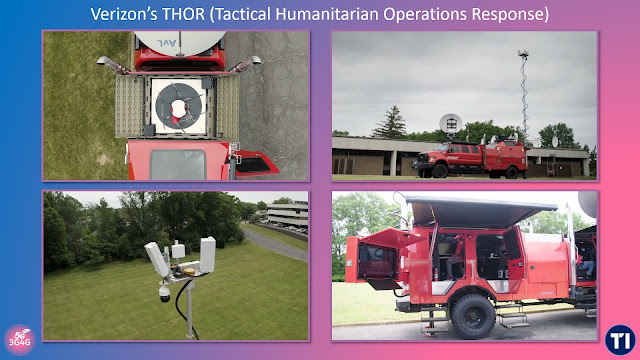
THOR - Verizon's Disaster Response COW

When we wrote about how Verizon uses satellite connectivity to restore services after hurricanes, someone made us aware of THOR, the Verizon disaster response vehicle in a league of its own.

The Verizon Response Team (VRT) has a collection of different types of field equipment, which they refer to as 'The Barnyard'. This includes COWs (Cell On Wheels), COLTs (Cell On Light Trucks), CROWs (Cellular Repeater On Wheels) and GOATs (Generator On A Trailer). The latest addition to this is THOR (Tactical Humanitarian Operations Response).

The press release points out:

THOR is National Incident Management System — or NIMS-1 — compliant and offers full radio interoperability and onboard Joint Operations Center services. It provides a multitude of connectivity options, spanning private 5G, commercial 4G LTE, Land Mobile Radio and tactical radio, wireless networking, microwave, mesh and more. Other components include 4G/5G radios, a rear command center, a camera, a six-seat cabin and an exterior touch screen display.

It also comes equipped with a tethered drone to capture an aerial view that can be fed over the network to devices on the ground and the command center below, potentially helping those in public safety or the military with risk and damage assessment, situational awareness or search and rescue operations.

As a prototype, there are currently no plans to build a second THOR, as designs for future 5G-enabled response vehicles continue to evolve.

Here is a video with more details of THOR.

Related Posts:

Friday, 29 January 2021

Samsung Link Indoor Solutions

Late last year, Samsung launched the Full Suite of 5G Indoor Products aimed at improving 5G connectivity indoors. As we move to higher frequencies for 5G, especially mmWave, alternative solutions will definitely be required to provide higher data rates. 

As can be seen in the picture above, there are three different solutions for different scenarios. The brochure here and this website here provides details but I have highlighted the relevant information below:

Link Cell is a compact indoor small cell that offers robust, ubiquitous in-building 5G mmWave coverage to deliver the high bandwidth, low latency and fast throughput needs for these businesses and public venues. The indoor solution can connect a large number of indoor users to data applications where signals from the outside 5G mmWave networks are hard to reach, enhancing productivity and providing a premium business experience. For enterprises that require dedicated connectivity and additional security needs the Link Cell can also serve as the foundation for a 5G private network. By combining a private 5G Core with Link Cells, an enterprise can have a secure, ultra-reliable, high-speed, low-latency 5G network that can accelerate their automation and digitization efforts.

To meet indoor coverage demands, particularly where capacity expansion is required or anticipated in the near future, Samsung offers a 5G Active DAS (Distributed Antenna System) solution called the Link HubPro. This system is especially useful in large buildings with extensive IT infrastructure. The solution includes two main components: a Radio Hub and Indoor Radio, and supports more diverse spectrums including, low-band and mid-band. With this simple architecture, single Radio Hub will allow a mobile operator to connect multiple radios and making multiple radios work as a single cell to build wide 5G indoor coverage without interference. 

Samsung Link Hub acts as a radio to connecting passive antennas supporting both LTE and 5G. If a building already has an existing passive DAS system, service providers can easily upgrade their indoor network to provide 5G service and reuse legacy cabling to save both time and costs. The Link Hub will act as a bridge between the 5G baseband and antennas by converting data traffic to radio signals, and vice versa, making 5G data traffic possible. The Link Hub can be managed remotely by an operator’s network management system.

The video below explains the solution in detail:

Here is another video that explains the indoor small cell, Samsung Link Cell

As a final thing, it should be pointed out that Samsung’s Link Cell features the Qualcomm 5G RAN platform, which builds on the collaboration between Qualcomm Technologies, Inc. and Samsung. 

Related Posts:

Sunday, 8 March 2020

Super Bowl 2020 Infrastructure in Miami, Florida, USA


Superbowl is a big thing in the US and is catching on in other parts of the world. My favorite part is all the trailers for the upcoming movies that gets dropped in the half time. All the US operators spend months getting ready with the infrastructure in the city and the stadium. After all, as an operator, you expect a fantastic feedback from your existing customers and show off the speeds after the game.

Quoting from Verizon news:

Verizon is on the ground in Miami working hand-in-hand with first responders, local and state government agencies to help keep everyone connected during the big game. 

Our work in Miami has been focused on three key areas: network investment, our state-of-the-art Command Center and being embedded at Florida’s Emergency Operations center.

Verizon's network engineers have been hard at work for more than two years to ensure that our network is ready for the big game and all the festivities that go along with it. As part of the preparations, Verizon has invested over $80 million dollars to enhance our to support the Super Bowl in and around the stadium and the greater Miami area.

Other investments include laying more than 230 miles of fiber throughout Miami, adding existing capacity to over 280 existing cell sites, installing 5G nodes to support NFL Super Bowl venues and events, installing close to 30 in-building solutions to enhance performance around the city (i.e. popular hotels and shopping centers), installing 5G at both the Miami and Fort Lauderdale Airports and more.

These are permanent network enhancements that will benefit the Miami residents and visitors for years to come.

In their announcement, AT&T said:

We’ve been working for more than a year – and have invested more than $85 million – to boost our network through a series of both permanent and temporary upgrades in the city. All this is designed to help residents, first responders and fans stay connected wherever they are.

And to keep fans safe at one of the year’s biggest sporting events, the FirstNet team at AT&T and the First Responder Network Authority (FirstNet Authority) are working hand-in-hand with dozens of public safety agencies to prepare. This advance work helps ensure first responders have the coverage, capacity and capabilities – network priority and preemption included – that they need to stay connected throughout the festivities.

We’ve upgraded our portion of the in-stadium Distributed Antenna System (DAS) and other network enhancements – like adding 5G+ and Band 14 spectrum – to provide over 300% more LTE capacity than what was available at the start of the football season. That means we’re utilizing the most LTE capacity currently available on any AT&T DAS in the state of Florida.

The DAS, a system of strategically-placed antennas that distribute and actively manage wireless network coverage throughout the stadium, help evenly distribute coverage, creating a better fan experience. This capacity boost helps manage heavy wireless traffic and gives fans and first responders strong wireless coverage throughout game day – from early tailgating to the final trophy presentation.  

We didn’t stop with in-stadium enhancements. Fans and first responders will be able to enjoy improved coverage in hotels, arenas, airports and convention centers, among other venues through a series of network enhancements:

  • We now offer extra speed and capacity over 5G+ in parts of 35 cities, including Miami and Miami Gardens.
  • We’ve upgraded or installed a new DAS at 29 additional locations throughout the Miami area.
  • We’re deploying 6 Cell on Wheels (COWs) to handle expected increased wireless network demands. They will improve reliability and data speeds during the week leading up to and during the Big Game.
  • We’re also enhancing network coverage for the 10th annual AT&T TV Super Saturday Night. The deployments will include a Super COW capable of 5G+ at Meridian Island Gardens to enhance coverage for all the fans headed to see Lady Gaga perform the night before the Big Game.
These investments will allow Florida residents, businesses, visitors and attendees at the festivities to celebrate the Big Game over the AT&T network at home, at work or on the go.
  
In addition to these network enhancements, we’ve been making public safety-specific preparations to ensure the FirstNet communications platform is ready for the Big Game:
  • We deployed high-quality Band 14 spectrum across the area to provide optimal coverage and capacity for first responders. We look at Band 14 as public safety’s VIP lane. In an emergency, it can be cleared and locked just for FirstNet subscribers, further elevating public safety’s connected experience and emergency response.
  • We’ve installed metro cells at numerous local and federal public safety agency centers. These enhancements provide agencies with a direct network connection to the critical information they need.
  • We’ll place three FirstNet Satellite Cell on Light Trucks (SatCOLTs) outside of the stadium for extra redundancy and to provide additional coverage to first responders, if needed.
  • We’re equipping first responders with FirstNet Ready™ devices to help ensure they have communications across the highly secure FirstNet network core.
Plus, members of the FirstNet team will staff the public safety command posts to support local, state and federal agencies in the week leading up to and through the day of the Big Game. This will help ensure communication needs for public safety officials are met.

In their announcement, T-Mobile said:

Over the last year, T-Mobile permanently boosted network capacity at venues throughout Miami so customers can share their game day moments in real time. T-Mobile and Metro by T-Mobile customers already have the biggest 5G network in Miami.  And now, customers with capable 5G smartphones can get a speed boost from millimeter wave 5G in places like Hard Rock Stadium and Bayfront Park.

With 150,000 people predicted to travel to Miami for Super Bowl LIV events, T-Mobile focused network enhancements where the biggest crowds will be, including Hard Rock Stadium, Miami Beach Convention Center, Bayfront Park, Miami Beach and Miami and Fort Lauderdale airports. And almost all the updates are permanent, so Miami residents and visitors can enjoy the improvements long after the Super Bowl is over.

T-Mobile more than doubled LTE capacity at Hard Rock Stadium so customers can stream, tweet, post and chat about every big moment from the game. To enhance indoor capacity at key venues throughout Miami, T-Mobile built new distributed antenna systems (DAS) and deployed small cells throughout the city to provide additional performance boosts in places that can be difficult for towers to reach.

Almost all of Miami is covered with T-Mobile’s far reaching low-band 5G and fast LTE, so whether customers watch the game from the couch or the beach they’ll be ready to share the action.  In addition to launching broad 5G coverage last month, T-Mobile has newly deployed millimeter wave 5G for customers with capable smartphones in parts of Miami, including nearly all of Bayfront Park and at Hard Rock Stadium in the lower bowl, parking lot and main entrances.

To ensure customers with compatible smartphones know where they can access 5G in Miami, T-Mobile has an interactive map of its nationwide low-band 5G to show where coverage is available down to the neighborhood level and created new millimeter wave maps for the city.

Finally, Sprint, who is the only one to share it's deployment pictures and equipment (shown on the top) said:

As part of our Next-Gen Network build, over the last two years we’ve invested millions of dollars in network infrastructure and upgrades to improve our customers’ wireless experience across Miami.

For the second year in a row, Sprint’s Big Game MVP for increased capacity and faster speeds than before is our innovative Massive MIMO technology. And this year, we’re not only bringing customers a better LTE experience, but we’ve lit up Sprint True Mobile 5G service in some areas of Miami including the stadium, in preparation for this exciting event!

Those who live, work or visit Miami should be fired up because these aren’t temporary fixes. These permanent solutions will benefit Sprint customers for a long time to come.

Based on the huge increase in customers’ data usage last year and in 2018, we’re using two different technologies this year to help meet fans’ demands to stream, download, video chat, text and connect on social.
  • In and around the stadium, Sprint’s Massive MIMO radios using our fast 2.5 GHz spectrum and breakthrough “split-mode” feature will enable us to simultaneously deliver our most-advanced LTE service and Sprint 5G for customers attending the showdown in person.
  • In addition, we will be providing 4G/5G dual connectivity within the stadium, transmitting 4G over a state-of-the-art distributed antenna system (DAS) with more than 1,800 antennas and 5G through Massive MIMO radios.
Together, these solutions will provide the equivalent of 10 macro cell towers at the stadium. That will give fans the coverage and capacity they need whether they’re in their seats, at the concession stand or tailgating in the parking lot.

With massive crowds expected throughout Miami and the surrounding areas, we extended our network upgrades in Downtown and Midtown Miami and Miami Beach, as well as areas in West Palm Beach and Ft. Lauderdale.
  • Several dozen new Massive MIMO radios in high-traffic areas such as Downtown Miami, Midtown Miami, Miami Beach, Fort Lauderdale Beach and the Palm Beach Convention Center will provide improved capacity and faster LTE speeds than before. Customers on Sprint 5G devices in these areas will automatically connect to even faster speeds on our next-generation wireless network. Sprint’s average 5G download speed of 215 Mbps is over 5X faster than our LTE.*
  • Hundreds of new small cells have been installed across the urban and dense areas of the city to “fill in” the network with our 2.5 GHz spectrum. This will result in more capacity in that area and a boost in speed for customers.
  • Nearly 300 cell sites throughout the area have been upgraded to use all three of Sprint’s spectrum bands - 800 MHz, 1.9 GHz and 2.5 GHz - for faster, more reliable service than before.
  • Dozens of new macro cell sites have also been built in areas including Delray Beach, Doral, Hialeah, Homestead, Miami, Palm Beach Gardens, and Pompano Beach to further expand wireless coverage in the Southeastern, Florida market.

So who won? Well, that depends on who you ask.

On the Speedtest blog, they said:

Sprint’s home team might have won the game, but Verizon triumphed when it came to mobile download speeds, coming in 143.7% faster than second-place T-Mobile when considering Speedtest® results over all technologies. Sprint had the third fastest mean download speed in this category and AT&T came in fourth.

Focusing on their 5G game really helped Verizon take the day when considering overall speeds as T-Mobile had the fastest mean download speed (66.35 Mbps) on LTE. Sprint was second on LTE with a mean download speed of 56.16 Mbps, AT&T third at 39.18 Mbps and Verizon fourth at 30.67 Mbps. We break out 5G speeds for each operator below.

T-Mobile’s mean upload speed over all technologies was far better than competitors’. Upload speed is especially important at big events like this as fans try to share their game day experience with those not in the stadium.

T-Mobile also had the lowest latency, coming in 26.0% faster than second-place AT&T. Sprint was third for latency and Verizon fourth.

For comparison, the mean download speed over mobile in the U.S. in January 2020 was 41.23 Mbps, upload was 10.55 Mbps and latency was 46 ms.

Verizon easily beat T-Mobile and Sprint when it came to mean download speed over 5G during the big game. Verizon came in last, however, for both mean upload speed over 5G and latency. T-Mobile showed the fastest mean upload speed over 5G and Sprint had the best latency on 5G. While we did see 5G Speedtest results for AT&T during the game, there were fewer than 10, the minimum threshold we set for this event.

In 2019, fans at Mercedes-Benz Stadium in Atlanta used over 24 TB of data on the stadium Wi-Fi network on game day with an average Wi-Fi download speed of 30.98 Mbps. To get a baseline on the Miami experience, we looked at Wi-Fi performance during the Bengals v. Dolphins matchup on December 22, 2019.

Wi-Fi at the stadium did show some game day stresses yesterday, with a mean download speed 33.7% slower than the December 22 game. Mean upload speed dropped 25.7% and latency was up 28.6%.

Verizon also provided Wi-Fi for their customers during the big game yesterday, and the mean download speed was comparable to that on the stadium’s SSID. Mean upload speed on Verizon’s SSID was 12.1% slower than on the stadium’s, but Verizon’s Wi-Fi latency was also lower, showing a 22.2% improvement over stadium Wi-Fi.

It’s worth noting that mean upload speed in all cases was faster than that on download. This is impressive and helpful to fans trying to livestream their experience for friends back home.

This does not mean that it has stopped T-Mobile in claiming that they were winners.

You can say that based on the 5G coverage, this was justifiable

Hopefully in the next Superbowl, we will see some more concrete deployment pictures along with the marketing spin.

Related Posts:

Saturday, 15 February 2020

Verizon's Small Cells Start Paying Dividends

Pictures Source: Dr Jonathan L Kramer

In their recent investor meeting presentation, Verizon talked about many different approaches that have helped them keep pace with the increasing traffic.


While basic improvements like 256-QAM, 4x4 MIMO, Carrier Aggregation and CBRS/LAA have helped, other innovations like Interference Management Software has helped improve capacity.


Densification solutions include increasing number of small cells and more carriers per sector.


This chart above from the deck is a good summary of how different enhancements affect the LTE User Peak Throughput as well as the LTE Network Spectral Efficiency. According to the graph, this year they are planning to deploy FD-MIMO, a.k.a. Full-Dimension MIMO.

This research paper (link) on FD-MIMO provides an excellent overview of the topic. According to that "3GPP decided to use tens of antennas with a two dimensional (2D) array structure as a starting point. Full-Dimension MIMO (FD-MIMO), the official name for the MIMO enhancement in 3GPP, targets the system utilizing up to 64 antenna ports at the transmitter side."


This chart above is a good summary of how these enhancements have helped Verizon expand capacity to handle the increase of user traffic.


With regards to the small cells, the number of 5G small cells is expected to increase by at least 5 times this year to cope with the 5G traffic increase and coverage improvement. As Verizon has deployed mmWave spectrum for 5G, they will need significant number of smaller cells to provide coverage.


The tweet below shows an example of 5G Small Cell


Here is an interesting recent video from Verizon explaining small cells to their end users.


It would be interesting to see in the next few years how these small cells solve the coverage gap and handle the capacity need.

Related Posts:

Monday, 2 September 2019

5G Small Cells on 'Smart Poles' in Denver


There was a good report in FierceWireless about Verizon installing 5G in Denver using special ‘smart poles’. We have covered this topic of smart lampposts and poles extensively for many different countries including India, UK, Portugal, China and even Japan.

The article states:

The Boulder, Colorado-based company Comptek Technologies has designed stand-alone poles to house wireless small cell equipment that is completely hidden within the poles. The City of Denver has approved the design of these Comptek City Poles, and Verizon is now deploying them in Denver for 4G and 5G small cell equipment.

In addition to Verizon, Comptek is also working in different parts of the country with all the other major wireless carriers either directly or through their deployment partners. For instance, Comptek is working closely with its customer Xcel Energy, which has an eight-state footprint. Xcel is helping carriers to deploy their small cells on the utility’s existing vertical infrastructure. And in some cases, Xcel is taking down existing light poles and replacing them with Comptek poles that combine small cell equipment along with a streetlight.

The company has a national agreement with Verizon. Besides Denver, Comptek is working with Verizon in other cities including Columbus, Cleveland and Cincinnati, Ohio; Anaheim, San Diego and Los Angeles, California; as well as Salt Lake City. In the Denver/Front Range area, the company has about 350 poles under contract. And across the U.S. it’s got contracts to erect about 1,000 poles by the end of 2019.

CityPoles' website here isn't updated with the latest info but the earlier press release stated 300 small cells in Denver.


Continuing from the article:

The poles are designed in modular sections. There’s a foundation, base cabinet, shroud, upper pole and top antenna section. They’re custom-designed to incorporate various wireless equipment configurations, cabling, power supplies and antennas. In addition to the physical pole itself, Comptek also provides electronics and environmental controls. The poles can support single or multiple carriers.

Jim Lockwood, CEO of Comptek said that for 5G, Ericsson’s mmWave equipment is mounted in a tri-sector format, meaning that the radios and antennas are integrated with each other and they’re mounted at the top of the pole in three panels that face in different directions. Representatives from Ericsson and Verizon could not verify the "tri-sector format" or provide any additional information about it.

Related info:

Related Posts:

Saturday, 10 March 2018

Some pictures of Small Cells from California (USA)

I came across them on various LinkedIn/Twitter posts

Two Small Cells on adjacent light poles in SF (signs used to somewhat shroud mRRU) - Source: Omar Masry

The comment mentions that One is Verizon. Other is likely ATT
I would argue that if this is an RRU (Remote Radio Unit) then its probably not a small cell but let's leave that one for another day.

Small Cell. Financial District. San Francisco - Source: Omar Masry


Comment mentions: Either T-Mobile or Verizon.  Likely done by Modus. Might be worth checking out this earlier post here too.

The next one is from Steve Blum's Blog of T-Mobile Small cell in Gage Canal, Riverside, California


The final one is from Santa Rosa, California. From a PressDemocrat article titled 'New Verizon antennas generate unwelcome buzz in Santa Rosa'


From the article (more pictures of this installation in the article):
A city-sanctioned bid to improve wireless connectivity for internet and cellphone users in Santa Rosa has run into opposition from some residents and generated concern among city officials after the first round of “small-cell” antennas went up on utility poles in recent weeks. 
The equipment — including large metal in-ground utility boxes about 5 feet tall — varies greatly in design from anything the city was previously shown by Verizon, the wireless provider installing the antennas, said Eric McHenry, director of Santa Rosa’s Information Technology Department. 
While the city had no role in the equipment design, Santa Rosa officials went through a significant amount of back-and-forth with representatives of the wireless carrier on what the units would look like on city-owned streetlights, McHenry said. Officials took pains to make sure the antennas would be as unobtrusive as possible, he said. 
“We frankly as a city were also surprised by what these first ones looked like,” he said, referring to the units Verizon is installing on utility poles. “They look nothing like what we had discussed with Verizon for our city streetlights or even the pictures that we shared with the council (of the installations) on wooden poles.”
Definitely a scope for improvement out there.

Related Article:

Friday, 9 February 2018

Verizon's got Balls and Small Cells

Matsing Balls are a first in an NFL Stadium at U.S. Bank Stadium - Source: Verizon

Love the fact that the mobile network operators have become quite open in talking about their infrastructure, data consumption statistics and their future plans. Last week I talked about Sprint's small cell deployments for Super Bowl, this week some info from Verizon.

Verizon has talked in detail in their blog about how its coping with the huge demand in data that has been increasing every year. Here is an extract from a few Verizon blogs.

The permanent new network enhancements will boost performance in U.S. Bank Stadium and areas of anticipated high demand, including Super Bowl LIVE, Super Bowl Experience, popular tourist attractions, airports, hotels, venues and other special event locations throughout the Twin Cities area. 

Verizon’s network enhancements for you include: 
  • 24 new permanent cell sites 
  • 230+ permanent small cell sites 
  • Doubling of network capacity on Nicollet Mall with a new small cell/design solution inside new bus shelters
  • LTE Advanced features added to the 4G LTE network for greater capacity and faster peak data speeds
  • 48 percent more antennas added to Verizon’s Distributed Antenna System (DAS) at the Stadium in 2017
  • A new neutral host DAS system at Mall of America® boosting Verizon’s network capacity by 900 percent
  • A new neutral host DAS system at Minneapolis-Saint Paul International Airport adding new 4G LTE coverage in tunnels, boosting Verizon’s network capacity throughout the airport by more than 1,000 percent 

Handrail antennas in U.S. Bank Stadium - Source: Verizon

DAS: Verizon built a neutral host state-of-the-art network system when the new tech-advanced U.S. Bank stadium opened in 2016 for the Minnesota Sports Facilities Authority and added 48 percent more antennas in 2017 with innovative design solutions exclusively for your connectivity, including drink rail, handrail and under the seat antennas. 

The stadium DAS system Verizon built is one of the largest in the U.S. and Verizon customers will be connected by more than 1,200 antennas distributed over more than 100 coverage zones. A similar outdoor stadium DAS provides coverage at the east entrance, light rail station and west plaza area. In the first indoor use at an NFL stadium, two Matsing Ball antennas (that appear like giant white disco balls) are installed 330 feet above the field on the ridge beam. They provide coverage by dividing the field into sectors, like slices of a pie, for Super Bowl photographers and staff, and for you at popular concerts with floor seating. 

One of Verizon’s small cells outside U.S. Bank stadium enhances wireless data capacity. - Source Verizon

Small Cells: Small cells are designed to blend into the urban landscape, literally “hiding in plain sight” on street lights, traffic signals or utility poles, and provide 4G LTE coverage for a radius of approximately 1,000 feet.  Small cells bring the fiber connections and network “densification” needed to enable Smart Cities technology (like managing traffic flow) and the next generation network, 5G. As part of our Smart Communities work with the city of Minneapolis, we’ve also installed security cameras on street lights with our small cells in the downtown area to help the city ensure the best experience possible for fans and citizens.

On the side, Verizon also deployed a network for Public Safety officials and it tested the limits of 5G.

So what did the statistics look like? Here it is from another blog post:

Game day facts 
  • Verizon’s network was used by 57% of the attendees in the stadium at this year’s Super Bowl, up from 45% the previous year.
  • Verizon fans benefitted from the highest average download speeds at U.S. Bank Stadium according to third-party testing by P3 of all four national carriers during the game. 
  • On Super Bowl game day, Verizon fans used 18.8 TB of data in and around the stadium, the equivalent of a single user binge watching HD video for 435 straight days.
  • The data usage by Verizon fans was 70.9% more than the 11 TB used at Super Bowl 51 – the same as watching HD video for 256 days in a row. At Super Bowl 50, Verizon customers used 7 TB of data – roughly 1/3 of Sunday’s big game.
  • Top wireless uses by Verizon customers were led, in this order, by web browsing, streaming video and using social media and sports apps.  
  • The top three favorite social media apps of Verizon customers were Snapchat, Facebook and Instagram, with Snapchat moving from third at last year’s Super Bowl to first most used.
The biggest spikes of wireless data usage occurred during:
  • The halftime show driven by social media video sharing. 
  • The next biggest usage spikes occurred when the Patriots fumbled the ball late in the fourth quarter, and;
  • At the game kickoff, with fans streaming video and web browsing.
Our Network team of 150 engineers, 3X the size of an NFL team roster, staffed Verizon’s network Command Center 24x7 to ensure a reliable network experience for fans, first responders and public safety teams.

So the headline figure was 'Verizon fans used 18.8 TB of data in and around the stadium'.

To put this in perspective, here is a tweet from EE CEO, Marc Allera:
So you can see how much data was consumed in the Super Bowl match.

Localytics has some more info on the data consumption pattern, apps, etc. during the Super Bowl here.

Looking forward to finding some similar info from T-Mobile and AT&T.

Thursday, 28 September 2017

Drones, More Drones & Droneway

I have written about Drones and Balloons in the past, mainly to BT/EE. Take for instance this presentation by Mansoor Hanif at TIP Summit and this one on Flying Small Cells. In addition I have also talked about Telefonica's Nano cell, which is a small cell on a drone; Verizon's 'flying cell-site' and AT&T's flying COW.


This week the US operator Sprint announced that they are trialing their Magic boxes on drones. Here is a video on that:


Back in August, IEEE Spectrum ran an article on how Flying Cell Towers Could Aid Search and Rescue. Base stations carried by drones would form an ad hoc network and connect first responders.

Picture Source: IEEE Spectrum

From the IEEE Spectrum article:

An aerial communications system supported by drones could be deployed much faster and operate with minimal interference. In 2013, we started to think about what such a drone-based communications system for public safety agencies might look like. We knew it would need a shared radio-frequency channel for first responders, drone-portable base stations, a power supply, and a digital database for exchanging information. We would also need controllers that would be easy enough for a licensed drone pilot to operate in a crisis.

Our first major challenge was to find a base station small enough for a drone to support. Drones under 25 kilograms—the limit now imposed by U.S. air-safety regulators—can carry a maximum payload of about 2 kg, so we would need a base station that weighed less, even with its battery.

Finally, my search led me to a startup named Virtual Network Communications. This company, based in Chantilly, Va., sells a product called a GreenCell that seemed suitable. It’s a scalable LTE base station, known as a picocell, which is typically used to extend the reach of an existing network but can also generate its own network. The base station contains an E-UTRAN Node B radio with two antennas and a credit-card-size component called a Micro Evolved Packet Core, which uses LTE technology to form an ad hoc network with nearby radios. Then, that local network connects to a nationwide cellular network.

With these components, our GreenCell can support communications for up to 128 users at a time from a distance of up to about 2 kilometers on any LTE frequency. Better yet, it measures just 12.5 by 12.5 centimeters and weighs only 2 kg with its battery, just light enough to be lifted by a drone.

Once we had found a suitable base station, we still needed to find a suitable drone. Ideally, it would be affordable and be capable of flying for 10 to 12 hours before needing a recharge. Unfortunately, no such drone exists today. Most commercial drones can stay aloft for fewer than 45 minutes.

After some research, I found a company named CyPhy Works, which has developed a drone powered through a 150-meter cord that extends up from a grid or generator. Technically, this drone could stay in the air for as long as it had access to a power supply on the ground. But in a disaster scenario, it would have to be tethered to a van loaded with a generator and fuel. That would limit it to serving the same road-accessible places to which mobile units already travel. Another drawback: The drone’s tether restricts its mobility once it’s in the air. We wanted to be able to reconfigure our network in an instant.

We briefly considered using balloons instead of drones, but we discovered through trial and error that balloons are difficult to reposition and hold in place, especially during high winds.

We decided instead to use the AR200 drone from AirRobot, a company based in Arnsberg, Germany. The AR200 has six rotors that allow it to hover more steadily than the usual four. And because the AirRobot drone is battery powered, it can zoom off to any location.

In summer, Qualcomm unveiled [PDF report] the results of a months-long drone trial program, which found LTE networks today already provide the aerial connectivity necessary to support commercial unmanned aerial vehicle deployments. But the tech giant noted some network optimizations will be necessary to take drone deployments to new heights. As per their blog post:

During the field trial, approximately 1,000 flights were performed to collect datasets that were post processed and analyzed. We also performed simulations to complement field trial results by allowing study of performance tradeoffs when the network is serving many mobile devices and LTE-connected drones simultaneously over a wide area. Simulations also enabled rapid testing of parameter and feature changes that are more difficult to study in a commercial network.

The field trial demonstrated that LTE networks can support safe drone operation in real-world environments. Our findings showed that existing commercial cellular networks can provide coverage to drones at low altitudes up to 400 feet AGL. Our test drones also showed seamless handovers between different base stations during flights. Below is a glimpse of these findings.


According to Mobile World Live,

The head of AT&T’s Unmanned Aerial Vehicles (UAV) business development team said the operator is working with regulatory authorities and standards organisations to “unlock” the potential of drones.

Speaking with Mobile World Live, Greg Belaus said many tests of drones on cellular networks so far have been conducted at a height of 400 feet. In the US, Belaus explained that airspace is governed by the Federal Aviation Administration’s (FAA) Part 107 rules. Belaus said “a lot of work” on drones right now is focused on what needs to be done to open that area for drone services.

There is an interesting AT&T Flying COW presentation on Youtube for anyone interested, here.

Finally, looks like "Droneway" may be becoming a reality soon. As one of the partners involved in the project, I may not be at a liberty to say much but this photo of the article below (click to expand) provides an idea 😊


*Full Disclosure: I work for Parallel Wireless as a Senior Director, Strategic Marketing. This blog is maintained in my personal capacity and expresses my own views, not the views of my employer or anyone else. Anyone who knows me well would know this.

Wednesday, 19 April 2017

Verizon's Small Cells and the roadmap to 5G


Verizon just disclosed their small cells numbers. Their CEO Lowell McAdam said in Fotune:

McAdam has so far decided that his company will follow a 5G strategy of adding many thousands of small cell sites in major urban areas, instead of relying just on the big cell towers it used in the past, and then connecting them with fiber optic cables. On Tuesday, Verizon announced a new deal to buy at least $1.05 billion of fiber optic cable and related hardware from Corning over the next three years–enough to cover 12.4 million miles, the companies said.

Verizon already has 13,000 small sites deployed, McAdam said, disclosing the total number for the first time, compared to about 60,000 current cell tower sites in its network. But Verizon will be adding in each major city 8,000 to 10,000 more small sites, tiny transmitters that can fit in the palm of a hand and be tacked onto a lamp post or traffic light pole.

Unfortunately, according to McAdam, the fiber networks that cable companies have installed don't have nearly enough capacity to meet Verizon's needs to connect all the small cells in big cities. While a typical fiber cable may have contained 144 separate strands of glass wiring in the past, Verizon's newest installations in Boston have 1,700 separate strands per cable.

Their VP of network, Mike Haberman earlier said in Fierce Wireless: Verizon is increasingly looking to small cells to increase capacity and improve network performance, particularly in urban areas. Small cells are complementary to more traditional macrosites, Haberman said, enabling carriers to fill in small gaps and transmit more data in areas where towers may not be sufficient.

“Think of it this way: The macrocells are sort of the umbrella network, and the small cells are underneath the umbrella network to provide the capacity needed,” he continued. “We’ve been doing this for many years. We’ve been on utility poles, we’ve been on traffic lights, and we’re putting the small cells on those locations.”

In Nebraska, the city of Lincoln inked a 20-year lease agreement with Verizon in December to install more than 100 small cells on light poles.

The deal calls for Verizon to pay a $1,500 permit fee, and $1,995 per pole, per year. The per-pole rent jumps 2.3 percent each year, meaning Verizon will pay more than $3,000 in the final year of the agreement.

According to the Lincoln Electric System’s website, the pole attachment fee is $16 per pole, far less than the $1,995 in the agreement, and applies to “other utilities and certain entities which may occupy public right of way and who attach communication appliances on SYSTEM poles.”

Plans by Verizon Wireless to strengthen and modernize wireless data service in Sioux City took a major step forward Monday, as the City Council granted approval to site plans for 11 small cell poles.

FiberComm LC, a Sioux City telecommunications company with an extensive fiber optic network, will build and maintain a dozen of the 35-foot poles, each of which will be capable of accommodating two cell phone service providers. The 12th tower had previously received the green light from the council during its Feb. 27 meeting.

Pole locations will include strategic spots throughout the city, including near the Hard Rock Hotel & Casino, the Tyson Events Center and UnityPoint Health -- St. Luke's hospital. 

"Many of these areas are where there is very poor coverage," Jeff Zyzda, FiberComm's director of operations and engineering, told the council Monday. "Also many of these areas are areas where there are events and high traffic."

Verizon is also demoing 5G in Washington and at the same time lobby for the access to city's poles.

To make that 5G simulation a reality someday will take hundreds of thousands of new, smaller, cell phone antennas all over the urban landscape. And that’s why the Verizon 5G bus came to Washington’s Capitol.

The wireless industry hopes to revive legislation that would preempt local zoning rules in order to fast-track placement of the new network of antennas.

Verizon’s Gordon Cook showed off one of these antennas.

“It’s a box about half the size of a toaster,” he said. “This one’s painted white, that one’s painted green to match the utility pole.”

Cook said Verizon wants to strap 5,000 to 6,000 of these boxes onto street poles in Washington in the next few years. First they’d be used to augment current 4G service. Eventually they would be swapped out with 5G antennas.

“We want to be able to put these up quickly and to serve more folks with them and bring higher quality data services to people,” Cook said.

But Cook said current local zoning rules are an impediment. City officials have fought back saying they want some control over how and where small cell antennas are placed.

In addition to all of the above, Verizon has been testing drone based 'flying cell-site' for emergency or disaster scenario, using small cells to connect indoor DAS and thinking about the possibility of deploying small cells in 3.5GHz CBRS bands.