Showing posts with label Company Crown Castle. Show all posts

Monday, 31 January 2022

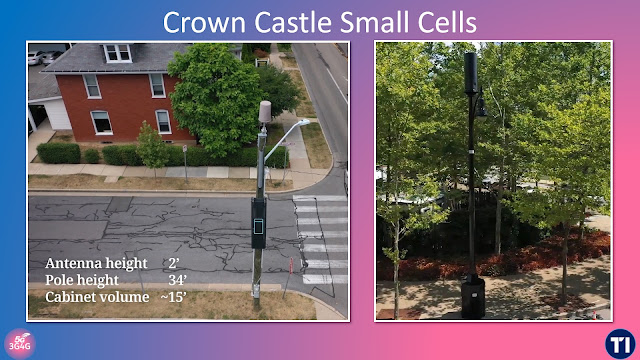
Crown Castle bringing more Small Cells to the USA

Crown Castle owns, operates and leases more than 40,000 cell towers and approximately 80,000 route miles of fiber supporting small cells and fiber solutions across every major U.S. market.

Earlier this month, T-Mobile US, Inc. and Crown Castle announced that the companies have signed a new 12-year agreement to support the continued build-out of T-Mobile's nationwide 5G network with increased access to Crown Castle's towers and small cell locations. The agreement enables the Un-carrier to further expand and deepen the reach of its industry-leading 5G network to serve consumers across the U.S. while also realizing financial synergies following its merger. The agreement also helps Crown Castle generate long-term tower and small cell revenue growth.

An RCR Wireless News article said:

Crown Castle secured commitments for over 50,000 new small cell nodes during the last twelve months, which equates to approximately 70% of the total small cells the booked in its history prior to 2021, the company’s CEO Jay Brown said in a release.

“As a result, we now have approximately 55,000 small cell nodes on-air and more than 60,000 committed or under construction in our backlog. Our customers are already planning for the next phase of the 5G buildout that will require small cells at scale, and this inflection in our small cells business reflects how well-positioned we are to support their wireless network needs for years to come, with our more than 80,000 route miles of fiber concentrated in the top U.S. markets,” the executive said.

“I believe 2022 will be an important transition year for our small cells and fiber business, as we prepare to accelerate our deployment of small cells from approximately 5,000 this year to what we expect will be more than 10,000 per year starting in 2023,” Brown added.

A Light Reading article from last year talked about a new report from Altman Solon. 

Altman Solon said it derived its findings from a database it constructed of small cells across more than 70 US markets. "Leveraging analysis of this database and augmenting with other primary and secondary research and our deep experience and knowledge base in the space for all small cell ecosystem players, Altman Solon has developed preliminary critical insights about the competitive landscape in the US small cell market," the firm boasted.

Among its findings:

  • "Small cell growth has been much slower historically than what industry reports have projected due to the regulatory climate, lack of neutral hosts, and limited backhaul," the firm wrote
  • Roughly 70% of the small cells it identified are located in dense urban and urban areas.
  • Crown Castle operates about 50% of all small cells identified, while mobile network operators like Verizon account for around 35%. Crown Castle operates about 50,000 commercially available small cells today, with another 30,000 on order. ExteNet Systems operates roughly 32,000 small cells across the country, while Mobilitie – recently acquired by Canada's BAI Communications – counts around 10,000 small cells.
  • Altman Solon identified very few neutral host small cells, which are small cells that transmit signals for more than one network operator. Such devices are considered critical to the growth of the industry considering neutral host small cells can generate significant revenues for the companies that operate them.

Here is a short video from Crown Castle explaining their view of small cells

Related Posts:

Sunday, 10 June 2018

Small Cells growing fast, just not in Europe


Small Cell Forum held a workshop in Beijing, China last month to gain an understanding of China’s perspective on densification on the path to 5G. Complete report is available here. From the report:

APAC leads the world in network densification, as is clear from recent market data and forecasts out to 2025. New deployments in South East Asia alone are set to be greater than the sum total of those in the rest of the world until 2025. APAC can be characterized as experiencing two phases of growth, with a small plateau from 2019-2021 as 5GNR small cells are being commercialized. Our survey of MNOs reveals that densification in APAC is primarily capacity driven, to ensure data services maintain their quality of experience as mobile traffic volumes continue to grow. CMRI (China Mobile Research Institute) predicted its data traffic would grow 8x from 2016-2020 and 119x from 2016-2030. Ericsson predicted 8x global growth from 2016-2022, and others cited Cisco VNI’s 7x global growth 2016-2021, dominated by APAC.

A summary presentation from the event is embedded at the end.

As per Mobile World Live's report from Small Cells World Summit last month in London:

Kicking off the event, David Orloff, chair of the Small Cell Forum said: “Small cells are integral for 5G, and the reality is that there are capacity needs, there are latency needs, and both of these aspects can be driven through integration with small cells.”

He observed: “Europe is lagging. We need a new mindset, we need to look at different ways on this – in the 5G era we do have densification needs in the entire global industry, and we need to work [out] solutions to ensure the framework is there and the foundations are there. We need to think differently.”

Speaking about the global rollout of small cell technology, he continued: “We see global synergies and global barriers, but we also see regional barriers that are delaying densification. A good example in the US is cell siting; in India there is a cost target that has to be met; in China there’s mindsets around operations; and in Europe there is a question around the business case and whether it is profitable to do densification.”

“Asia is cranking, North America is doing well, really preparing that framework and foundation and starting to deploy cells that are NR capable, so that we have a structure in place so that we can turn on 5G, working on mmWave. Europe is pretty far down.”

Notwithstanding this lag, Small Cell Forum forecasts an increase in the number of non-resident small cells deployed in Europe from 52,000 in 2017 to 310,000 in 2022. But mobile operator deployments are not the only game in town: enterprises are an important driving force due to quality of service and IoT requirements, and technologies including MulteFire and CBRS are easing the way for new players.


According to Crown Castle, in a report in Fierce Wireless:

The small cell market continues to expand, and Crown Castle’s Mike Kavanagh pointed to two big factors as evidence: Small cell buildouts are starting to happen in smaller, tier 2 markets, and some small cell locations are now serving more than one carrier.

Small cells are “a big part of every big carrier’s build,” he said. “It’s a good time to be in the space.”

In the early days of small cells half a dozen years ago, Kavanagh said that a major installation would cover 50 nodes in a city. Today that number is reaching 2,000—and in some dense markets it can grow to 7,000. “You’re utilizing small cells as a much bigger element of the network build,” he said. “You’ve got to have that tower layer. And you’ve got to have small cells.”

He said in some deployments Crown Castle is seeing 2 to 4 small cells per mile, and in some dense, urban areas that number grows to 7 to 12 per mile. Kavanagh, the company’s SVP of sales and its chief commercial officer, said that Verizon kicked off the push toward small cells, but today all of the nation’s largest wireless operators are embarking on major small cell deployments.

And a big driver of revenues for Crown Castle is the growing trend toward multitenant small cells, which Crown Castle calls “leasing up.” Essentially, Crown Castle typically builds a small cell for one carrier’s equipment, but increasingly the company is adding equipment for a second carrier to that location, thus deriving more revenues per small cell site. Such site sharing is typical in the macro tower business.


Finally, here is summary of presentation from SCF looking at APAC in detail with regards to drivers and barriers for densification.