Showing posts with label Telecom Infra Project. Show all posts

Wednesday, 21 December 2022

Details on India's First Neutral Shared RAN Solution

Back in August, RailTel and CloudExtel partnered to launch India's first Shared RAN solution for congested locations with the objective to enhance the telecom user experience. A press release said:

RailTel and CloudExtel carried out the successful pilot of this project in partnership with Bharti Airtel, Vodafone Idea, Nokia, and the Telecom Infra Project's NaaS Solutions Group, with vital support from the Railways, in one of the most network stressed locations, Mumbai Central railway station. The outcomes have been impressive with 5 times increase in average user speed (from 3Mbps to 15Mbps) for both Bharti Airtel and Vodafone Idea, while the data consumption jumped up by 20%.

At Telecom Infra Project's Fyuz 2022 conference, Kunal Bajaj, CEO & Co-Founder, CloudExtel provided details on this in a breakout session dedicated to Neutral Host Network-as-a-service (NaaS) business model. His part of talk is embedded below and you can also check out his presentation from the main stage here. 

In an interview with Economic Times earlier this year, Kunal pointed out:

How many small cell sites are there in the country at present?

Small cells are not just for 5G rollout. There is a substantial 4G component of it today. As per industry standards, there are over about 30,000 odd small cell sites that have already been rolled out. Of that, about one-third to one-half of those sites have been rolled out by Reliance Jio. The balance have been rolled out by Airtel and Vodafone, and of that we have the largest market share. We have done over 4,000 sites for these two telcos, and there are all primarily 4G sites.

What’s the demand like for 4G small cells?

Even in the 4G space, month on month, year on year, data consumption has continued to grow pretty substantially. We are at 19 gigs per user, per month today, and if I remember correctly, we were at 12 gigs just a year ago, and much lower than that before. And this is all coming from 4G. 5G is not there yet, and what that really demonstrates is the reliance that users have on wireless connectivity. We have don’t much fixed line infrastructure today in India to really speak of. 25 million fixed line broadband users is nothing compared to the over 500 million 4G subscriptions. This growth in 4G data densification, even with 5G auctions coming up, will continue for the next two years.

Going forward, will these 4G sites be converted to 5G, or that will be part of a separate infrastructure?

If you see what has happened historically, when we went from 2G to 3G, and more relevantly, when we went to 3G to 4G, the 4G sites came up wherever you have very high capacity usage on 3G. 3G was not taken away, but those sites were upgraded to dual technology, by upgrading the equipment and adding an additional 4G radio to bring up 4G traffic from those sites. And I think that’s exactly what we are going to see in the 5G environment. The good thing is a lot of telecom operators learned from the 3G to 4G transition, and started investing very early in hardware that would be upgradeable to 5G.

Obviously the radio band is different, and there’s nothing really you can do in software to make the same radio to radiate multiple bands. So there will be investment. That happens in radio ugprades, but the core base station technology, the back haul, switches and things like that, a lot of that is now software upgradeable, and therefore it is going to be hopefully a much easier transition from 4G to 5G.

So what’s your projection of the number of small cells that will come up with the 5G rollout from August?

Some of the industry projections that we see from a lot of analysts and consulting companies is that India needs somewhere around 2,50000 small cell sites in the next five years across all three of the major operators. What that basically means is over 5-6 lakh unique small cells to be deployed. So that’s a tremendous amount of growth that we are going to see. The first one or two years from now is primarily going to be 4G, but then after that, the huge acceleration, the hockey stick curve is going to come from 5G deployment.

What is the kind of investments you are looking at in the next five years to cater to this demand?

We are talking of hundred of crores, just for us. We are looking at our base growing from 4000 small cells to 40000 small cell sites in the next five years. That’s a conservative projection, obviously, we believe and hope that we can do a lot more than that, but that will require well over 400-500 crores for us to really pull that off, and that’s where the opportunity to scale and build a substantial network. Today, when you compare us to the mainline tower companies, we are still a startup and in the beginning of our first innings, so we have a long way to go.

There certainly is a bright future for Neutral Host Network-as-a-service (NaaS), especially in country like India, with a large population of young people.

Related Posts: 

Monday, 28 November 2022

NTT Docomo Expands Open vRAN Options in its 5G OREC

We have done quite a few blog posts on NTT Docomo on our blogs (see related posts at the bottom) as they always share a lot of latest useful and relevant information. In a blog post last year, we talked about their 5G Open RAN Ecosystem (OREC). 

Back in September, NTT Docomo announced that it will be adding a fourth type of flexible and highly scalable virtualized base station (vRAN) to its verification environment for Open RAN that will allow equipment and components of various vendors to integrate via standardized specifications. The press release said:

The new virtualized base station will combine NEC Corporation's open virtualized RAN software, Red Hat Openshift, Qualcomm Technologies, Inc.'s inline accelerator cards and Hewlett Packard Enterprise's servers. This will be DOCOMO's first time to use the Qualcomm® X100 5G RAN Accelerator Card and the HPE ProLiant DL110 Telco server, the latter optimized specifically for Open RAN workloads to improve system performance and power efficiency.

Since February, DOCOMO has been providing global carriers with access to its Shared Open Lab environment to allow them to mix and match the equipment and components of various vendors in order to verify performance with virtualized base stations. In addition to three types of virtualized base station equipment/system configurations that carriers have been accessing so far, the new configuration will become available for verification in the Shared Open Lab starting in 2023.

As the increasing global availability of 5G continues to raise interest in Open RAN, DOCOMO has been a leader in helping telecoms worldwide to prepare to introduce this highly versatile new technology. In February 2021, DOCOMO was joined by 12 global equipment vendors in establishing the 5G Open RAN Ecosystem (OREC) to promote Open RAN, which supported the development of the virtualized base station being announced today.

DOCOMO and its OREC partners plan to continue adding new equipment/system combinations before and after commercializing virtualized base stations, which is expected within the current fiscal year ending in March 2023.

Through the promotion of Open RAN, DOCOMO looks forward to continuing to enhance the efficiency and flexibility mobile communication networks around the world.

In fact their OREC page has this and a lot more details here.

At Telecom Infra Project's Fyuz 22 conference, NTT Docomo and other operators shared their vision, progress and approach to Open RAN. You can watch the panel discussion here.

Related Posts:

Tuesday, 4 October 2022

Disaggregated Networking for 5G - What is Needed to Make it Work?

The Open Optical & Packet Transport (OOPT) group is a project group within Telecom Infra Project (TIP) that works on the definition of open technologies, architectures and interfaces in Optical and IP Networking. We looked at a detailed webinar from OOPT here.

The Disaggregated Cell Site Gateways (DCSG) within OOPT works on the definition of open and disaggregated whitebox cell site gateway devices that operators can deploy in their current 2G/3G/4G cell sites, as well as in the upcoming 5G deployments. The team produces technical specifications that define software, hardware and API requirements that represent the needs of mobile network operators and also works with industry partners to develop devices that meet the specifications.

At TIP Summit Latam in 2021, Ulrich Kohn, Director, Solutions Marketing, ADVA presented a talk on Disaggregated Networking for 5G where he looked at disaggregating high-end routers, DCSG, strategies of making white boxes timing aware and finally, disaggregated synchronization solutions.

His talk is embedded below.

You can check out ADVA's portfolio of TIP products here.

Related posts:

Friday, 6 May 2022

Comba Telecom Helps Bring Open RAN to New Markets

Comba Telecom is a global leading wireless solutions provider with their own R&D facilities, manufacturing base, and sales and service teams. The company offers a comprehensive suite of products and services including wireless access, wireless enhancement, antenna and subsystems and wireless transmission to its global customers. Comba's core product portfolio includes antennas and subsystems and network products (DAS, Small Cells, Repeater, RRU, etc.), offering turnkey solutions for indoor and outdoor 2G/3G/4G/Wifi/5G to their global customers.

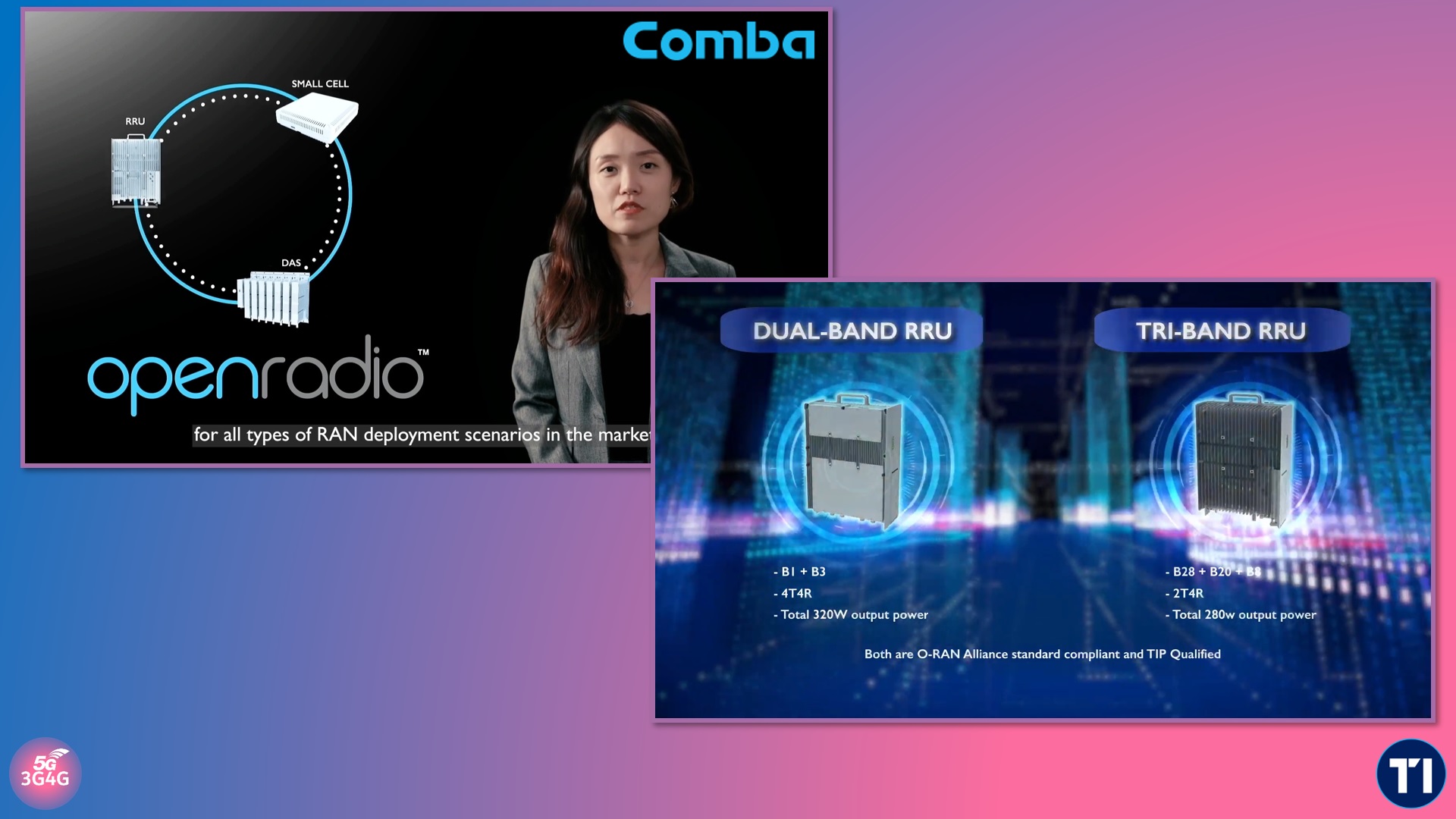
Last year, Comba announced the launch of the industry's first Open RAN multi-RAT, multi-band Remote Radio Unit (“RRU”) that supports 1800MHz and 2100MHz, promoting widespread adoption of emerging open standards in the globe. The announcement says:

The RRU is designed to minimize the total cost of ownership (“TCO”) for operators and neutral hosts in macro deployments through fast and easy deployment, energy savings, improved coverage and throughput, smaller footprint and easy maintenance. Engineered for efficient high power (320W) operation, the multi-RAT multi-band 4T4R RRU minimizes the environmental footprint and reduces the energy spend for the operator. 

As a first in the Open RAN industry the GSM/UMTS/LTE/5G NR multi-mode operation makes it ideal for simple upgrades of legacy sites without compromises. The 4T4R radio supports two LTE/5G NR carriers per band and Dynamic Spectrum Sharing (“DSS”). This enables operators to serve arising 5G traffic demand without additional spectrum or removing LTE service.

Comba has a long-standing collaboration with major industry partners and alliances and has participated in the initial Open RAN trials and lab projects in different regions. With all in-house expertise in interoperability and optimizing radio designs for market specific criteria, Comba enables mobile operators to accelerate time to market, and mitigate the overall technology risk when adopting to Open RAN strategy in their next generation of RAN. 

A recent video looks at these Open RAN Multi-band RRUs

While most Open RAN RUs are focused on 4G & 5G, Comba's radios work on 2G & 3G as well. This has allowed them to bring Open RAN solutions to many different parts of the world that may not be ready for 5G yet. Some of these include announcements with their software partner Parallel Wireless in Latin America and Indonesia. Another recent standalone announcement included one with Turkcell in Turkey.

Telefonica also listed them as one of the partners in a presentation at MWC

Telecom Infra Project's TIP Exchange features quite a few radios from Comba which you can see here.

If you are interested in learning more, what the Comba keynote and Panel Discussion on Maturity of Open RAN Adoption at MWC22 Open RAN Summit below:

Related Posts:

Thursday, 7 January 2021

TIP Announces Total Site Solution (TSS) for Ultra-Rural Network Deployments

Telecom Infra Project (TIP) and its members have developed a Total Site Solution (TSS), an optimized, lean site configuration specifically adapted to ultra-rural environments. TIP announced the solution back in December. A clear idea can be obtained from the excellent video accompanying the announcement as follows:

The press release says:

Deploying reliable and high-speed networks to ultra-rural communities has long been one of the greatest challenges for the telecoms industry. The combination of lower population densities, lack of existing infrastructure, and availability of local expertise means that expanding networks into these areas has traditionally not been economically viable, leaving significant areas of the world unconnected. To help catalyze the industry to find a solution to this challenge, the Telecom Infra Project (TIP) and its members have developed the Total Site Solution (TSS), an optimized, lean site configuration specifically adapted to ultra-rural environments.

The solution which incorporates a range of essential elements, including low-power RAN equipment, off-grid energy solutions and satellite backhaul links, has been created by a diverse group of technology partners, including vendors and local system integrators, who have built, tested, and validated each of the necessary elements and their interoperability, as well as their ability to work with TIM Brasil’s core network.

The first TSS use case targets greenfield deployments to off-grid populations of less than 5,000 people, looking to address mid to low amounts of data consumption, through a “Town Center Model” for 4G coverage and supporting VoLTE for voice service.

For the use case, TIM Brasil created the technical and business use case requirements in a Pilot Program. Initial lab trials were then conducted at TIP’s Community Lab in North Los Angeles, California, in collaboration with vendors BaiCells (RAN); Morningstar (power systems); and Gilat (satellite backhaul links) to evaluate the interoperability of the elements. After the validation in the labs, local system integrator partners WLLCTEL and Zurich/Amerinode created cost-optimized site designs tailored for ultra-rural environments. Two test sites were subsequently built to prove the design and to simplify the construction process of the sites, after which TIM Brasil conducted a field trial to test the effectiveness of the solution in preparation for market trials and commercial deployments.

TSS has now gone through TIP’s Rural Site Configuration PlugFest which has expanded the initial configuration to include additional RAN (Airspan, Parallel Wireless, VNL) and VSAT backhaul equipment vendors (including ST Engineering iDirect), and validated them against a comprehensive test plan. These proven configurations are now listed on TIP Exchange and PlugFest, making them available to all members for further trials of TSS in other areas of the world.

Next steps for the TSS project include:

  1. Sharing ultra-rural TSS test plans, site installation runbook, and RSC PlugFest summary with TIP community (linked on TSS website)
  2. Working with additional partners globally to launch the proven ultra-rural TSS configuration into networks, bringing more unconnected people online
  3. Working with ecosystem partners across the NaaS Solution Group to apply the proven TSS incubator model to develop additional NaaS use-cases
  4. Market trial with TIM Brasil in the first half of 2021

The TSS sub-site has documents and additional details here.

Related Posts:

Thursday, 5 November 2020

OpenSoftHaul - Disaggregated White Box Solution from TIP

Telecom Infra Project (TIP) is on a mission to disaggregate all network components so backhaul is no exception. OpenSoftHaul (OSH) is a wireless backhaul transport solution, adopting the principles of an open and disaggregated architecture as can be seen in the picture above. A detailed specification is available here. 

Axiata, Deutsche Telekom, MTN, Telefónica, and TIM Brasil have been coordinating a joint RFI to assess the global technology landscape for building the first-in-the-world service providers-driven Open and Disaggregated wireless backhaul solutions as a part of the Telecom Infra Project’s Wireless Backhaul Project Group (WBH PG). A press release on their website said:

The industry’s leading hardware and software technology providers have been asked to participate in the RFI, share information on their current technical capabilities, and supported features to measure the level of compliance and their plans to build solutions that fulfill the OpenSoftHaul (OSH) technical requirements developed in TIP.

“The Wireless Backhaul Project Group is a multi-operator led program. By having worked together since the ideation phase, we decided to execute a joint RFI to maximize the demand signal to the industry and the technology makers to accelerate innovation with solutions that will promote deployment flexibility and will lead the way in automation and operational efficiency,” said Dimitris Siomos, Principal Network Expert at Deutsche Telekom Group.

Multiple technology providers have answered the RFI, focusing on one or multiple components of the wireless backhaul system and have gone through a detailed technical evaluation with the operators of all RFI answers based on the following criteria: solution architecture, openness, functionality, scalability, availability & solution roadmap.

Following the technical evaluation, the operators have identified the following best positioned suppliers (in no particular order) :

  • For HW ODU : Aviat Networks, Ceragon, Intracom Telecom & SIAE Microelectronica
  • For HW IDU : Alpha Networks, Ceragon, Delta, Edgecore Networks & UfiSpace
  • For NOS SW : Aviat Networks, Ceragon, Adva Optical Networking, IP Infusion, Altran, Exaware & Infinera

The technical specifications document, represents the alignment of the operators on the transformation needed in the wireless backhaul technology. Together, they have defined the key aspects of an OpenSoftHaul product, including performance, openness, standardized interfaces, scalability, flexibility of deployment, operation, automation, and total cost of ownership.Earlier this year, the WBH PG published the technical specifications document of the OpenSoftHaul (OSH) solution.

The technical specifications document, represents the alignment of the operators on the transformation needed in the wireless backhaul technology. Together, they have defined the key aspects of an OpenSoftHaul product, including performance, openness, standardized interfaces, scalability, flexibility of deployment, operation, automation, and total cost of ownership.

The OpenSoftHaul RFI announcement webinar also provides a lot more details on OSH. It is embedded below.

OpenSoftHaul RFI Announcement from Telecom Infra Project on Vimeo.

Disaggregation is expected to play a huge role in future networks where operators are looking for plug and play components from multiple vendors to reduce dependency on any single vendor as well as reduce the TCO. We will start seeing some major rollouts of this in the next couple of years.

Related Posts:

Monday, 24 August 2020

Leveraging Streetlights for the Digital Future

If you are a regular reader of this blog then you will know we love lamp posts, street lights and poles. There are quite a few posts whose references you can find at the end of this post.


The mmWave Networks group at Telecom Infra Project (TIP) have recently released a new whitepaper, Leveraging Streetlights for the Digital Future. Street fixtures like lamp posts, light poles, traffic signals and other vertically-oriented assets that provide line of sight to targeted facilities and residential areas were identified as having a huge potential for rapid deployment of high speed future broadband networks (including 5G) in the TIP Playbook for Smart Cities.


This new whitepaper looks at "Deployment of high capacity urban mobile networks and smart city applications converges on assets in the public space, such as streetlights. This study and analysis deepens the understanding of the obstacles to deploying on streetlights today and points to possible pathways to accessing such assets to enable fast and flexible deployments"


Quoting from the whitepaper:

In a Digital Networks Working Group handbook by the Federal Ministry of Transport and Digital Infrastructure (Germany), streetlighting infrastructure has been identified as being very suitable in comparison to other street fixtures.

Deutsche Telekom initiated a study to explore such fixtures and possible pathways to accessing them. Before tackling any challenges, we wanted to understand what the "landscape of the players' ecosystem" looks like, what drives it, what slows it down or stops it from moving, how it works today, and what may need to change.

We did this specifically for our German home market, but feel confident that the study results can serve as pointers for the challenges and opportunities this asset poses for many other markets. We also believe the political and legal challenges will be very similar for similar assets apart from streetlights.

The study set out to describe the rules and regulations of public administration, public economy, and public law to which this infrastructure is subject, as well as to identify challenges, opportunities, and potential for its future design.

We chose a design thinking approach because we need to understand the players and stakeholders who control this infrastructure. And we wanted to undertake this before assessing what can and should be done with these potential assets to enable comprehensive broadband coverage and smart city development.

The whitepaper is available here.

Related Posts:

Monday, 20 April 2020

SuperMicro's 5G Pole-Mounted DU Server Solution

Back in December 2019, Supermicro launched Server Class Edge Systems for Open 5G Radio Access Network (RAN) Solutions. These new SuperServers offer O-RAN Open-Platform Software, Intel Xeon Scalable Processors, GPUs, FPGA and IP65-rated protective enclosures for Pole-Mounted Cell Tower Deployments. The solutions for 5G cell tower deployments leverage fully-configurable SuperServers based on 2nd Gen Intel Xeon Scalable processors and Intel Xeon D processors, O-RAN compliant partner software, and ability to operate in harsh environments. These capabilities accelerate the mobile network evolution from proprietary hardware/software to open source software and disaggregated hardware for 5G installations.


The press release states:

“Supermicro’s data center customers and global telecommunication operators are asking for non-proprietary disaggregated hardware and software 5G solutions supporting multi-vendor web-scale networks, said Charles Liang, president, and CEO of Supermicro. “Supermicro’s new SuperServer solutions provide the 5G network infrastructure with maximum deployment flexibility and efficient total cost of ownership (TCO).”

Supermicro’s two new systems are its first servers for 5G, the Intelligent Edge, and other embedded applications to be based on 2nd Gen Intel Xeon processors. The E403-9P-FN2T is built for demanding environments and includes three PCI-E slots for GPU and FPGA accelerator cards. The compact 1U 1019P-FHN2T is well-suited for controlled environments such as micro data centers and re-purposed central office locations and features two full-height full-length PCI-E slots.

With these expansion slots, Supermicro can provide real-time Edge AI inferencing via GPU cards, and accelerate 5G RAN software and open-standard site-to-site communication using the Intel FPGA Programmable Acceleration Card N3000. These new servers complement Supermicro’s successful Intel Xeon D-based 1019D and E403 models. Supermicro is developing IP65-rated protective enclosures to meet the needs of outdoor environments such as cell towers and microcell sites.


5G Physical Layer splits can be seen in the picture above. While 4G used the BBU + RRU/RRH architecture, 5G will have a Central Unit (CU) and a Distributed Unit (DU). A Radio Unit (RU) may be present in some scenarios as well.

The Outdoor Edge Systems page on their website provides more information about the Pole-Mounted IP65 Server Platform for 5G and the Intelligent Edge. We will end with a video that depicts their vision


Related Posts:

Tuesday, 7 April 2020

TIP Webinar on Open Optical & Packet Transport (OOPT)

The Telecom Infra Project (TIP) Open Optical & Packet Transport (OOPT) group is a project group within Telecom Infra Project that works on the definition of open technologies, architectures and interfaces in Optical and IP Networking.

The project is an engineering-focused effort led by major operators, technology vendors and research institutions. It concentrates on different parts of the Transport network architecture, including optical transponders, line systems, IP access devices, open APIs and network simulation and planning tools.


TIP held a public webinar on 25th March with a lot of details about the group and the different projects within the group. The webinar is embedded below:
OOPT Public Webinar March 2020 from Telecom Infra Project on Vimeo.

You can jump to the part that may be of interest to you:

02:20 - Welcome & Introduction to TIP, Attilio Zani (TIP)
12:30 - Introduction to Open Optical & Packet Transport (OOPT) Project Group, Víctor López Álvarez (Telefónica)
23:00 - Disaggregated Cell Site Gateways (DCSG), José Antonio Gómez (Vodafone) & João Gabriel Evangelista Aleixo (TIM Brasil)
41:00 - Disaggregated Optical System (DOS), Johan Hortas (Telia)
45:00 - Cassini Overview, Jeff Catlin (EdgeCore) & José Miguel Guzmán (Whitestack)
1:00:00 - Phoenix Overview, Anders Lindgren (Telia)
1:09:00 - Disaggregated Optical Routers (DOR), Kenji Kumaki (KDDI)
1:17:00 - Physical Simulation Environment (PSE), Gert Grammel (Juniper) & Gabriele Galimberti (Cisco)
1:28:30 - Control, Information Models and APIs (CIMA), Harald Bock (Infinera) & Stephan Neidlinger (ADVA)
1:38:30 - Converged Architectures for Network disaggregated & Integration (CANDI), Oscar González de Dios (Telefónica) & Hirotaka Yoshioka (NTT)
1:52:30 - OOPT NOS – Goldstone, Kingston Selvaraj (PaIC Networks)
2:02:00 - Closing Remarks, Víctor López Álvarez (Telefónica)

Sunday, 24 November 2019

5G CrowdCell: World's First 5G OpenRAN Small Cell

I explained about Open RAN in a tutorial here. In the recent TIP Summit, there was a lot of discussion of Open RAN. In their presentation, Miguel Marin, Technology Director, AMAP, Vodafone talked about world's first 5G OpenRAN small cell. Known as the crowdcell, it can be seen in the picture below.


I wrote about Crowdcell earlier here. While it was more in an initial stage then, it is already working and under trials in Turkey. The video below shows a demo of crowdcell from TIP Summit 2019


You can learn more about CrowdCell on TIP website here.

This video from Lime Microsystems from last TIP Summit explains the CrowdCell concept.

TIP Summit 2018 from Lime Microsystems on Vimeo.

It should be borne in mind that the TIP website says that CrowdCell is intended for extending indoor coverage. Sprint's / Airspan's MagicBox is solving exactly the same issue. You can read more about that here. The only real difference here is that CrowdCell is based on OpenRAN architecture and principles.

Parallel Wireless has a similar solution for outdoors. You can read more about that here and here.

Related Posts and Articles:

Wednesday, 7 November 2018

MTN sees future in 3G

I blogged about MTN last year after their presentation at Facebook's TIP Summit. This year again, another MTN Group executive, Babak Fouladi, Technology and Information System (Group CTIO) at MTN delivered an insightful talk. I have my summary below with video embedded at the end.


MTN has 223 million subscribers. Out of that only 72 million are data users, the rest are primarily voice users. The problem with that is their monthly spend is very low.


The typical entry and emerging segment customers in rural areas spend 30% of their incomes on food and often have limited access to reliable basic services. Its very tricky to convert these users to use high amount of data or any data at all in many cases.

5 Challenges known as CHASE need to be overcome to reach the volume segment. These are:

  • Coverage: Data Coverage is insufficient in rural or low income areas and costly
  • Handsets: Limited affordability and access to data enabled devices
  • Affordability: Data services are unaffordable in some markets
  • Service Bundling: Bundling and selling of data are unnecessarily complex and not regionally relevant
  • Education: Lack of digital literacy & awareness of the potential of broadband content

To overcome these challenges, a dual data strategy is needed. Newer technologies, ultra high speed & superior customer experience for high value segment. Ubiquitous low cost data coverage for volume segment.
There are many rural coverage barriers. These practical challenges hinder the rollout. The main being that there is no infrastructure in place, the roads are inaccessible, there is no power, the security is poor, etc.
To solve the challenges due to rural coverage barriers, MTN has defined three solution categories for rural:

  1. Rural Site - 50 to 100 km from urban
  2. Ultra Rural Site - Very low population densities locations
  3. Ultra-ultra Rural Site - Very small remote villages

MTN are already doing field trials with AMN and Huawei. With Huawei, they are using the RuralStar (see earlier post here). Other vendors listed above are working with them in the labs and will be trialed for Ultra and Ultra-ultra rural sites.

Their main motivation for working with Facebook and TIP is to find affordable solutions for Ultra and Ultra-ultra rural locations. There is a large scale trial happening soon in 2 countries, 120 sites in total.
One of the challenges in African market is that the average lifespan of handset is 7 years. What this means is that many people still on 2G today will be migrating to 3G in near future. As a result, 3G will be the most dominant technology in Africa in 2025.

While most operators and vendors are focusing on 4G and 5G, there is still going to be a big market for 2G and 3G in 2025. These users cannot be ignored and the operator that serves them well will eventually be the winner.


Further Reading:

Tuesday, 20 March 2018

CrowdCell heads for TIP

Recently I wrote about Facebook's Telecom Infra Project (TIP) here. The following is from a recent announcement coinciding with MWC:

In our existing project groups, there are numerous TIP technologies that are moving from the lab stage to field and production trials. Each trial has operator sponsorship and includes key members of our technology ecosystem. Together, these TIP teams are working to validate technologies, share learnings, and accelerate toward commercialization at scale. Simultaneously, TIP members are contributing designs and specifications for new technologies and building new network tools.

Our TIP community is also growing and expanding in scope to address new challenges. Over the last month, TIP has added three new project groups and subgroups: Crowd Cell, Power and Connectivity, and Disaggregated Cell Site Gateways. At MWC, we are also announcing a new TIP community lab near BT’s Adastral Park campus in the UK and more than €100 million in venture capital funding available for infrastructure-focused startups participating in the TIP Ecosystem Acceleration Center (TEAC) in Germany.

In addition, we are excited to welcome some of TIP’s newest members: China Unicom, Sprint, and Telenor. They join more than 500 companies around the world that are active within TIP.
...

Crowd Cell is a new project group led by Vodafone. Crowd Cell is a concept based on relay architecture to help extend the range of existing cellular networks. Due to its plug-and-play design, Crowd Cell can be a rapid and low-cost small cell solution for traditional 4G networks. This project will focus on creating a Crowd Cell by leveraging generic hardware and open source designs for software to minimize costs through this “one design” flexible platform.
...


I blogged about the CrowdCell concept back in 2016 here. Then there were updates on the CrowdCell at MWC 2017 which I blogged here. This year, as the TIP announcement says, Vodafone is taking the CrowdCell to Telecom Infra Project. The following is from Vodafone's announcement:

Vodafone is developing new technologies designed to enable the cost-effective deployment of base stations in currently unconnected areas of Africa and India. The deployment will be supported by Vodafone’s new Open RAN technology and Facebook’s OpenCellular wireless access platform, which were developed within the Telecom Infra Project (TIP).

Open RAN technology significantly reduces the costs of rolling out networks in rural areas, fundamentally improving the economics of providing data and voice services to millions of unconnected people.  This new approach is expected to reduce the cost of radio network equipment by up to a third.

Vodafone also believes Open RAN technology will jump-start the establishment of an end-to-end industry of software and hardware vendors and integrators that will drive innovation, which is critical for achieving such a complex endeavour.

Picture Source: Michael Thelen

Vodafone has already conducted successful trials in India with two new vendors that have developed bespoke high-power base stations using software-defined radio and general purpose hardware based on Vodafone’s specifications and support. Wider scale trials are planned for later in 2018 where up to 200 sites will be equipped with the new technology. Tests are also currently ongoing in South Africa with TIP´s OpenCellular platform for 2G and 4G services.

This OpenCellular technology is being showcased at Vodafone’s booth at Mobile World Congress 2018.

Vodafone joined the TIP board in November 2017 and is a founding member and co-chair of TIP’s Open RAN project group, which aims to develop fully programmable RAN solutions based on general purpose processing hardware and disaggregated software. TIP is an engineering-focused initiative driven by operators, suppliers, integrators and startups to disaggregate the traditional network deployment approach.

The acceleration and expansion of this collaborative trend – embodied by TIP – will lead to significant change in the telecom industry and provide the ability to connect millions of people in rural communities for the first time.

Other TIP initiatives in which Vodafone is playing a major role include:
  • Vodafone is leading a TIP working group to develop a new, open version of CrowdCell. The award-winning CrowdCell technology – developed by Vodafone’s Networks Centre of Excellence in Madrid – makes networks more “localised” to deliver faster download speeds and enhance the network’s reliability. For more information: http://www.vodafone.com/content/index/what/technology-blog/crowdcell.html
  • Beyond radio, Vodafone and TIP are working together with Cumulus, Zeetta Networks and the University of Bristol’s High Performance Networks Group on evolving Voyager, the industry’s first white-box transponder and routing solution. Vodafone will demonstrate Voyager’s capabilities in a trial in April.
  • Vodafone is also founding a new TIP sub-group within the Open Optical & Packet Transport project group focused on transport on disaggregated cell site gateways. Similar to the gateways in radio, these would reduce the current vendor lock-in that operators face in transport networks. Cell site gateways will be also based on off-the-shelf hardware, open software and interfaces on a technology agnostic platform.

Here is a slide deck that I prepared and shared on 3G4G blog here. The part embedded below starts from Vodafone section.


Happy to hear your views on TIP or Vodafone's CrowdCell announcement. Please add them as comments.

Monday, 29 January 2018

Ultimate Guide to the Telecom Infra Project (TIP)


Some of you may have noticed that I am a big fan of Facebook's Telecom Infra Project (a.k.a. TIP). I blogged about the TIP summit in 2016 here, BT/EE Mansoor Hanif's presentation on Airmasts here and MTN Navindran Naidoo's recent presentation here.

Telecom TV has done an excellent Ultimate Guide to the TIP project here. The video from that is embedded below.


Monday, 4 December 2017

MTN: Connecting Rural & Remote Africa


The annual Telco Infra Project (TIP) Summit took place recently in California. As always, there are some great presentations that have all be shared online here.


The video of the presentation is embedded below but the two images above are the main points of discussion from this presentation. The first image shows the challenges and possible approaches to solve them. The second one highlights the important point that the traditional infrastructure costs are just too high to provide connectivity in rural and remote locations.

A slightly surprising point that the speaker, Navindran Naidoo, Executive, Network Planning & Design, MTN Group brought up was that they are still looking to rollout 3G networks. In an earlier post on 3G4G blog, I talked about how the developing nations will ditch 3G in favour of 2G & 4G so this is a bit of a surprise. Even the OpenCellular project is focusing on 2G & 4G as can be seen below.


Steve Song in his blog post here highlights some good points. He points out that not enough 4G devices have reached African markets, VoLTE has still not matured and also operators have 3G spectrum available today or they can re-farm 900MHz.

Anyway, here is the video from Navindran Naidoo, Executive, Network Planning & Design, MTN Group in TIP Summit 2017.