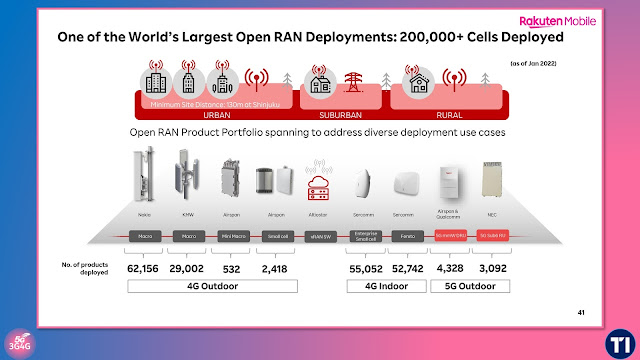
During the Full Year and Fourth Quarter 2021 earning call, President of Rakuten Mobile, Yoshihisa Yamada gave a short summary of the progress of the mobile network. During that, he also showed the Open RAN product portfolio spanning to address diverse deployment use cases.
The portfolio can be seen in the picture above and you can listen to his part of the talk in the video below:
We wrote about Nokia's 5G Small Cells late last year and about AirScale indoor Radio (ASiR) Small Cells back in July. Now they have just announced the launch of the Nokia Smart Node, a unique indoor mobile module solution delivering high-quality 4G and 5G indoor mobile coverage for residential and small-medium enterprise use. In simple words, a modular 4G/5G femtocell.
Nokia has "launched" its 4G/5G Smart Node femtocells. Says will be available Q4 2021. In October 2020 it announced this product would be based on Qualcom FSM100xx platform. Today's release: https://t.co/sbBlyOOWrb October release: https://t.co/63T4HAsm5a
The compact, ‘plug and play’ modular design can be deployed readily in any environment to support evolving consumer applications. It is future-proofed to support 4G now and 5G networks when required and both non-stand-alone and stand-alone 5G applications through a software upgrade. Nokia Smart Node is available from Q4 2021.
Stylish, durable and smart, Nokia Smart Node is a dedicated indoor mobile solution with superior coverage and capacity and can be easily scaled from single to multiple units to meet total indoor coverage requirements. Its high-quality coverage, latency and reliability delivers ubiquitous 5G connectivity for specific use cases such as immersive entertainment. The ‘plug and play’ capabilities also make it easy to set up, which keeps installation costs to a minimum. It can be wall, ceiling or desktop mounted.
Nokia Smart Node supports traffic management by reducing core network load and optimizing macro resource allocation. It delivers uncongested high throughput network performance with existing secure authentication and provides a secure connection and SIM-based authentication to assure the quality required in mobile networks.
Nokia is marketing the solution to both enterprises and carrier customers. For enterprise customers, the vendor promotes the femto as part of a mobile network that can offer “hack proof” security, without requiring IT managers to understand and install complex security solutions. The Smart Node security solutions include digital certificates, IPSec for encryption with IKEv2, and firewall and tamper alarms.
For network operators, a 5G femto can provide local breakout and reduce operating costs, according to Nokia. Whereas an outdoor small cell near an enterprise will require power, backhaul and real estate, an indoor solution lets the enterprise itself cover these expenses. The downside, of course, is that indoor solutions typically support just one enterprise customer while outdoor small cells could support several.
More information on Nokia Smart Node Femtocells is available here.
It is worth pointing out that many operators are choosing to phase out their indoor femtocell offerings in favour of Wi-Fi calling (VoWiFi). One such example is Vodafone UK who have announced that their Sure Signal femtocells will be switched off by September 2021.
In addition, Wireless Wireline Convergence (WWC) in 5G is also expected to make access connectivity independent of the core services by allowing connectivity over Wi-Fi. This will accelerate phasing out of femtocells in future.
We looked at Nokia's Airscale Indoor Radio Small Cells only recently. In addition their small cells keep popping up in the news on a regular basis; see related posts below. There has been quite a few announcements by Nokia on 5G small cells recently, so here is a summary:
Nokia announced that its market-leading Smart Node portfolio of All-in-One base stations for 5G indoor use will be powered by Qualcomm Technologies, Inc.’s unique chipsets. The press release says:
The product, which leverages the industry-leading Qualcomm 5G RAN platform for small cells, is designed to deliver ubiquitous indoor 5G coverage for residential and enterprise networks. The new 5G Smart Node complements Nokia’s portfolio of 5G Small Cells such as the AirScale Micro Remote Radio Head and AirScale Indoor Radio, which are commercially deployed by many operator networks globally to boost 5G capacity and coverage. It is expected to be available from Q1 2021.
Nokia is working with Qualcomm Technologies to bring its 5G RAN technology into Nokia’s Smart Node portfolio, delivering 5G in a compact, cost-effective plug-and-play package for smaller indoor network use-cases. Nokia’s use of Qualcomm Technologies’ innovations will enable 5G deployment at a significantly lower price point and smaller form factor, lowering the barriers to entry into the 5G-powered world. The working relationship underscores Nokia’s commitment to selecting best-in-class partners for the delivery of unmatched solutions within the industry’s only end-to-end 5G portfolio.
Nokia 5G Smart Node, based on the Qualcomm 5G RAN platform, is a low-power, flexible mount product that enables operators to address 5G network densification and indoor coverage requirements. Easy and quick to install, 5G Smart Nodes are a cost-effective way to extend the availability of 5G across multiple locations and provide a compelling option for in-home, small office and enterprise coverage.
With 80 percent of mobile sessions initiated indoors, home and small businesses remain a hub of mobile device use, making high-quality indoor 5G coverage a necessity. Many 5G frequency bands, especially those with wider bandwidths, cannot penetrate buildings due to propagation losses; this makes 5G Smart Nodes a great option for home and small office coverage. Where total cost of ownership (TCO) is a key factor, 5G Smart Nodes deliver reliable voice, data and services over 5G with minimal overheads and do not require any specialist in-house expertise for installation.
The modular design of the Smart Node solution offers ultimate flexibility and is easy to upgrade from 4G to 5G, touch-safe, and deployable on tabletops, ceilings or walls. Now with the inclusion of the Qualcomm FSM100xx software-defined small cell modem, software upgrades allow for simplified advancement to future mobile network standards and releases. Features such as Narrowband IoT support for low-power, wide-area coverage, emergency helpline services, local break out and telecom grade security help operators address indoor network needs without the complexity and cost of a macro deployment.
Nokia’s portfolio of residential and small-medium enterprise small cells caters to the full range of consumer and enterprise requirements. Working together with Qualcomm Technologies brings 5G to more locations and environments than ever before. The unmatched price point of the 5G Smart Node offering has been achieved through unique optimizations to the all-in-one architecture, pushing the boundaries of the intended use-cases.
Our understanding is that Nokia (and former Alcatel-Lucent, which is part of Nokia now) already uses Qualcomm chipset for it's small cells and femtocells.
There's lineage here because the Nokia femtocells (Smart Node) are (I think) of Alcatel-Lucent heritage - and Alu and Q had/have been partners for years. https://t.co/63T4HAsm5a
In other news, Nokia announced that they have won 5G small cells deal in Taiwan with Chunghwa Telecom (CHT). The press release says:
Nokia today announced that it will provide Taiwanese mobile operator, Chunghwa Telecom (CHT) with a range of products from its innovative small cells portfolio to support CHT’s initiative to deliver comprehensive 5G coverage. CHT is the first operator in Taiwan to deploy a 5G non-standalone (NSA) small cells solution enabling instant 5G coverage in specific areas such as business as well as tourist districts. Nokia has already commenced deployment and has installed 140 5G small cells to date.
Nokia has been a long-term partner of CHT, since the 2G era. The deal will see Nokia supply CHT with its flexible AirScale indoor Radio (ASiR) solution for better indoor coverage and capacity, as well as its AirScale micro RRH for outdoor and urban hot spots. These will be deployed to complement the existing base of over 2,500 sets of 4G small cells. Nokia’s 5G small cells portfolio is quick to install and enables operators to address 5G network densification and indoor coverage requirements. With enterprise being a key 5G market CHT is working closely with local small to medium-size enterprises to provide secure 5G coverage to enable industry 4.0 automation. Approximately 80 percent of mobile sessions are initiated indoors from homes and businesses and high-quality indoor 5G coverage is pivotal to ensuring a good end-user experience.
Nokia has been working with CHT for a long time and have numerous press release and announcements with them. The following video from 2016 shows Small cells & Mobile Edge Computing being deployed in a stadium to cover all the bases for Taiwan baseball fans.
The small-cell contract award comes hard on the heels of 5G wins with Taiwan Mobile and Asia-Pacific Telecom (APT), as well as a 5G RAN contract from CHT earlier in the year.
CHT is also buying RAN equipment from Ericsson, and using the Swedish supplier as its sole provider of 5G core equipment (Ericsson is mopping up a fair bit of 5G business in Taiwan, too). But the operator opted for Nokia when it came to a 5G non-standalone (NSA) small cells solution: the AirScale indoor Radio (ASiR), for better indoor coverage and capacity, and the AirScale micro RRH, for outdoor and urban hot spots. Coverage is aimed at specific areas, such as business and tourist districts.
More details of Nokia's Small cells and Smart Node femtocells here. Femtocell products here.
Here is an interesting talk from recent HITBSecConf by Xiaodong Zou. HITBSecConf or the Hack In The Box Security Conference is an annual must attend event in the calendars of security researchers and professionals around the world. Held annually in Kuala Lumpur, Malaysia and Amsterdam in The Netherlands, HITBSecConf is a platform for the discussion and dissemination of next generation computer security issues.
Femtocells offer a user the ability to have a small base station located within their house or other area. These small base stations provide access to the core telecom network where poor reception from an eNodeB would normally prevent consistent coverage. Femtocells has been standardized in LTE since release 8, and is referred as Home eNodeB, or HeNB. HeNBs are mandated to have an IPsec connection back to a security gateway (SeGW) to protect traffic flowing into and out of a Mobile Network Operator (MNO)’s core network. If the HeNB is within the physical possession of an attacker, this provides unlimited time to identify a flaw on the HeNB. A compromised HeNB can be used in a manner similar to a rogue base station, but will also provide the attacker access to clear text traffic before it is sent back to the core network. There are more than ten different types of HeNBs deployed in China. Ericsson ENC-nRBS01B40 is one of them – a TD-LTE base station working on band B40. In this talk, we will cover: 1.) How to root a 4G LTE femtocell. 2.) How to make the femtocell portable. 3.) How to perform man-in-the-middle attack with the femtocell. 4.) Show the prototype of Hacking Box of S1 Interface (HBoS)
Came across this slightly old news in March issue of ETRI Webzine:
Following the development of the LTE small-cell base station SW in 2016, ETRI announced on February 7 that it successfully developed a SW supporting LTE-TDD dual connectivity. These technologies are evaluated as core technologies for future 5G communication through upgrading of conventional SW technologies, since they may be applied to buildings, stadiums, and homes. The technologies are suitable for the locations where the traffic is rapidly increased, such as stadiums, department stores, disaster-stricken areas, and military camps. The small cells may be attached, like a wireless LAN AP, to walls inside and outside buildings, utility poles, and communication antennas, or may be carried in the form of a backpack. The research team explained that the size of the small-cell was minimized as the size of a wireless LAN AP for indoor purposes and as the size of a shoe box for outdoor purposes. The small-cell backpack weighs about 10 kg. These accomplishments will remove the communication shadows and blind spots between cells, and will help to develop independent technologies by replacing the conventional products from other countries.
In a more recent news on this topic (September 2018):
Following the successful localization of software for LTE Small Cell, which is used in the same manner as wireless access points operating within tens of meters to 1 km, while serving as a small base station, ETRI researchers began research to localize small cell equipment essential to establishing 5G infrastructure going forward. The focus of the research is on the development of technology capable of increasing the maximum transmission speed (eMBB), which is one of the most critical criteria for 5G technology, and especially the perceived transmission speed on the user side.
According to Yonhap News (translated by Google translate):
SK Telecom will be participating in 'Intelligent 5G Small Cell Technology Development Task' together with Korea Electronics and Telecommunications Research Institute (ETRI), domestic wireless communication equipment company Teltel and U Cast. The project is sponsored by the Ministry of Science, Technology and Information and is organized by ETRI. In this project, SK Telecom sets up requirements for small cell system development. In addition, ETRI and equipment companies provide a test environment for small cell equipment verification. ETRI develops software, and Contela and Yu Cast develop hardware. SK Telecom and other collaborative research groups plan to open API (application programming interface) to small cell. This reduces the burden of SMEs and start-ups to develop their own interfaces. SK Telecom and ETRI are planning to develop international standard technology and secure original patents in the small cell field based on research results.
SK Telecom announced on February 23 that it will participate in 'Intelligent 5G Small Cell Technology Development Task' together with Korea Electronics and Telecommunications Research Institute (ETRI), Kontela and U Cast of domestic wireless communication equipment. A joint research team is taking a commemorative photo in front of the first workshop at Daejeon ETRI fusion technology research and production center. 2018.8.23
SK Telecom Park Jong-kwan, director of Network Technology, said, "In the 5G era, 80% of total traffic will occur indoors." "We will take the lead in 5G technology development so that customers can fully enjoy virtual reality and hologram services."
Small Cell Forum recently released the updated 'Small cells market status report February 2018'. It contains the latest SCF market status update, which is based on operator surveys, modelling and forecasts, completed between November 2017 and February 2018. A total of 105 operators’ deployment plans were surveyed or modelled. The forecasts now include the first phases of 5G small cell deployment. SCF members can access the full data set associated with this report from the Resources folder on the member website.
The report confirms the continuing growth of small cells in non-residential scenarios – notably urban and enterprise sectors – and sees 5G, virtualization and densification playing a strong role in that growth. It also highlights the significance of ensuring simple, scalable and repeatable deployment processes. SCF is working with regulators globally to make this happen.
Key findings include:
The installed base of small cells to reach 70.2m in 2025.
Densification initially led by APAC and North America, with Europe lagging as it works to address commercial, technical and regulatory barriers.
Massive annual growth (36%) in the rate of new non-residential deployments of small cells, led by urban and enterprise small cells, between 2015 and 2025
5G cell deployments overtaking 4G by 2024. The total installed base of 5G or multimode small cells in 2025 is predicted to be 13.1m, over one-third of the total in use.
A stronger emphasis on virtualization, notably for 5G and multimode 4G/5G small cells. Virtualized systems will grow at a CAGR of 52% to reach 57% of the total in 2025.
The vast majority of new deployments to be in dense or hyperdense environments by 2025.
C-Band and high frequency bands to be the most important bands for 5G small cells.
Strong support from operators for the deployment of 5G small cells as their 5G capacity layer where LTE remains the coverage layer.
Here is a small video from SCF in the recently concluded Mobile World Congress (MWC18)
I have been meaning to create a video tutorial on Small Cells for a long time. The problem is that its not as easy as most people may think. To explain small cells concepts, its necessary to explain macrocell, C-RAN & DAS. This is what I have attempted to do in this presentation.
The slides are embedded below and can be downloaded from Slideshare. The video is embedded on slideshare presentation but if you prefer, the direct Youtube link is here.
Please note that this video is for guidance only. Many vendors & operators use their own definition which may not agree to mine. In the end, we are all correct 😉
Came across this interesting case study from Cellcom Israel where femtocells cause interference with the macro to reduce availability and in one case paralyze the whole area. Case study embedded below
There were some good news that was announced in MWC 2015. Here are some interesting points from Total Telecom:
Operators around the globe have purchased more than 10 million small cells
In excess of 75 operators worldwide are using small cells in their networks
The majority of these to date have been deployed in residential scenarios, but we have also seen a significant step upward in the enterprise and urban sectors.
17,000 small cells have been deployed in rural or remote applications
While this all sounds good, Small Cells are facing many challenges. The biggest among them being WiFi. With the introduction of VoWiFi, many operators are starting to play a waiting game rather than deploy more small cells.
I blogged back in 2013 that AT&T planned to deploy 40,000 small cells by 2015 but it looks like they have now abandoned their goal. The reason being cited is that they acquired another small operator (Leap Wireless) which gave them additional macro sites, hence removing the need for small cells.
As per a report by the analyst firm ThinkSmallCell, TalkTalk, a UK based "thick" MVNO is trying to deploy an "Inside-out" Femtocell network. They have also been experimenting with 3MHz bandwidth in LTE and surprisingly, it works fine on most devices.
Another option could be to have LTE-LAA/LTE-U along with this and they could provide good speeds not only to the people indoor but also outdoor.
In any case, we will have to wait and see if operators continue rolling out small cells and if they do why, how, where and in which situations.
Going through my old presentations, I came across this prestigious lecture delivered by Dr. Tim Whitley of BT. The main argument of that lecture was, The future of mobile is fixed and the future of fixed is mobile. During the ending of the presentation there is a discussion on Outside-in v/s Inside-out. Lets look at those slides here:
Qualcomm is a big fan on Inside-out as can be seen here. Other small cell manufacturers support the inside-out approach too.
The question is, does inside-out approach matters any more. By next year many operators and devices will support VoWiFi in native client. Which means that even if your coverage is poor or non-existant inside, you will still receive voice calls and text messages. Data will continue over WiFi as normal.
An argument in favour of cellular is better/guaranteed QoS as in VoLTE and maybe new services can be available faster but private WiFi best (or no) effort is not bad generally.
While the Small Cell Forum defines the different types of Small cells clearly and these Small Cells can be said to contain the complete/partial functionality of the eNodeB, 3GPP definitions of Small Cells can be a bit fuzzy sometimes.
Generally, in the 3GPP documentation, there is a reference to Femtocells and Picocells. Femtocells are Small Cells that are defined as Closed Access (see my old post here) by 3GPP. The open access small cells are referred to as Picocells. Sometimes remote radio heads (RRH's) are also referred to as Small cells, open access type.
Relays, even though not referred to as Small Cells by 3GPP, is also referred to as Small Cells by some people.
A question that often keeps cropping up regularly is regarding the open access and closed access small cells. Before we look at the explanation of these cells, lets see the different types of cells (from 3GPP TS 36.304) in brief:
Acceptable cell: An "acceptable cell" is a cell on which the UE may camp to obtain limited service (originate emergency calls and receive ETWS and CMAS notifications).
Suitable cell: A "suitable cell" is a cell on which the UE may camp on to obtain normal service. It is mandatory for the UE to have a USIM card belonging to the operator to which this cell belongs.
Barred cell: A cell is "barred" if it is so indicated in the system information. Its not available for use by anyone.
Reserved cell: A cell is reserved if it is so indicated in system information. It is reserved for operator use only.
Restricted Cell: A cell on which camping is allowed, but access attempts are disallowed for UEs whose access classes are indicated as barred.
Camping on the cell: With the cell selection, the UE searches for a suitable cell of the selected PLMN and chooses that cell to provide available services, further the UE shall tune to its control channel. This choosing is known as "camping on the cell".
To keep the discussion simple, I have ignored that some UE's may belong to MVNO and the PLMN Id of the operator would be stored as Equivalent PLMN Id.
Now lets look at a simple explanation of the different types of small cells.
Open Access: All (suitable) cells are open access by default. This means that they can be accessed by any device belonging to the operator whom the cell belongs to. Some people also refer to these cells as Open Subscriber Group (OSG) cells.
Closed Access: A (suitable) cell is closed when only certain devices can camp on them. These devices form a part of whitelist stored in a database to allow camping on the cell. Devices that are not part of the whitelist are not allowed to camp on this cell, even though they belong to the same operator and this cell is a suitable cell. The devices are said to belong to ‘Closed Subscriber Group’ (CSG). The cell is said to be a CSG cell as its transmitting CSG Indication set to 'true' and the CSG Identity.
Residential Femtocells are generally Closed Access but there are exceptions. Softbank, Japan for example gives open access Femtocells that can also provide coverage to users nearby. Another example is the operator Free in France that also offers similar open access Femtocells.
Hybrid Access: A (suitable) cell can also be hybrid access, thereby allowing all devices that either belong to a CSG or non-CSG to camp onto it. A hybrid cell may offer prioritised and/or additional services to the users that belongs to the CSG it is a part of.
I am not aware of any Hybrid Access Small Cells deployment to date. Please feel free to correct me.
Japanese operator, NTT Docomo recently published some more details about its Xi Femtocell service. The Femtocell is a dual mode LTE-WCDMA femtocell. WCDMA is mainly used as a CS Fallback option when used with LTE device. In this case if the WCDMA part stops working for some reason then depending on the macro availability, it may hand the UE back to Macro or just keep using the LTE only service.
I could not completely figure out but it also looks like the Femtocell operates in co-channel with the Macro. During the power on, SON algorithms device the codes, the power of the femtocell, etc.
SK Telecom does not fail to impress with their aggressive roll-outs and impressive solutions to challenging problems. One such presentation from the Small Cells World Summit 2013 in London is embedded as follows:
December last year marked the first launch of a dual mode 3G/LTE femtocell by NTT DoCoMo which allows CS fallback and will be used to promote the migration from 3G to LTE. Orange France has also launched consumer femtocells, diversifying its small cell offerings.
The small-cell market is growing at a rapid pace: The largest deployments have already reached 1 million active cells. Initial metrocell deployments are taking place while all the operators in several markets now offer femtocells.
Both SKT and KT have launched LTE small cells for public access in South Korea.
According to Informa Telecoms & Media’s estimates, the small cell market will generate US$22 billion during 2016, 73% of which will be driven by public area small cells.
The number of small cells deployed overtook the total number of macrocells between October and November 2012 and consumer femtocells overtook macrocells during February 2013.
The femtocell market now includes several deployments that reach well into hundreds of thousand units, including Vodafone, Softbank and SFR. Sprint’s deployment reached 1 million units as of October 2012 and analysts estimate that AT&T’s deployment has reached similar numbers.
As of February 2013, there are 46 commercial services and a total of 60 deployment commitments.
According to this report: The Small Cell Forum released these numbers here at the Mobile World Congress. Gordon Mansfield, chairman of the Small Cell Forum, said 2013 is the "year of public access" small cells, noting that by 2016 public access small cells will drive $16.2 billion in revenue despite the fact that they only make up 4 percent of small cells today. Mansfield also said 98 percent of mobile operators believe small cells are essential; however, of the 46 operators that have deployed small cells, the majority are larger operators.
The Informa report does provide a definition of the type of Small Cells but clearly mentions that these are for guidance only. I have posted my views earlier about what Metrocells are here and here. I much prefer to use the term 'Indoor Metrocells' rather than Picocells as Picocells are associated with legacy networks without an intelligence (SON, etc.) of its own. The same is true in outdoor case as I prefer 'Outdoor Metrocells' rather than Microcells. Having said that Microcells are still available from vendors and are comparatively more expensive but provide capability to cover larger areas and more simultaneous number of users.
The Small Cell Forum has also embarked on a Release plan to help speed up operator deployments. 'Release One' was released in the Mobile World Congress 2013 with focus on Home, the future releases with focus on Enterprise and Metrocells. An Infographic on releases is available here.
Below are some of the announcements regarding Metrocells from the last couple of weeks:
Russia Is Bringing High-Speed Fiber to All Its Towns and will also provide cellular coverage in those towns using Metrocells. See here and here.
ALU and China Mobile unveil TD-LTE lightRadio. The TDD lightRadio Metro Radio houses two of ALU's now-famous 'cubes' (highly compact radios which can be installed on lamp posts) integrated with a directional antenna. This enables a level of coverage which would normally require a far larger remote radio unit linked to an external antenna via cable. Details here.
Node-H supports Broadcom’s Dual-Mode Small Cell SoC Family. Details here.
Giza Systems and Bluwan Partner to Accelerate Middle East Heterogeneous Network Rollouts. Details here.
CEVA and Mindspeed Extend Relationship to Address LTE-Advanced Small Cells. Details here.
Aricent and Mindspeed Raise the Bar — Announce Launch of a High-Performing 20MHz Small Cell Reference Solution. Details here.
Jin-Magic and Ubiquisys Join Forces to Improve Small Cell Performance. Details here.
David Chambers from ThinkSmallCell has written an excellent report rounding up Small Cells from the MWC which is available here.
Finally, there is one last chance to come to out Metrocell Masterclass in Cambridge on the 21st of March. Details here.