Showing posts with label Private Networks. Show all posts

Tuesday, 3 June 2025

Viettel’s Growing Influence in 5G, Private Networks and Open RAN

Back in 2020, we wrote about Viettel's ambition to launch 5G using homegrown technology. Fast forward to 2025 and the Vietnamese operator has significantly advanced those ambitions. At MWC 2025, Viettel showcased its latest Private 5G Network solutions, and has since taken major steps in deploying commercial Open RAN networks, developing international partnerships, and building its own end-to-end 5G ecosystem.

Viettel’s commercial Open RAN 5G network is now live in Vietnam, marking a major milestone in the operator’s journey from national champion to global contender. Powered by Qualcomm’s X100 platform for distributed units and QRU100 for Massive MIMO radio units, the network delivers high capacity and energy efficiency across multiple provinces. Viettel is using inline accelerators to offload baseband processing, lowering cost and power usage while enhancing performance. These O-RAN-compliant radio units support 32T32R Massive MIMO and form part of Viettel’s strategy to provide public and private 5G services with full network automation and orchestration capabilities.

This deployment is not just a local success story. Over 300 sites were deployed in the first quarter of 2025, with thousands more planned both within Vietnam and internationally. The scale of the effort makes Viettel one of the largest carriers to launch a commercial Open RAN network. In addition to the network infrastructure, Viettel High Tech (VHT), the group’s R&D and equipment manufacturing arm, has contributed a substantial portion of the RAN software, positioning itself as a serious technology supplier in its own right.

The software stack developed by Viettel replaces what operators would traditionally source from vendors like Ericsson or Nokia. Viettel High Tech's in-house team is responsible for critical software components that run on central and distributed units, while Qualcomm supplies the Layer 1 functions on dedicated inline accelerator cards. These accelerators bypass the need for general-purpose CPUs in handling time-sensitive RAN tasks, offering improved performance without compromising on the virtualisation or cloud-native aspects of the deployment. Qualcomm’s Layer 1 is containerised and compatible with cloud platforms from AWS and Red Hat, underlining its open architecture credentials.

Viettel’s use of inline accelerators on this scale is unprecedented. Each site includes an X100 card, making it one of the largest global deployments of this architecture. Outside Vietnam, most virtual RAN deployments rely on Intel’s lookaside model, where the CPU handles much of the processing. Viettel’s decision to go with inline accelerators marks a departure from this norm and showcases a different approach to RAN virtualisation.

The partnership between Viettel and Qualcomm is also expanding beyond Vietnam’s borders. At MWC Barcelona 2025, Viettel High Tech signed a memorandum of understanding (MoU) with Emirates Integrated Telecommunications (du) and its partner High Cloud Technologies. This agreement covers testing and future deployment of both 5G Open RAN and Private Network solutions in the UAE. The initial focus is on evaluating these technologies on du’s network, with potential applications in smart cities, industrial IoT and immersive technologies like AR and VR. This represents the first time Vietnamese-developed 5G equipment is being tested for commercial use outside the country.

The collaboration aligns with the UAE’s digital infrastructure strategy and could open the door to large-scale commercial deployments in the Middle East. Successful trials with du are a key step in Viettel’s broader plan to become a global supplier of advanced telecom infrastructure. Viettel is already present in markets such as Myanmar, Cambodia and Peru, where the 5G rollout is still in early stages. These regions offer opportunities for Viettel to replicate its success at home and extend its influence.

While Viettel’s 5G rollout includes other major vendors, with Ericsson and Nokia reportedly securing two-thirds of the deployment share, the remaining share, driven by Viettel High Tech and Qualcomm, is significant in scale and innovation. The collaboration showcases an alternative model where operators develop critical network software in-house and pair it with silicon from a specialised vendor.

Qualcomm’s contribution is not limited to the distributed units. The company also provides critical components for radio units, including beamforming and signal processing via its QRU and QTR chips. These are integrated into Viettel’s Massive MIMO units, each equipped with 32 transmitters and receivers, enhancing both coverage and capacity. Although the solution appears vertically integrated, Qualcomm continues to validate its Open RAN credentials through efforts such as interoperability work with NEC under the OREX programme in Japan.

Viettel’s approach demonstrates a vertically integrated yet standards-compliant model that leverages in-house development, strategic partnerships, and cloud-native design. It is building a scalable and sustainable 5G infrastructure that supports both domestic and international ambitions. As it rolls out thousands more sites and extends its presence into new markets, Viettel is proving that national champions can innovate at a global level.

Vietnam’s investment in indigenous telecom technology and its collaboration with global partners like Qualcomm is reshaping perceptions of where cutting-edge 5G innovation can originate. With continued momentum in Open RAN, Private Networks, and global expansion, Viettel is now firmly established as a telecoms infrastructure player to watch.

Sunday, 13 March 2022

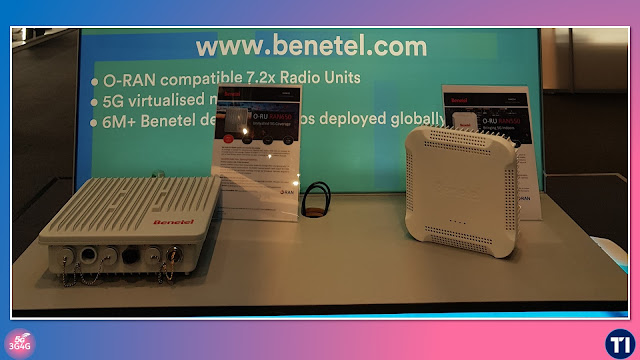
Benetel shows their Open RAN RU Progress

Benetel, headquartered in Dublin, Ireland, has a 20 year history with over 6 million Benetel designed radios deployed around the world. We caught up with them at Mobile World Congress 2022 to find out what they have been up to. 

We first heard of Benetel when they announced the launch of its flagship BNTL-RAN550 High-Performance 5G O-RAN radio unit (O-RU) back in 2020. Their MWC 2022 press release provides details on their latest RAN650 RU :

This is intended to bring 5G capacity to private, campus and industrial networks, as well as rural networks and public hotspots. A 4T4R antenna arrangement is featured with up to 5W of output power being delivered per antenna port (equating to 20W in total). The 7.2x functional split employed will help minimize the costs associated with fronthaul network implementations, while support for 100MHz of instantaneous bandwidth will allow maximum coverage to be attained.

Benetel’s new RAN650 RU can be deployed in either a Cat A or Cat B based configuration (using selected distributed units), thereby providing flexibility to address radio access network architectures. Key to its elevated performance and versatility is the cutting-edge semiconductor technology that has been designed into it. Each RU incorporates an Intel Arria 10 FPGA along with an Analog Devices’ ADRV9029 4T4R transceiver with integrated Digital Pre-Distortion (DPD). The initial version of the RAN650 covers the n77u (3.7GHz to 4.2GHz) frequency range. An n78 variant (3.3GHz to 3.8GHz) will be made available in the second quarter of 2022.

The RAN650 RU runs off a 48V supply. It has a maximum power consumption of 110W. The robust IP65-rated enclosure use means that even the most challenging of outdoor conditions can be coped with. An operational temperature range spanning from -33°C to +45°C is supported.

The RAN650 complements Benetel’s existing OpenRAN portfolio, including the RAN550 indoor 5G RU that the company announced back in late 2020. Active network trials are already being conducted on the Benetel RAN650 by several pilot customers.

TMN reported last year that, Benetel said it has integrated its Radio Unit (RU) with Radisys’ 5G NR Open RAN CU-DU software and has also licensed Radisys’ LTE software for its eNodeB radio platforms. The official announcement comes after Benetel told TMN last month that it was working with both Radisys and Altran on DU-CU integration.

If you are interested in learning more about Benetel then watch Olli Andersson, Benetel's senior VP for the Americas, discussing the O-RAN architecture's climb into market relevance here.

Related Posts:

Friday, 11 June 2021

AWS for Public and Private 5G Networks

wrote about AWS Edge being used to power Private Networks and Industry 4.0 back in March. Since then we had this big announcement from DISH and AWS about formation of 'Strategic Collaboration to Reinvent 5G Connectivity and Innovation'.

It talks about how the new US operator, DISH, will leverage AWS infrastructure and services to build a cloud-based, 5G Open Radio Access Network (O-RAN) that delivers consistent, cost-effective performance from core to the edge. 

Netmanias has done an awesome job of explaining how AWS will be used in the Dish network and compares it with the Rakuten Virtualised network. Reproducing the original from them below.


In addition, they have also done a fantastic job of explaining how different operators are planning to use AWS in their Networks. 


You can read more details for each of the operators below:

  • AWS and Verizon Expand 5G Collaboration with Private MEC Solution
  • AWS and Vodafone Business Bring Edge Computing Closer to Organizations in Europe
  • Announcing the first AWS Wavelength Zone in South Korea on SK Telecom (SKT)’s 5G network
  • KDDI To Launch "AWS Wavelength" On December 16, Offering Ultra Low Latency on the 5G Network Edge
  • Singtel and Optus expand 5G ecosystems with AWS for 5G edge computing
  • Telefónica Germany / O2 builds new 5G core network in the cloud
  • DISH and AWS Form Strategic Collaboration to Reinvent 5G Connectivity and Innovation
  • Bell Canada teams up with AWS for edge computing

Let us know what you think about the operator strategy of moving to AWS for something or other.

Related Posts

Friday, 12 March 2021

AWS Edge to Power Private Networks and Industry 4.0

At the ONF 2020 Spotlight Series, '5G Connected Edge Cloud for Industry 4.0 Transformation', Ishwar Parulkar, Chief Technologist, Telco, Amazon Web Services (AWS) gave a keynote presentation on 'How AWS Edge is Powering Industry 4.0'. 

He talked about how AWS Edge is powering the 4th Industrial Revolution by building the connected edge cloud. His talks covers:

  • Edge Developer Expectations
  • AWS Vision of Edge
  • Edge Infrastructure
  • AWS Enabled Private Networks
  • Services for the Connected Edge

The video of the talk is embedded below and the slides are available here.

Back in January, AWS also released a nice whitepaper on 'Next-Generation Mobile Private Networks Powered by AWS'.


This whitepaper introduces the relevant use cases, solutions, and best practices for designing and deploying mobile private networks powered by AWS. Cloud-enabled mobile private networks allow enterprises, governments, and professional organizations to autonomously deploy their own geo-dispersed, secure mobile private networks. These networks cover private facilities while meeting their performance, reliability, availability, security, and scalability requirements. 

It's available to download here.

Related Posts:

Thursday, 17 December 2020

5G connectivity and IoT intelligence for Leuven Digital City Pole project

We have seen some interesting lamp posts and poles concept on this blog (see related posts at the end of this post). Now, Nokia announced last week that it is providing industrial-grade, 5G-ready private wireless networking to the Digital City Pole project in Leuven, Belgium. The project paves the way for future citywide 5G connectivity that will stimulate local innovation, drive productivity and create jobs, particularly among small and medium-sized businesses.

Working with the consortium led by TRES, Nokia is demonstrating use cases that leverage IoT intelligence across a new secure city data backbone. In doing so, the project will explore new revenue opportunities based on IoT data and energy marketplaces.

The TRES broader initiative will also see streetlight poles upgraded with energy-efficient LED lighting and electric vehicle charging points. Distributed extensively in urban areas, digital city poles provide an effective platform to host high performance connectivity and sensors as cities seek to introduce ubiquitous smart city services.

The Digital City Pole project is supported by the Flemish Government and the EU Agency for Innovation and Entrepreneurship. Leuven, which was recently awarded European Capital of Innovation 2020, is committed to new technologies to boost sustainable development and it aims to become one of Europe's Labs of the Future through a mission-oriented model that facilitates collaborative innovation.

In addition to Nokia 5G-ready connectivity deployed in partnership with local service provider Citymesh, Nokia will also supply its Gigabit Passive Optical Networks technology for ultra-high-speed connectivity over an end-to-end broadband network.

TRES's website does not have much information but this presentation from last year has some details of this project. The following video explains the concept and shows some real deployment and use case examples 

We will hopefully hear more about the results, etc. next year.

Related Posts:

Sunday, 12 May 2019

Impact of Small Cells on Key Enterprise Markets


I missed the last CW (Cambridge Wireless) Small Cells event 'Are small cells ready for private LTE primetime in the lead-up to 5G?'.


From the CW website:

The limited progress towards excellent in-building cellular coverage is well-attested, and in many enterprise and industrial sectors, this is not just frustrating, but has a tangible impact on productivity and agility. In a wide range of industries, from transport to logistics to healthcare, there is pent-up demand for highly reliable, highly secure cellular connectivity, which often needs linking with localised applications and data.

That demand is only growing even more with the advent of IoT applications and edge computing. This is a huge opportunity for small cells, even before 5G, but these sectors cannot all be served by one generic network. Each has its own particular requirements, which need to be well understood by suppliers and partners, so that the deployment can be carefully aligned to business and performance objectives.

Excellent mobile connectivity indoors and out is the baseline requirement – each sector has its own additional needs, which will help to make the business case add up. For some, low latency may be important, for others, massive device density or enhanced security. All of these can be delivered optimally by small cells, but the design of the network, and the business model to deploy it – e.g. neutral host or private network – must be tailored to the enterprise, if users and suppliers are both to achieve the best ROI.

This event focuses on the real-world issues needed for the success of small cells in the emerging private LTE market.

The presentations are available for a limited time for non-CW members here.

The following presentations are available:

  • 'Is private LTE disruptive' by Ian Taylor, Quortus [PDF]
  • 'Small cells in private networks: An Overview' by Caroline Gabriel, Rethink Technology Research [PDF]
  • 'Bringing connectivity to a mechanical test centre' by Peter Stoker, AutoAir [PDF]
  • 'Private Networks for Critical Comms & IoT' by Tadhg Kenny, Druid Software Ltd [PDF]
  • 'Business ready applications, not the connectivity solution, will be the driver for private networks' by David Rose, Veea Systems Ltd [PDF]


Related Posts:

Thursday, 27 April 2017

Telefonica's LTE Nano Small Cell

The popularity of drones and balloons have made it possible to try and come up with innovative solutions for providing connectivity, surveillance and many other use cases. I have talked in detail about the UK operator EE's attempt to use Airmasts (which are now called E.M.M.A. - Emergency Mobile Mast Aid) and connect rural Scotland using Drones and Helikites.


In my Small Cells at MWC report, I talked about how there were many operators, vendors, etc. showing different things they were doing with drones and recently in my posts talked about Verizon's 'flying cell-site' and AT&T's 'Flying COWs'.

I only looked briefly at Telefonica's announcement about the LTE Nano.

From the press release:

This innovation, an evolution of the former project “LTE in a Box” presented at the MWC2015 that brought all the benefits of private critical LTE communications to the corporate world, will allow to bring the same advantages to new scenarios where small scale, low consumption and portability are paramount.  LTE Nano runs on a 40 grams SBC (Single Board Computer), on a Quad Core Cortex™-A53 processor and 2GB of RAM.

For the LTE Nano Project, Telefónica has integrated several components, one of the most essential being the EdgeCentrix virtual Enhanced Packet Core (vEPC) solution from Quortus, one of the most efficient and scalable software implementations of a mobile network functionality, able to run the essential elements of both 4G and 3G networks, including voice and data communications, with minimum HW requirements.

The most eye catching use of LTE Nano is for the rescue teams. An autonomous and portable LTE solution in a backpack, providing critical LTE communications in isolated places with no pre-existing coverage and difficult Access.


A drone with an LTE enabled camera transmitting video.
In addition, LTE Nano could be used to access retail intranets, though apps could do this job much better I think and
private LTE communications for small offices. Here I remain to be convinced that this scenario will not be superseded by WiFi calling, etc.

All these scenarios include the well-known Quality of Service provided by LTE networks in licensed spectrum which guarantee the absence of interferences and the security of communications, typical characteristics of regulated environments.

The presentation on LTE Nano is available here and a video from MWC is below (in Spanish):


Related posts: