Showing posts with label Macrocell. Show all posts

Friday, 15 April 2022

ZTE Shows-off New 5G Products and Solutions at MWC 2022

Like all other big vendors, ZTE's booth at MWC 2022 was closed for visitors. They did however create a video explaining all their new products and solutions launched at MWC. Here is a summary from their press release:

ZTE's UniSite NEO, among the new solutions, is the industry’s simplest site solution. Powered by the integrated radio unit OmniUBR Series, it is capable of reducing the radio units from 18 to 5, and supporting a 6-band 3-sector site with only 5 units, thus significantly decreasing site rental cost by up to 57% and delivering 40% lower power consumption. 

Also, ZTE has updated its 5G RAN portfolio with the new-generation Massive MIMO product series. It includes 32TR and 64TR AAUs, up to 192 antenna elements and 320 watt, and introducing the industry's lightest Massive MIMO product weighing 9kg for high traffic site with limited space. ZTE's full scenario product portfolio update wraps up the radio network enhancement and improves the ROI for its operators.

At MWC 2022, ZTE presents an all-in-one 5G private network solution based on the new model of 5G network as a service. This is a one-stop order-to-service package with the pre-integrated software and hardware, as well as converged 4G and 5G networks. The package has the tailor-made network features to empower the digital society. 

ZTE introduces three major types of 5G private network, including the compact cabinet for smart factories with dozens of enterprise applications to be launched on the cloud, single server i5GC for comprehensive campus where applications are more diversified and data security and self-service are mandatory, and embedded MEC for a very limited equipment room and simple application scenarios.

In additon, ZTE has launched VMAX, the accelerator of digital transformation at MWC 2022, to satisfy the increasing complexity of the network O&M, which is regarded as one of the biggest issues for operators.ZTE's VMAX can help improve customer experiences, reduce costs and enhance operating performance.

VMAX is a part of uSmartNet, ZTE's Autonomous Network solution, and changes single-domain operation into all-domain and end-to-end perspective providing One-stop Insight. When network errors occur, VMAX supports cross-domain service self-healing. It gets to the root cause of service problem and customer complaint in minutes with more than 80% location accuracy and efficiency increase by 30%. 

In addition, VMAX can interpret the service intent, output network planning suggestion accurately with minimal intervention. Meanwhile, it provides end-to-end security for different scenarios to protect personal privacy.

Here is the video of their products and solutions

Related Posts

Sunday, 27 February 2022

Rakuten Mobile shows off their Open RAN Portfolio

(Click on image to enlarge)

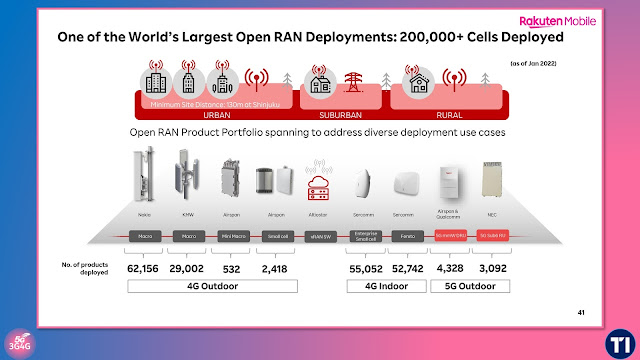
During the Full Year and Fourth Quarter 2021 earning call, President of Rakuten Mobile, Yoshihisa Yamada gave a short summary of the progress of the mobile network. During that, he also showed the Open RAN product portfolio spanning to address diverse deployment use cases.

The portfolio can be seen in the picture above and you can listen to his part of the talk in the video below: 

You can download the slides from here.

Related Posts

Thursday, 28 October 2021

AT&T Small Cells and Macrocells

It's been a while since I posted some small cell pictures from the USA. It's always nice of people to share their pics on Twitter and here are some of them I found interesting.

On it's website, Raycap has a case study with AT&T:

To see a range of solutions for concealing small cell wireless sites, look no farther than Dallas, Texas, home to AT&T corporate headquarters. Raycap worked with the carrier to complete two very different concealment projects.

  • Six custom-designed wall-mounted enclosures, designed, manufactured and painted to match the granite walls of AT&T’s buildings and provide 5G mmWave coverage around the AT&T Discovery District
  • Nearby, highly customized small cell poles were engineered to meet the carrier’s needs, the utility’s access requirements, and the city’s aesthetic guidelines—including an integrated image of the iconic Pegasus logo.

These two projects show how Raycap-led collaboration among all stakeholders can solve challenging wireless deployments: wall mounted, rooftop mounted, integrated in poles, and others.

You can download the PDF here.

Related Posts:

Friday, 10 September 2021

Ericsson's Street Solutions

Ericsson’s announced that their Street portfolio offers operators and other service providers an opportunity to seamlessly bring connectivity to where it is needed. Part of the Ericsson Radio System, the street solutions are an integrated part of the network, with feature parity and end-to-end performance. 


In a recent press release they announced:

5G deployments are accelerating across the country at a faster rate than expected. According to Ericsson’s annual mobility report, by the end of 2021, 25 percent of the global population will have 5G coverage. In North America, more than 360 million 5G subscriptions are anticipated in the region by 2026, accounting for 84 percent of mobile subscriptions.

However, connectivity can suffer in dense urban environments, and as 5G comes to U.S. cities, urban rollouts are grappling with challenges like how to deploy non-intrusive sites, how best to utilize all frequency layers, and how to streamline site permitting and installation. Many sites need to expand 5G capacity, and hotspots and streets need strengthened capacity in both low, mid and high-band to build a complete 5G network as traffic grows.

Powered by Ericsson Silicon, these new solutions are:

  • Street Radio 4402: Designed to turn a streetlight into a low- or mid-band 5G site in 15 minutes, these compact radios are an industry-unique collaboration with Ubicquia, boosting 4G and 5G experience with zero footprint;
  • AIR 4435: The world’s smallest 4T4R street antenna-integrated radio is designed for minimum footprint and easy installations, adding excellent mid-band capacity to macro coverage gaps;
  • Street Macro 6705: A complete mmWave base station with integrated RAN Compute is an industry-leading end-to-end solution with low visual impact.

Ericsson Street Solutions also include transport solutions for any 5G street site, with wired and wireless backhaul and fronthaul solutions. And zero footprint power systems for street and hotspot sites are 100 percent carry to site, with low maintenance and operations costs.

A brochure with all the necessary details is available here.

Related Posts

Tuesday, 4 August 2020

Some Pictures of Macrocells (and Small Cells) from Rakuten, Japan

If you have been following the Japanese operator Rakuten's progress, you will already know that they use variety of radio hardware vendors. Some of these we have covered in this blog. For example, Airspan's macros and small cells that I blogged here is used in quite a few locations. Similarly, I blogged about NEC O-RAN radios here that are being used in the live network too.

Here are some pictures from Twitter.

Rakuten mobile base station in Akiba (source)

Rakuten Mobile 5G base station, Komazawa Dori from Kanhachi (source)

Rakuten Mobile's 5G n77 base station. (source)

Indoor Rakuten mobile base station at the Haneda Airport International Terminal (source)

Antenna for high-rise buildings (source)

NEC on Rakuten Mobile 5G (source)


Airspan Air5G RDU 46, 28GHz (n257) (source)

You can't have a post on base stations without a speed test, so here we go

Speedtest on Rakuten 4G network (source)

Related Posts:

Thursday, 12 September 2019

Airspan Small Cells and Macrocells Portfolio, including 5G


Back in April, a presentation from Airspan showed that they have shipped nearly 500k small cells. Sprint has nearly 300k MagicBoxes while Jio has around 120k small cells.


As you can see above, Airspan has a range of outdoor small cells and as shown below, a wide range of indoor small cells.


Airspan recently announced that it has partnered with Rakuten, the newest MNO in Japan, to bring comprehensive 4G and 5G solutions to the world’s first fully virtualized cloud-native mobile network. The announcement said:

Airspan’s Air5G OpenRange28 mmWave platform in 28GHz will deliver ultra-high capacity to Rakuten Mobile with record time-to-market, enabling unprecedented monetization opportunities. Airspan’s open RAN platforms will provide Rakuten Mobile the flexibility to disrupt the economics of traditional network operators and lay the foundation for transformational 5G architectures. With over half a million systems deployed globally, Airspan brings its proven disruptive economics to the fully virtualized Rakuten Mobile network.


Airspan’s mmWave virtualized Air5G OpenRange28 platform utilizes Qualcomm’s FSM100xx 5G chipset and supports open RAN architectures, seamlessly connecting to Rakuten Mobile’s virtualized BBU to deliver the world’s most advanced open interface virtualized RAN solution.  The OpenRange28 mmWave platform supports multiple functional splits for the widest possible set of deployment options, ensuring Rakuten Mobile customers benefit from the highest level of efficiency and the best user experience in Japan.

Airspan's 5G products can be viewed here.

With so many innovators working with Rakuten, it would be interesting to see their 4G & 5G network rollout. Looking forward to some big announcements at MWC next year.

Related Posts:

Thursday, 2 November 2017

Tutorial: An Introduction to Macrocells & Small Cells


I have been meaning to create a video tutorial on Small Cells for a long time. The problem is that its not as easy as most people may think. To explain small cells concepts, its necessary to explain macrocell, C-RAN & DAS. This is what I have attempted to do in this presentation.

The slides are embedded below and can be downloaded from Slideshare. The video is embedded on slideshare presentation but if you prefer, the direct Youtube link is here.


Please note that this video is for guidance only. Many vendors & operators use their own definition which may not agree to mine. In the end, we are all correct 😉

Saturday, 11 February 2017

Deployment guidelines for Small Cells and Not So Small Cells

This post is collection of an article and presentation from Omar Masry, Senior Analyst at City and County of San Francisco. The presentation is a good quick summary and the article below gives a more detailed explanation of some of the issues


Also read: 10 Key Issues for California Cities & Counties on the Challenges of Small Cells & “Not So Small Cells” by Omar Masry.

Saturday, 29 November 2014

'Inside-out' or 'Outside-in'

Going through my old presentations, I came across this prestigious lecture delivered by Dr. Tim Whitley of BT. The main argument of that lecture was, The future of mobile is fixed and the future of fixed is mobile. During the ending of the presentation there is a discussion on Outside-in v/s Inside-out. Lets look at those slides here:


Qualcomm is a big fan on Inside-out as can be seen here. Other small cell manufacturers support the inside-out approach too.

The question is, does inside-out approach matters any more. By next year many operators and devices will support VoWiFi in native client. Which means that even if your coverage is poor or non-existant inside, you will still receive voice calls and text messages. Data will continue over WiFi as normal.

An argument in favour of cellular is better/guaranteed QoS as in VoLTE and maybe new services can be available faster but private WiFi best (or no) effort is not bad generally.

What are your thoughts on this topic?

Saturday, 31 May 2014

DAS or 'Small Cells' for Indoor Location


There was a recent webinar by Maravedis-Rethink & EJL. The slides are available on Slideshare here. I think there were some good points made about using DAS or Small Cells for the Indoor environment. Here is the youtube clip. You can drag the pointer to the beginning, to listen from the start.


Tuesday, 8 October 2013

Super Macros and HetNets

The other day I read the following on Light Reading:

UK operator EE wants to turn its existing macro cell sites into "super macros," according to Andy Sutton, the carrier's principal network architect, speaking at the recent Base Station conference in London.

EE 's plan to super size its macro cell sites fits in to a broader Heterogeneous Network (HetNet) strategy for adding capacity and extending coverage. The operator rolled out the first LTE network in the UK last year, and has now covered 55 percent of the UK population and has 1 million 4G customers.

"Super macro is the first step toward building a HetNet,” said Sutton. “Evolving the macro is the most cost-optimized way to adding capacity into our networks."

But what makes a macro super?

According to Sutton, a super macro would typically have multiple radio access technologies (RAT), three-to-six base station sectors, and operate in multiple frequency bands using carrier aggregation techniques. It could be a standalone base station or a hub for subtended, smaller micro cells. He added that infrastructure sharing is vital to the strategy as well.

Once the operator has sufficiently beefed up its macro cell sites, then it can look to smaller cells to be deployed indoors and outdoors in hotspots or cell edge locations. Sutton described a small cell deployment as an "underlay" to the super macro.

The term super macro isn't exactly new, but the fact that operators are talking about it now indicates just how much more they are looking to do with their existing radio access network (RAN) infrastructure before introducing new small cells or while planning a small cell deployment.

"Within the super macro concept, there's quite a lot operators can do to improve performance," says Heavy Reading senior analyst Gabriel Brown.

Along with adding sectors, using more spectrum bands, or employing carrier aggregation, Brown also includes in the super macro concept using 4x4 and 8x8 MIMO, active antenna systems, vertical sectorization, or beamforming.

The advantage of improving macro sites is that many of the basic elements that go into the total cost of ownership of a cell site are already in place, such as power, real estate rental, and backhaul, according to Brown.

I remember the folks from Ericsson mentioning about Super macros but I had not given any thoughts to it. Well, I went back to see what they have been talking about and found this:


Since it was not very clear, I found some additional information from an NGMN presentation as follows:


In order to reduce UEs’ frequently handing over between neighboring cells when moving at high speed which results in voice service or data download breakouts in the railway/subway/highway scenario, different RUs in different sites using C-RAN architecture can cooperate with each other and many macro chain cells can be combined to a super macro cell. In this burst communication scenario, network performance has higher priority than network capacity.

So my suspicion is that Super macros would be ideally using C-RAN where it would be possible to combine what could be many macros into a 'super macro'.

If I start thinking about it, there can be additional uses of the super-macro:

  1. Carrier aggregation - scenario 4 - see here. In Release-10 scenario 4 is not possible because of different timing advance requirements but this has been resolved in Rel-11. Super Macros can be useful in this scenario where small cells provide capacity, super macro provides coverage and reduces the need for constant handovers, etc.
  2. NCT - related to the above - see here - again, smaller cells (metrocells/microcells) using NCT to provide capacity, super macro for coverage
  3. Phantom Cell - see here - related to 1 and 2 above, super macro is the coverage, connectivity and mobility layer, small(er) cells are phantom cells that provide higher data rates. 

Anyway, a lot of information is pure speculation so feel free to add more info or correct my understanding.