In support of the Noto Peninsula's recovery, PEACEFUL PARK 2024 took place on July 6-7. NTT Docomo played a key role, both as a co-host and by ensuring robust connectivity for attendees.
To maintain stable communication, Docomo deployed a mobile base station vehicle and "Carry 5G" equipment to cover indoor live venues. Leveraging Massive MIMO technology, they provided a reliable network even in crowded areas. The Docomo booth also showcased their disaster response initiatives, highlighting their commitment to resilient infrastructure.
「PEACEFUL PARK 2024 for 能登」 7月6,7日に能登半島の被災地復興支援を目的としたライブイベントが開催されました🕊️
Earlier in the year we wrote about Deutsche Telekom's Mini-Mast a.k.a. “Cell Tower To Go”. Last year, DT set a new benchmark in sustainable technology with the deployment of hydrogen-powered antennas at the Nibirii Festival in Germany. This initiative replaced the traditional diesel generators with hydrogen fuel cells to provide eco-friendly energy for mobile base stations. The hydrogen is sourced in a CO₂-neutral process, marking a significant step towards green innovation.
For anyone who doesn't understand what hydrogen fuel cell is, this video has a good explanation.
At the festival, a hydrogen-powered mast supported 30,000 attendees with seamless LTE and 5G connectivity. The fuel cells, developed by SFC Energy, ensured reliable, uninterrupted service for 28 days, showcasing their potential for large events, emergencies, and remote areas. This shift underscores Deutsche Telekom's commitment to combining sustainability with technological advancements.
Additionally, compact mobile masts and stage-mounted small cells enhanced coverage and user experience. These innovations promise to redefine mobile connectivity, emphasizing rapid deployment and reduced environmental impact.
Like every operator, Vodafone UK has a variety of Cell On Wheels (COWs) that they take to special events where there may be a need for extra coverage and/or capacity. While we have a good number of posts looking at COWs (see related posts 👇), here is their short video explaining it:
Quoting from their news article earlier this year:
Some of the UK’s best known and largest events, from music festivals and agricultural shows to leading events in the sporting calendar, will see the masts. Known as ‘Cells on Wheels’ (COWs), they will be wheeled onto site to deliver an outstanding network experience and to cope with the extra demand expected on the network.
With over 120 deployments planned, Vodafone’s fleet of COWs will be kept very busy throughout the year. Some events will receive more than one unit, depending on terrain, the size of the event area and estimated number of attendees.
The season started at Cheltenham Race Festival in March. Compared to last year, overall data usage at Cheltenham increased by nearly 10%, with 35% of all data carried over 5G.
In September 2023, Vodafone revealed that 5G data usage at special events was rapidly increasing, with customers using 80% more 5G data in 2023 compared to 2022. One of the busiest was Glastonbury 2023 where Vodafone deployed nine COWs. Over 168 terabytes of data was consumed across the event. Elsewhere, the King’s Coronation saw COWs being placed around Hyde Park and Buckingham Palace. Data usage increased by around 90% compared to a typical Saturday in the capital.
A slightly more detailed video is ☝️ here while this detailed article from last year talks about the process:
Vodafone’s planning for any given event starts long before the organisers open their doors to the public; up to a year in advance for some city-sized. Surveying the site in question, requesting access from landowners and working out how to get lorry loads of equipment up narrow country roads – these are are serious logistical issues that can’t be left to chance.
Mobile signal at an event will be provided by one or more ‘cells on wheels’, or COWs. A COW is effectively a mobile mast – and its associated equipment – mounted on a trailer manned by a crew of three or four engineers. Setting up a COW can not only require a hoist, crane and/or cherry picker, but also the usual data links, power and a suitable location. This trifecta is tricky enough to secure under everyday circumstances in the UK’s villages, towns and cities – never mind the stadia, fields, valleys, shorelines and other unusual venues that host festivals and other such special events.
For festivals and shows that take place in remote rural locations, short-range microwave radios may be needed. These link the COW to the rest of Vodafone’s network as the usual fibre optic or copper cables often aren’t available or can’t be laid.
But such radio links need to be within line-of-sight of the next mast along to work, so locations need to be reasonably clear of obstructions such as trees and hills – obstructions that can also block the mobile signal from the mast once it’s operational.
While Vodafone may have the pick of locations at events that it has partnered with, that’s not always the case, with space at any given event in high demand for stages, retailers and of course the room needed for audiences and tents.
Powering the COW takes more than running a mere extension lead. If grid power isn’t available, then diesel generators are used. The generators then need to be carefully tended and guarded to ensure they continue working properly and aren’t ‘borrowed’ by either desperate or opportunistic third parties.
Getting a COW up-and-running in a surveyed location can take at least a day, often two to three days. But the work doesn’t stop once it’s powered on. Engineers carefully monitor and adjust the COW’s antennas and other equipment to ensure that it delivers the speeds and capacity that the public expect.
Frederic Sundin, Vodafone’s Head of Network Connectivity and Deployment explains: “You have stages in the way, depending on where the special event is, or it can be hilly, it can be trees. That can block the signal. And you need to predict where the crowds will be, because they move around.”
Vodafone’s engineers can draw upon analyses of traffic patterns in previous years when providing coverage at events that the company has been to before. But for new events or those that have relocated to new venues, responding quickly to unexpected events can be crucial.
For example, if there is a massive shift of people up a hill because they’re all watching and snapping/livestreaming the sunset, then engineers must be able to spot this and then actively optimise the network for such a sudden concentration of people in a small space.
The demands expectations of the public lie at the heart of why Vodafone provides mobile coverage at special events. “Festivals, summer events – the UK audience just love it. They flock to them. And, rightly so, they demand good coverage, a good experience,” Andrea, Vodafone’s Chief Network Officer in the UK said.
There is, of course, the other crowd at any given event – the organisers and the retailers. From ticketing to contactless payments, a variety of business processes now rely on mobile connectivity, not to mention first responders from the emergency services and event security.
If you spot a COW in a field near you, snap a picture and send it to us.
Last year Deutsche Telekom developed a mini-mast (or as they call it, ultra-mobile mast) prototype called "cell-tower-to-go". Think of this as Cell On Wheel (COW) with no wheels. In a recent press release they indicated that it has already become a customer favourite within a short space of time.
Around a dozen companies are testing the flexible solution so far. "With our call to test our ultra-mobile cell tower, we have raised great interest among companies from a wide range of industries. This high demand shows: The need for a flexible mobile communications solution is there - also among business customers. This has strengthened our decision to offer this innovation 'made by Telekom' commercially in the future," says Klaus Werner, Managing Director Business Customers at Telekom Deutschland.
One of the first testers is the leading Swiss construction and real estate service provider Implenia. The company will provide its bridge construction site in Bad Lobenstein (Thuringia, Germany) with 5G and 4G/LTE during the two-year construction phase. The construction site in the valley could not be reached by the conventional mobile phone masts in the surrounding area. However, due to the high degree of digitalization of the construction site, a fast and reliable mobile network connection is essential.
Telekom's cell-tower-to-go provides high-performance coverage at the construction site. Smartphones and computers then use fast mobile connections via frequencies in the 2.6 and 3.6 gigahertz range. For Implenia, this basic mobile communications coverage is also an ideal basis for IoT applications. The company uses them to optimize processes and material flows on the construction site. The easy-to-connect mast is linked to the network on the bridge construction site via fiber optics. However, the connection via satellite will also be tested in a next step. This will provide additional flexibility and an even faster connection to the network.
The micro-container is also making a big impact at the delivery service flaschenpost SE. The food and beverage delivery service from Münster, Germany, uses the additional 5G supply within a logistics hall. This speeds up its operational processes.
The special feature of the ultra-mobile mast is that it is significantly smaller, lighter and more flexible than previous solutions. The entire radio technology fits into a compact micro-container (length: 1.6 meters, width: 2 meters, height: 2.6 meters). This makes the mobile mast space-saving and easy to transport. It can be set up by one person in less than an hour - and is immediately ready for use. The micro container can be connected to a local power supply or operated using any other mobile power source. It can be connected to the data network via fiber optics or radio relay.
These advantages make the mobile “dwarf” not only the first choice for fast or temporary coverage for business customers. The use of mobile masts also provides rapid assistance in disaster areas thanks to their enormous flexibility.
Deutsche Telekom will launch a commercial offer for the use of ultra-mobile transmission masts in spring 2024.
Between May and June, test release of water is done to check that the emergency spillway gate is working fine. On these occasions, many tourists visit to experience this. There may be mobile coverage there but there isn't capacity to support large number of people.
To alleviate the network congestion, many Japanese networks send their Cell On Wheels' (COWs) to handle the traffic. NTT Docomo's COW is as shown above.
The United States of America (USA) is a huge country. With such a vast area it is no surprise that it experiences a relatively high number of natural hazards and disasters. It is prone to hurricanes along the Atlantic and Gulf coasts, tornadoes in the central region known as Tornado Alley, earthquakes along the West Coast, wildfires in dry areas, and floods in various regions.
It is for this reason that all US operators have to be prepared for any emergency at a very short notice. In earlier posts we looked at AT&T’s Flying COWs (Cell on Wings) and Verizon's Disaster Response COW, THOR. In this post we will look at T-Mobile's COWs.
In a recent news article, T-Mobile detailed their disaster preparedness. Quoting from the article:
Since 2021, T-Mobile has made strategic investments to increase its network hardening footprint by more than 30%, placing fixed backup generators at even more towers, cell sites, network switches, data centers and other critical sites nationwide. These investments also enable the Un-carrier’s emergency response teams to leverage the network in innovative ways. For example, technicians and engineers who monitor weather in the field can remotely adjust sites in real-time to concentrate the signal in impacted areas, providing first responders with more bandwidth for data-intensive activities such as orchestrating rescues. This saves critical time and has minimal impact on customers due to T-Mobile’s network resiliency.
T-Mobile is increasing its inventory of heavy-duty network disaster response vehicles—Satellite Cell-On-Wheels (SatCOWs) and Satellite Cell-On-Light-Trucks (SatCOLTs)—by over 50%. And this year, the Un-carrier is also rolling out new Class Super C RV Command Centers for on-site operations management and new heavy-duty community support trucks that provide device charging, charging supplies and Wi-Fi for anyone who needs it.
The Un-carrier’s fleet already includes Network Emergency Operation Centers, Rough Terrain Dual Mast COLTs (which provide coverage for up to two miles, two-way radio communications, Wi-Fi and emergency lighting), Jeep COLTs, network and community Command Centers, Wi-Fi charging trailers, tow response vehicles and more.
The emergency response team also stages agile solutions like COWs, VSATs (small satellite terminals) and microwave/long-range microwave kits to quickly restore service in impacted areas.
The Un-carrier is looking ahead and innovating on the next wave of natural disaster prevention and response technology. Through an award-winning partnership, Pano AI leverages T-Mobile’s 5G network, ultra-high-definition cameras and a proprietary AI platform to scan and locate early-stage wildfires. With this technology, utility companies, fire authorities, forestry companies and private landowners can detect and respond to wildfires in rural areas faster than ever before.
Earlier this month, T-Mobile and Valmont announced the longest ever beyond visual line of site (BVLOS) drone flight for infrastructure inspection—77 miles—enabled by T-Mobile’s 5G network. During the flight, Valmont demonstrated the capability of a 5G-enabled technology to preemptively monitor infrastructure such as power lines, railroads and bridges in Texas with greater accuracy, helping to prevent malfunctions and infrastructure-related emergencies.
When disasters strike, T-Mobile deploys cutting-edge 5G Search and Rescue (SAR) drones and tethered drones to aid in disaster response efforts. SAR drones can fly up to 75 miles per mission to provide coverage and use infrared and thermal imaging to locate people, especially in unfavorable conditions. And with a 55-pound payload capacity, they can also deliver lifesaving supplies. Connected to power and backhaul resources, tethered drones can fly up to 400 feet to provide nearly continuously coverage to surrounding areas.
You can read the complete article here which contains a lot of pictures of their disaster response vehicles.
I first got introduced to COWs (Cell on Wheels) when AT&T talked about them back in 2014. Since then I have written about AT&T's Flying COWs (Cell on Wings as opposed to Wheels) and also the Flying COW - Helicopter. All of the Flying COWs were transmitting 4G/LTE.
In an announcement last June, AT&T announced that their Flying COW was able to transmit 5G. Surprisingly they haven't shared any videos publicly, unlike the 4G ones. Their announcement said:
The AT&T drone team picked this remote location for the ground-breaking launch of its Flying COW® (Cell on Wings), because of that: it’s remote. No trees. No houses. No humans. Only wide-open spaces and the occasional four-legged cow.
“We had intermittent, weak LTE signal at the flight location before we launched the 5G Flying COW®,” said Ethan Hunt, Unmanned Aircraft Systems (UAS) Principal Program Manager, AT&T. “We flew the drone up to about 300 feet, turned on the signal and it began transmitting strong 5G coverage to approximately 10 square miles.”
Did you notice the PM named in the story? Ethan Hunt. Same guy from Mission: Impossible. Expect #5G on high speed motorcycle chase next.
That means, customers with a capable 5G phone in the area could have gone from no service to super-fast wireless connections in seconds. In the future, this could help first responders in a search and rescue mission.
“Drones may use 5G for command and control or to stream video, but the AT&T 5G Flying COW® is the only drone that provides a 5G network,” Ethan said.
A COW serves as a cell site on a drone, and AT&T has been using this technology to beam LTE coverage to customers during big events and disasters for years. Other companies may use 5G signals to communicate with drones, but the 5G Flying COW® could be a game changer.
“Our focus within the drone world is connectivity. All of our drone solutions have that focus,” said Art Pregler, Unmanned Aircraft Systems (UAS) Program Director, AT&T. “5G brings a lot of new capability to the table. We can connect a lot larger number of devices with 5G. When we put that up, we can share with a larger population.”
We’ve taken #5G to new heights! @ATT launched an industry first, delivering 5G via our Flying COW® (Cell on Wings). This can revolutionize the way first responders communicate when disaster strikes and connect those in rural communities across the U.S. https://t.co/NDNq5UstNSpic.twitter.com/XwlxV1jydT
Elizabeth II, Queen of the United Kingdom and the other Commonwealth realms, died on 8 September 2022 at Balmoral Castle in Scotland, at the age of 96. Elizabeth's reign of 70 years and 214 days was the longest of any British monarch.
A lot of people attended the funeral procession. To ensure that connectivity is available to the people attending, all UK operators put up temporary sites to supplement the capacity available. Peter Clarke posted photo of the infrastructure along with the speed test results as can be seen in the Tweet below:
5G NR utilises Ericsson 32T32R Massive MIMO AAUs and Three's 140MHz n78 bandwidth across two carriers. Ericsson LTE is six sectors of 4T4R L18+L21 and three sectors of 2T2R L07+L08, 2T L14. 3 sector 3G from Nokia Flexi. Backhaul: SIAE 2/2 pic.twitter.com/0GFJlrc3Dl
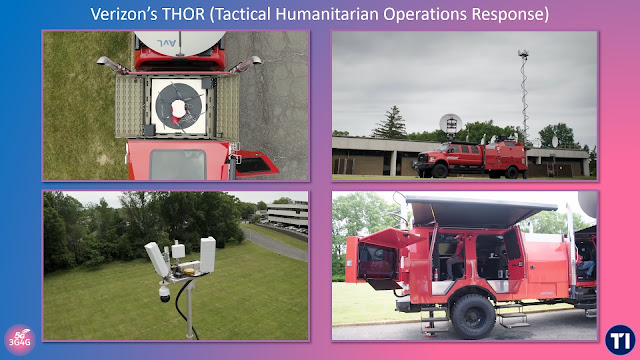
When we wrote about how Verizon uses satellite connectivity to restore services after hurricanes, someone made us aware of THOR, the Verizon disaster response vehicle in a league of its own.
The Verizon Response Team (VRT) has a collection of different types of field equipment, which they refer to as 'The Barnyard'. This includes COWs (Cell On Wheels), COLTs (Cell On Light Trucks), CROWs (Cellular Repeater On Wheels) and GOATs (Generator On A Trailer). The latest addition to this is THOR (Tactical Humanitarian Operations Response).
THOR is National Incident Management System — or NIMS-1 — compliant and offers full radio interoperability and onboard Joint Operations Center services. It provides a multitude of connectivity options, spanning private 5G, commercial 4G LTE, Land Mobile Radio and tactical radio, wireless networking, microwave, mesh and more. Other components include 4G/5G radios, a rear command center, a camera, a six-seat cabin and an exterior touch screen display.
It also comes equipped with a tethered drone to capture an aerial view that can be fed over the network to devices on the ground and the command center below, potentially helping those in public safety or the military with risk and damage assessment, situational awareness or search and rescue operations.
As a prototype, there are currently no plans to build a second THOR, as designs for future 5G-enabled response vehicles continue to evolve.
I really enjoyed watching couple of video's from Peter Clarke of temporary masts that are installed at events like Glastonbury festival and other high profile events. They are both embedded below:
If you enjoyed, check out more videos like these on his Youtube channel here.
The popularity of drones and balloons have made it possible to try and come up with innovative solutions for providing connectivity, surveillance and many other use cases. I have talked in detail about the UK operator EE's attempt to use Airmasts (which are now called E.M.M.A. - Emergency Mobile Mast Aid) and connect rural Scotland using Drones and Helikites.
In my Small Cells at MWC report, I talked about how there were many operators, vendors, etc. showing different things they were doing with drones and recently in my posts talked about Verizon's 'flying cell-site' and AT&T's 'Flying COWs'.
I only looked briefly at Telefonica's announcement about the LTE Nano.
This innovation, an evolution of the former project “LTE in a Box” presented at the MWC2015 that brought all the benefits of private critical LTE communications to the corporate world, will allow to bring the same advantages to new scenarios where small scale, low consumption and portability are paramount. LTE Nano runs on a 40 grams SBC (Single Board Computer), on a Quad Core Cortex™-A53 processor and 2GB of RAM. For the LTE Nano Project, Telefónica has integrated several components, one of the most essential being the EdgeCentrix virtual Enhanced Packet Core (vEPC) solution from Quortus, one of the most efficient and scalable software implementations of a mobile network functionality, able to run the essential elements of both 4G and 3G networks, including voice and data communications, with minimum HW requirements.
The most eye catching use of LTE Nano is for the rescue teams. An autonomous and portable LTE solution in a backpack, providing critical LTE communications in isolated places with no pre-existing coverage and difficult Access.
A drone with an LTE enabled camera transmitting video.
In addition, LTE Nano could be used to access retail intranets, though apps could do this job much better I think and
private LTE communications for small offices. Here I remain to be convinced that this scenario will not be superseded by WiFi calling, etc. All these scenarios include the well-known Quality of Service provided by LTE networks in licensed spectrum which guarantee the absence of interferences and the security of communications, typical characteristics of regulated environments.
The presentation on LTE Nano is available here and a video from MWC is below (in Spanish):
In the recent Boston marathon on the weekend, they also used their COW (Cell on Wheels) to boost the service. Here is a picture from their official tweet account. To know more, check their tweet out below.