Showing posts with label Metrocells. Show all posts

Thursday, 30 September 2021

Metrocells to help Telstra Increase Density for Greater Capacity and Speed

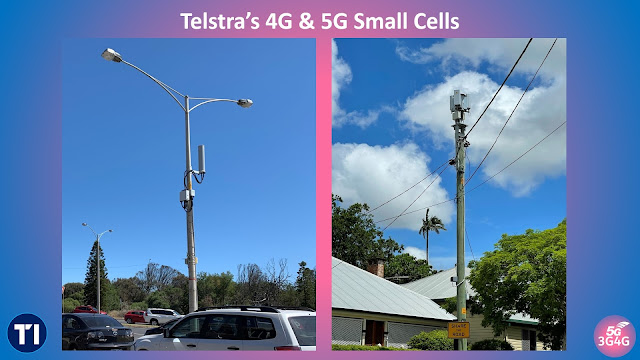
We looked at Telstra's Small Cells some years back. While they were 4G only or 3G/4G back in those days, now small cells are also being talked about for 5G.

On their Q&A page on small cells, Telstra has explained what they mean by them. In fact we also wrote about how Telstra is using small cells to do EME testing here.

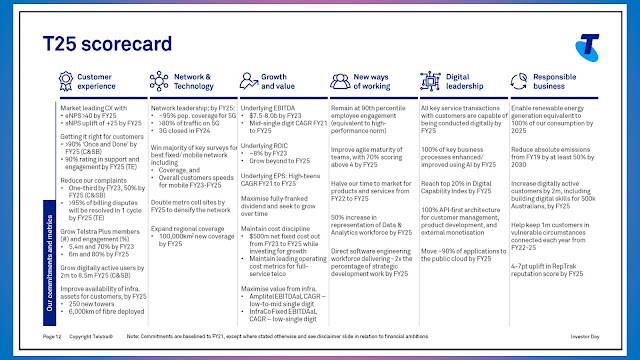
In their investor day this earlier this month, Telstra presented their T25 vision and the role of small cells in that. During the last three years, they’ve been talking about the journey of transformation that they have called T22. T22 was a strategy of necessity – a strategy designed to transform every aspect of Telstra. The new T25 strategy is being billed as a strategy for growth, which they have broken down into four pillars:

  • Provide an exceptional customer experience you can count on
  • Provide leading network and technology solutions that deliver your future
  • Create sustained growth and value for our shareholders
  • Be the place you want to work

As you can see in the slide above, Pillar 2 of their T25 strategy is focused on leading network and technology solutions that deliver the future. As they describe in their analyst day notes:

There is no doubt we are continuing to see rapid technology adoption and innovation. This is manifesting as a convergence between core telecommunications technology and software-based technology solutions.

What this means is that Telstra not only needs to continue to lead in telecommunications technology with the best networks, but also increasingly lead in the role that software plays in orchestrating and managing the network and integrating applications and services for customer solutions. 

Under T25 we will continue to invest in our network leadership in 5G with 95% population coverage and 80% of all mobile network traffic being on 5G by FY25. We also plan to double the number of metro sites leveraging small cell technologies to further densify and add capacity to the network and we will add at least another 100,000 square kilometres of mobile coverage to our national footprint to support regional and remote customers.

By FY24 we will have extended our 4G coverage to 100% of our network enabling us to continue to lead in composite coverage, speed and performance for 4G and 5G as we close 3G. This will set us up well for the early planning on 6G which will clearly be on the agenda by the end of our T25 program.

We will be a vastly different company because of our network leadership with 95% 5G population coverage, a densified small cell network and expanded regional coverage.

Hopefully, the end users will be the real winners with these network upgrades.

Related Posts: 

Thursday, 2 November 2017

Tutorial: An Introduction to Macrocells & Small Cells


I have been meaning to create a video tutorial on Small Cells for a long time. The problem is that its not as easy as most people may think. To explain small cells concepts, its necessary to explain macrocell, C-RAN & DAS. This is what I have attempted to do in this presentation.

The slides are embedded below and can be downloaded from Slideshare. The video is embedded on slideshare presentation but if you prefer, the direct Youtube link is here.


Please note that this video is for guidance only. Many vendors & operators use their own definition which may not agree to mine. In the end, we are all correct ðŸ˜‰

Tuesday, 1 July 2014

3GPP Definitions of Small Cells


While the Small Cell Forum defines the different types of Small cells clearly and these Small Cells can be said to contain the complete/partial functionality of the eNodeB, 3GPP definitions of Small Cells can be a bit fuzzy sometimes.


Generally, in the 3GPP documentation, there is a reference to Femtocells and Picocells. Femtocells are Small Cells that are defined as Closed Access (see my old post here) by 3GPP. The open access small cells are referred to as Picocells. Sometimes remote radio heads (RRH's) are also referred to as Small cells, open access type.

Relays, even though not referred to as Small Cells by 3GPP, is also referred to as Small Cells by some people.

Do you know of anything else?

Monday, 4 March 2013

Is 2013 the year of Metrocells?


A recent market market report by Informa for the Small Cell Forum has highlighted the following:

  • December last year marked the first launch of a dual mode 3G/LTE femtocell by NTT DoCoMo which allows CS fallback and will be used to promote the migration from 3G to LTE. Orange France has also launched consumer femtocells, diversifying its small cell offerings.
  • The small-cell market is growing at a rapid pace: The largest deployments have already reached 1 million active cells. Initial metrocell deployments are taking place while all the operators in several markets now offer femtocells.
  • Both SKT and KT have launched LTE small cells for public access in South Korea.
  • According to Informa Telecoms & Media’s estimates, the small cell market will generate US$22 billion during 2016, 73% of which will be driven by public area small cells.
  • The number of small cells deployed overtook the total number of macrocells between October and November 2012 and consumer femtocells overtook macrocells during February 2013.
  • The femtocell market now includes several deployments that reach well into hundreds of thousand units, including Vodafone, Softbank and SFR. Sprint’s deployment reached 1 million units as of October 2012 and analysts estimate that AT&T’s deployment has reached similar numbers.
  • As of February 2013, there are 46 commercial services and a total of 60 deployment commitments.
According to this report: The Small Cell Forum released these numbers here at the Mobile World Congress. Gordon Mansfield, chairman of the Small Cell Forum, said 2013 is the "year of public access" small cells, noting that by 2016 public access small cells will drive $16.2 billion in revenue despite the fact that they only make up 4 percent of small cells today.  Mansfield also said 98 percent of mobile operators believe small cells are essential; however, of the 46 operators that have deployed small cells, the majority are larger operators.


The Informa report does provide a definition of the type of Small Cells but clearly mentions that these are for guidance only. I have posted my views earlier about what Metrocells are here and here. I much prefer to use the term 'Indoor Metrocells' rather than Picocells as Picocells are associated with legacy networks without an intelligence (SON, etc.) of its own. The same is true in outdoor case as I prefer 'Outdoor Metrocells' rather than Microcells. Having said that Microcells are still available from vendors and are comparatively more expensive but provide capability to cover larger areas and more simultaneous number of users.


The Small Cell Forum has also embarked on a Release plan to help speed up operator deployments. 'Release One' was released in the Mobile World Congress 2013 with focus on Home, the future releases with focus on Enterprise and Metrocells. An Infographic on releases is available here.

Below are some of the announcements regarding Metrocells from the last couple of weeks:

  • Russia Is Bringing High-Speed Fiber to All Its Towns and will also provide cellular coverage in those towns using Metrocells. See here and here.
  • ALU and China Mobile unveil TD-LTE lightRadio. The TDD lightRadio Metro Radio houses two of ALU's now-famous 'cubes' (highly compact radios which can be installed on lamp posts) integrated with a directional antenna. This enables a level of coverage which would normally require a far larger remote radio unit linked to an external antenna via cable. Details here.
  • Node-H supports Broadcom’s Dual-Mode Small Cell SoC Family. Details here.
  • Giza Systems and Bluwan Partner to Accelerate Middle East Heterogeneous Network Rollouts. Details here.
  • CEVA and Mindspeed Extend Relationship to Address LTE-Advanced Small Cells. Details here.
  • Aricent and Mindspeed Raise the Bar — Announce Launch of a High-Performing 20MHz Small Cell Reference Solution. Details here.
  • Jin-Magic and Ubiquisys Join Forces to Improve Small Cell Performance. Details here.


David Chambers from ThinkSmallCell has written an excellent report rounding up Small Cells from the MWC which is available here.


Finally, there is one last chance to come to out Metrocell Masterclass in Cambridge on the 21st of March. Details here.

Saturday, 16 February 2013

What is a Metrocell? - definition by Alcatel-Lucent

Looking through an old ALU whitepaper, I found another way of describing Metrocell, so here it is:

Metro cells, the latest evolution in small cells, are based on the same low cost femtocell technology that has been successfully used in home and enterprise cells, but with enhanced capacity and coverage. With higher processing and transmit power, the first generation of metro cells is engineered to serve from 16 to 32 users and provide a coverage range from less than 100 meters in dense urban locations to several hundred meters in rural environments. However, unlike home and enterprise cells, metro cells are owned and managed by a MSP and typically used in public or open access areas to augment the capacity or coverage of a larger macro network.


Available in both indoor and outdoor versions, metro cells are plug-and-play devices that use Self-Organizing Network (SON) technology to automate network configuration and optimization, significantly reducing network planning, deployment and maintenance costs. While indoor versions use an existing broadband connection to backhaul traffic to a core network, outdoor versions may be opportunistically deployed to take advantage of existing wireline or wireless sites and backhaul infrastructure, such as Fiber-to-the-Node (FTTN), Fiber-to-the-Home (FTTH), Very-high-speed Digital Subscriber Line (VDSL) street cabinets, and DSL backbone.

Since metro cells use licensed spectrum and are part of the MSP’s larger mobility network, they provide the same trusted security and quality of service (QoS) as the macro network. With seamless handovers, users can roam from metro cells to the macro network and vice versa. Metro cells also deliver the same services as the macro network (for example, voice, Short Message Service (SMS), and multimedia services), and support application programming interfaces (APIs), that may be used for developing new, innovative services. In short, metro cells promise to be the ideal small cells for network offloading.

Original post: 3G and 4G Wireless Blog: Macrocells or Metrocells?:

There is one final chance to register for our Metrocells Masterclass in London on the 21st of Feb. Details here.

Thursday, 24 January 2013

LTE Metrocell Overview Presentation

The embedded presentation below was given at yesterday's Telco Evangelist event in London, attended by around 40-50 people. This was a taster session for our full day Metrocell Masterclass, being held next in London on 21 Feb, but with more emphasis on LTE metrocells.

The audience was quite interested - for some, the idea of millions of small cells (including LTE metrocells) will be needed was new to them, and the consequences became more apparent. Good round of questions from the audience, with a lot of interest in the new commercial models of who (and how) may deploy metrocells - will site sharing, national roaming etc. be required in the future.

For more details of the Masterclass and wider range of information about small cells, see the ThinkSmallCell.com website


Wednesday, 23 January 2013

Ubiquisys to focus on 'indoor metro' and enterprise at #MWC13

Our intelligent small cell technology has delivered 99.999% availability in some of the world’s most demanding indoor metro deployments. And we’ve doubled the number of tier 1 systems integrator partnerships from 2 to 4, meaning that Ubiquisys intelligent small cell tech is now embedded in the major slice of commercially available solutions.
LTE multi-mode small cells – focus on indoor metro and enterprise
Working with silicon platforms from long-term partners Texas Instruments and Broadcom, Ubiquisys will be demonstrating a range of novel LTE/3G/WiFi products that can handle the immediate need to ramp capacity and provide an adaptive evolution to LTE provision. Ubiquisys has deployed outdoor small cells but our focus is on intelligent cells for indoor public spaces, where the majority of mobile data is consumed. The combination of abundant sites, simple installation and automatic operation means that indoor cells can be economically deployed in much larger numbers for a sustainable ramp in integrated 3G/4G/WiFi capacity (see our infographic on indoor/outdoor small cells).

High availability indoor metrocells
Our latest products feature ActiveCell® high-availability software designed, developed and deployed in 10s of thousands of Small Cells serving high capacity demand public environments. ActiveCell® high-availability software has now been proven in thousands of indoor metro sites in South Korea and Japan, delivering 99.999% availability and parity with macro network features and KPIs. This is in addition to the proven ActiveRadio® the most widely deployed intelligent self-organising cellular small cell, and ActiveSON® self-organising grids of multiple networked small cells that are continuing to be commercially deployed in Enterprises in significant numbers on a daily basis.

Complete article at: The Ubiquisys Blog | Ubiquisys Small Cells & Femtocells:

'via Blog this'

Tuesday, 15 January 2013

What is a Metrocell? - by Think Small Cell


Metrocells are compact and discrete mobile phone basestations, unobstrusively located in urban areas. They can be mounted on lampposts, positioned on the sides of buildings or found indoors in stadiums, transport hubs and other public areas. They provide excellent mobile phone service, delivering very high data speeds and capacity, solving the problem of growing data traffic demand cost effectively.


These small cells are usually owned and installed by the mobile network operator themselves, who plan, manage and maintain them in the same way as their larger macrocell cousins. However, the large numbers of metrocells change the way in which the industry operates.


Complete article follow link:
What is a metrocell? | Metrocells | Small Cells:

'via Blog this'

Tuesday, 25 December 2012

'Metrocells'' or 'Neighborhood Small Cells'


Is 'Neighborhood Small Cells' just another name for 'Metrocells'?

Looks like the Metrocells would be used for the same purpose and does the same functionality.