Showing posts with label Vendor Commscope. Show all posts

Monday, 11 July 2022

Three UK's 5G C-RAN Infrastructure in Birmingham, UK

The Wireless Infrastructure Group (WIG), recently announced the launch of a significant new infrastructure project set to transform mobile connectivity across Birmingham. They have deployed their own fibre backbone across the city and partnered with Birmingham City Council to connect up tens of thousands of streetscape assets for mobile infrastructure. An article highlighted:

WIG’s neutral host network infrastructure can support all mobile networks and has been anchored by Three UK running 5G services and creating the UK’s first large-scale 5G centralised radio access network (C-RAN) to enable super-fast speeds for all Three’s customers.

WIG’s network will also play a key role in supporting the vital testing of connected and autonomous vehicles (CAVs) on Birmingham’s streets. WIG has developed this complex project in its role as lead communications infrastructure partner to Midlands Future Mobility – the organisation responsible for the UK’s largest real world test bed for CAVs.

Project Highlights:

  • Birmingham-wide 5G C-RAN network utilising WIG-owned fibre back-bone enabling ultra-low latency capability with fibre fronthaul.
  • Contiguous high speed and high capacity 4G and 5G services from Birmingham International Airport through to the city centre.
  • Future-proof, multi-operator, multi-technology architecture that will support 5G in standalone and non-standalone modes.
  • Long-term agreement for WIG and its customers to utilise tens of thousands of assets owned by Birmingham City Council.
  • Deployment of long-term sustainable infrastructure solutions, supporting small cells and making use of existing street furniture.
  • Three UK customers already benefitting from 4G and 5G delivered by the infrastructure with service throughput in excess 1Gb/s. Three’s initial deployment area includes city centre capacity hot spots together with contiguous high speed and high-capacity services across 20kms of the busiest parts of the Midlands Future Mobility testbed route.

A short case study on this is available here.

In a recent video, embedded below, Dr. Peter Clarke highlighted 'Blazing Three UK 5G from Brand New Small Cell Poles of Wonder in Birmingham'. The video embedded below feature Commscope VVSSP-360S-F antennas, Commscope cabinets and Ericsson Radios.

For more details also checkout Peter's LinkedIn post here.

Related Posts

Sunday, 10 October 2021

Multi-sectorised sites and Small Cells help O2 UK handle Capacity in Busy Areas

Radio planning becomes essential in dense urban areas where operators don't only have to serve the highly mobile users but also slow moving pedestrians and users indoors. One some location in London, UK, is O2 UK's highest capacity Nokia site with six-sector low-band LTE in 800 and 900MHz in addition to high-band 4T4R L18/L21, 8T8R L23 as well as standard n78 8T8R 5G.

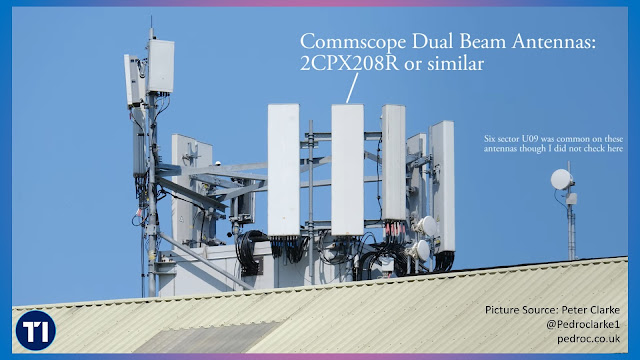
The site also features numerous high-end Commscope antennas with dual-beam panels that are needed to create six-sector LTE 800 and 900 MHz and then 24 port antennas that carry all the other including 8T8R 2300 MHz, 1800 MHz, 2100 MHz as well as n78 8T8R.

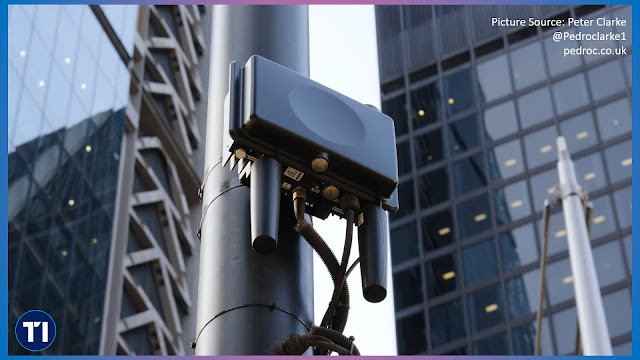
In addition, O2 has multitude of Nokia Small cells sprinkled across the City of London. While these come in all different shape and configurations. In many locations there are ones with directional antennas while there are others with omni-directional antennas as well.

The small cells are located on their own poles, rather than lamp posts and many of these also feature Wi-Fi access points as additional means to alleviate the capacity crunch. In fact they can also be mounted on-top of phone boxes, shops, side of buildings, etc. 

If this is an area of interest and you enjoyed reading the post above, you will no doubt enjoy watching this short video from Peter Clarke who has a great collection of infrastructure from UK and Ireland on his website here. Video as follows:

Related Posts

Friday, 4 June 2021

Three UK's Gigabit 5G Poles Explained


Peter Clarke does a great service to the mobile industry, especially in UK, with his detailed look at the mobile network's infrastructure. 

Three UK was Huawei shop but after the limitations imposed on them, they moved to Ericsson and announced with a big bang.

When they said in December that they will have 1000 5G sites, many were left wondering how many of those would be Huawei and Ericsson

But they did make a fantastic progress transitioning to E///

Now Peter has made a video detailing the Ericsson Three UK sites. It has a lot of useful information and is embedded below.

Let us know what do you think.

Related Posts:

Monday, 17 August 2020

Commscope's 4G / 5G Outdoor Small Cell Solutions


Commscope are well known for their small cells deployment solutions. Their small cell densification page contains a lot of different implementations, some of which have been compiled in the image above.

CommScope provides virtually everything needed to deploy outdoor small cells—from base station antennas, RF transmission systems and fiber to poles, concealment solutions and more. The Professional Services team can help with network designs, construction plans, and permitting.

In addition, Commscope offers a wide range of concealment options that integrate advanced technology into aesthetic packages to complement urban streetscapes and meet permitting requirements. The small cell site concealment solutions are designed to meet both thermal and aesthetic requirements across multiple types of radios and environments.

This 4G/5G Outdoor Small Cell Solutions Brochure provides more details while the Metro Cell Concealment Solutions video shows the solution.


Related Posts:

Wednesday, 17 April 2019

Vodafone UK improving coverage with Phone Boxes, Mini-masts & Manhole Covers


Scott Petty, CTO of Vodafone UK wrote a post about how 'our cunningly imaginative network team has devised some ingenious ways of boosting mobile reception.' While readers of this blog will have already seen most of these innovations from around the world on our blog, it's nevertheless an important step to bring connectivity to users in rural and remote areas that suffer digital exclusion.

Late last year, Vodafone talked about how their mini masts (picture on top) are making huge differences to JCB Staffordshire quarries. Around half the height of a standard mast, the mini masts can be painted to fit in with the local surroundings. The masts also require less power and electronic equipment.  This means they are ideally suited to providing a mobile signal in hard-to-reach rural business locations, such as the two JCB sites, near its World Headquarters. The mini mast is developed in partnership with infrastructure technology company Commscope according to the PR.

Continuing from the original PR:


4G networks can easily become congested in densely populated cities. This is especially true for urban areas regularly visited by waves of tourists, such as London’s Covent Garden. Fitting a mini-mast to the underside of a manhole cover to increase mobile coverage may sound bizarre, but it makes perfect sense. Our incredibly fast fibre optic network runs beneath the streets of Covent Garden and provides the bandwidth muscle behind our manhole cover mini-masts. Each mini-mast isn’t designed to boost coverage for all of London or even the West End, but for specific stretches of Covent Garden where overwhelming demand for a strong and stable 4G signal would otherwise go unmet.

But manhole cover mini-masts won’t be appropriate or possible in every locality. For some places, such as Edinburgh’s historic Princes Street, mini-masts built into phone boxes make more sense. These converted phone boxes not only provide a boost to mobile reception on this bustling thoroughfare, but help preserve a much-loved icon of our national urban heritage.

In a post back in December, I wrote about Small Cells in Phone Boxes here.

In another press release yesterday, Vodafone said:

Picture source: ThinkSmallCell

Visitors to the popular seaside resorts of Polzeath and Sennen Cove in Cornwall this Easter can now receive fast mobile Internet and great voice reception along the beach after Vodafone installed the latest 4G technology in beachfront phone boxes.

Mobile coverage can often be difficult to provide in remote areas and coastal locations due to the local topography and the lack of power and fibre cables needed to link up masts. Vodafone is continually looking at new ways of providing customers with great coverage, including by installing 4G technology into traditional phone boxes, returning them to their roots.

Beach-goers will not only be able to use their smartphones on Vodafone’s ‘4G from a phone box’ service within approximately a 200-metre radius. They can also make use of Vodafone’s range of connected devices, including the V-Pet Tracker to help you pinpoint a dog that has wandered off.

Vodafone is working on a number of initiatives to help support the Government’s ambition of extending mobile coverage to 95% of UK landmass by 2022. In addition to drawing up industry-wide proposals to create a single rural network to cover not spots and partial not spots, last year, Vodafone achieved an industry first by installing the UK’s first mini mobile mast at Porthcurno in Cornwall.


The Cornish 4G-enabled phone boxes are equipped to cope with the increase in mobile usage over the Easter break and over the summer months. During the heatwave in 2018, our network in Cornwall carried nearly 90% more mobile Internet traffic than the previous year.

Vodafone is also testing 4G in phone boxes in busy shopping areas in Edinburgh, Oxford and soon in London. At its technology headquarters in Newbury, Berkshire, Vodafone is trialling housing 4G on the underside of manhole covers.

All pictures, unless mentioned are from Vodafone.


Related posts:

Monday, 21 November 2016

Friday, 13 May 2016

Small Cells Deployment Stories


I recently got an opportunity to hear about the small cell deployment studies, organised as SCWS pre-conference workshop. The combined slides from the presentation are embedded below and available to download from Small Cell Forum page here.