Showing posts with label Region Europe. Show all posts

Tuesday, 25 August 2026

Rome 5G Shows How Neutral Host Infrastructure Can Modernise a Historic City

Deploying better mobile connectivity in a modern city is rarely straightforward. Doing it in Rome, where much of the historic centre is protected and almost every street seems to contain something of archaeological or architectural significance, takes the challenge to another level.

This makes the Roma 5G project particularly interesting from a telecoms infrastructure perspective. Rather than relying simply on more conventional macro sites, the project combines neutral host infrastructure, small cells, fibre, Distributed Antenna Systems (DAS), Wi-Fi and IoT infrastructure to improve connectivity while minimising the impact on the city itself.

The project was originally led by Boldyn Networks through a 25-year public-private partnership with Roma Capitale. The original plan included more than 2,200 small cells, public Wi-Fi across 100 squares, around 1,800 IoT modules, 2,000 connected cameras and extensive mobile coverage across the Rome Metro.

One of the biggest challenges is obvious when walking around central Rome. Large towers and conspicuous new infrastructure are simply not suitable in many areas. The Boldyn case study explains that existing urban infrastructure, including lamp posts and bus shelters, could instead be used as mounting locations for small cells. This allows capacity to be placed closer to users while keeping the radio equipment relatively unobtrusive.

This is an increasingly important aspect of mobile network densification. In very busy locations, improving capacity is not necessarily about building another large macro site. A layer of smaller radio nodes, supported by fibre and integrated with existing street furniture, can provide capacity exactly where it is required.

Rome provides an unusually demanding example of this approach because infrastructure deployment also has to coexist with archaeological restrictions, visual-impact requirements and huge numbers of residents and visitors.

The project goes beyond outdoor small cells. The Metro is another major part of the connectivity problem.

The original project envisaged 4G and 5G coverage through the stations and tunnels, creating a shared infrastructure that could be used by the mobile operators. The network uses a multi-operator Distributed Antenna System, with fibre and radio infrastructure carrying the operators' services through the underground environment.

This is important because neutral host infrastructure avoids every operator having to independently install essentially the same physical infrastructure. A shared fibre, DAS and antenna layer can support multiple operators while reducing duplication, construction work, cost and disruption.

The same principle applies above ground. The infrastructure is designed to be open to mobile network operators rather than acting as another competing mobile network. Neutral hosting effectively separates ownership of much of the physical connectivity infrastructure from the retail mobile services running over it.

This is arguably one of the most interesting lessons from Roma 5G.

As networks become denser, particularly in city centres, transport systems, stadiums, airports and other high-footfall locations, it becomes increasingly difficult to justify every operator installing a completely separate set of infrastructure. Shared infrastructure can provide a more practical way of achieving the required density.

The project has evolved considerably since Boldyn published its original case study.

In October 2024, INWIT acquired a controlling 52.08% stake in Smart City Roma, the project company originally known as Boldyn Networks Smart City Roma. Boldyn remained involved in the infrastructure build-out, while Smart City Roma became part of the INWIT Group.

Deployment has also moved from plans into operational infrastructure.

In April 2025, the first nine Metro A stations were activated with multi-operator 4G and 5G coverage, including connectivity through the tunnels between the stations. The infrastructure supports Fastweb-Vodafone, Iliad, TIM and WINDTRE.

By September 2025, coverage had been completed across all 27 stations and tunnels on Metro Line A, using more than 85 km of fibre and around 1,500 mini-antennas. At the same time the city was progressively activating Wi-Fi 6, cameras and other smart-city infrastructure across Rome's public squares.

The rollout has continued during 2026. INWIT reported that by the end of June, work had been completed across Lines B and B1, reaching 48 Metro stations overall, while deployment was under way at seven stations on Line C.

The outdoor network has also continued expanding. By March 2026, infrastructure including public Wi-Fi, IoT systems, cameras and small cells had reached 92 squares, and INWIT subsequently reported free Wi-Fi connectivity across 100 Rome squares during summer 2026.

There is an important distinction here between connectivity infrastructure and smart-city applications.

The network does not automatically make Rome a smart city. What it provides is the digital foundation on which applications can be built. The original plan included connected cameras, environmental sensors and other IoT systems, potentially supporting areas such as traffic management, public safety, environmental monitoring and waste management.

The diagram in the Boldyn case study provides a good summary of this layered approach. It combines indoor coverage for buildings, street-level sensors and cameras, outdoor small-cell coverage, Wi-Fi 6 in public squares, fibre connectivity and 4G/5G DAS throughout the Metro.

The result is therefore much more than a conventional mobile-network rollout.

It is effectively a shared digital infrastructure layer for the city, with different access technologies being used depending on the requirement: macro mobile where appropriate, small cells for street-level capacity, DAS underground, Wi-Fi for public access, fibre for transport and backhaul, and IoT connectivity for municipal applications.

The recently released Threads of Connectivity documentary, featured on National Geographic's digital platforms, looks at the challenge of bringing modern connectivity into two cities whose infrastructure was built long before anyone imagined mobile networks: Rome and New York. The Rome segment is particularly interesting because much of the successful infrastructure is deliberately designed not to be noticed.

That may ultimately be one of the most important lessons from Roma 5G.

As mobile networks continue to densify, the infrastructure supporting them may increasingly need to disappear into the environment rather than dominate it. Small cells integrated into street furniture, shared fibre, multi-operator DAS and neutral-host models make it possible to add significant network capacity while reducing duplication and visual impact.

Rome may be an extreme example because of its history and architecture, but the underlying problem is common to cities everywhere.

The future of urban mobile infrastructure may therefore be less about building more obvious mobile sites and more about creating a dense, shared and largely invisible connectivity layer woven into the city itself.

Related Posts: 

Thursday, 27 November 2025

Nokia and Citymesh Bring Drones-in-a-Box to Life Across Belgium

Belgium is emerging as a true pioneer in aviation, public safety and telecom convergence, thanks to the nationwide Drones-in-a-Box network delivered through the partnership between Nokia and Citymesh. What began as small-scale trials in ports and industrial zones has now grown into one of the most ambitious drone grid deployments in the world. It blends 5G connectivity, automated drone operations and remote command capabilities to support emergency response and critical infrastructure monitoring.

Citymesh, now well established as Belgium’s newest mobile operator and a European leader in private networks, has been championing the idea of safety drones for several years. The company has already proved the concept in locations such as Brussels Airport, the Port of Antwerp Bruges, Kortrijk and Genk. These pilots demonstrated how much time is lost in the first moments of an incident when responders are unsure of what they will face. A drone that can be airborne in seconds and provide live video, thermal analysis and AI-assisted insights significantly improves situational awareness.

Nokia’s Drone Networks platform is central to the national rollout. The agreement covers 70 Drone in a Box units which are positioned across 35 emergency zones. When integrated with Nokia’s 4G and 5G connectivity, the drones can be remotely launched from one of Citymesh’s Remote Operations Centres. These centres operate around the clock and ensure that flights remain compliant with aviation rules while delivering reliable coverage during both planned and unplanned missions.

The platform is engineered for demanding environments. Each drone carries high definition and thermal cameras capable of identifying smoke, fire boundaries and people. Twin 4G and 5G modems maintain real time links, and the Nokia MX Industrial Edge keeps sensitive data processed and stored locally. A presentation by Citymesh at Portcomms 2025 highlights additional elements such as certified parachutes, environmental control in each docking station and a robust API framework that allows further integration with port systems, security platforms or smart city tools.

Operationally, the SENSE network is already proving its value. In the first years of service the drones have supported more than a thousand beyond visual line of sight flights and hundreds of flight hours. The system has been validated across busy urban environments, coastal zones and industrial complexes. With three Remote Operations Centres and certified pilots, Citymesh has created a repeatable operational model that blends telecom expertise with aviation-grade processes.

The impact goes beyond emergency response. Ports and industrial plants are using drones for inspections, environmental monitoring, perimeter detection and asset management. The presentation shared at PortComms 2025 outlines how ports benefit from fast inspection of quays, cranes, buoys and fumigation zones, as well as pollution detection and situational awareness for safety teams. Similar gains are emerging across utilities, transport operators, municipalities and even defence, where civil and security use cases can share the same network.

The legislative environment in Belgium currently restricts nationwide beyond visual line of sight operations to emergency services, but future expansion into commercial use cases is expected. As demand grows for automated inspections, border surveillance and environmental assessment, the Drone-in-a-Box network provides a ready-made foundation for new services.

For Nokia, the project reinforces its role in mission critical communication systems and industrial digitalisation. For Citymesh, it marks the evolution from smart city experimentation to a smart country approach where aerial intelligence becomes a first line tool for public services.

Belgium’s nationwide drone network is an example of how telecom infrastructure continues to evolve. Private 5G, edge computing and automated platforms are increasingly central to public safety and industrial operations. The Nokia and Citymesh partnership shows what is possible when connectivity, aviation technology and real operational requirements come together with a clear purpose. 

Tuesday, 23 April 2024

'Connected Urban' - CU Phosco's 5G Smart Pole Streetlight Solution

When it comes to deploying outdoor small cells and infrastructure on streetlights and lamp posts, Germany is at the forefront. Check out the related posts at the bottom of this post to see all that's going on there.

In a recent press release, Telefónica Deutschland announced (Google translated from German):

The telecommunications provider O2 Telefónica and the infrastructure provider 5G Synergiewerk, together with the Würzburg public utilities, have put the first 5G street light into operation in Bavaria as part of a pilot project. The 5G lighting tower combines street lights and cell phone sites. In doing so, it fulfills two central utility tasks: to provide lighting at night and at the same time to offer the city's citizens a high-performance 5G mobile network.

The aim is to use the existing urban infrastructure as efficiently as possible for an improved mobile network and new digital applications - and thus increase the quality of life for city residents.

CU Phosco Lighting, which supplied the smart pole solution, announced on its website: 

CU Phosco Lighting is thrilled to announce the successful deployment of Connected Urban, its pioneering new smart pole solution designed to enhance mobile network capacities. As part of a Pilot project with our German partner, 5G Synergiewerk, the first 5G streetlight was recently installed in Würzburg, Bavaria, in collaboration with telecommunications provider O2 Telefónica and the Würzburg public utilities.

A smart city, modular, and fully customisable lighting and small cell high-performance mobile network solution within a single, compact footprint, Connected Urban is a break away from more traditional rooftop or cell phone mast locations, and so the installation marks a significant milestone in the evolution of street-level mobile network densification.

Replacing a conventional lamp post, the innovative solution efficiently utilises existing infrastructure and grid connections, to provide citizens with both night-time lighting and advanced telecommunications capabilities, setting a new standard for high-performance 4G and 5G mobile connectivity.

With digital infrastructure facing increasing demands, including music and video streaming, the Metaverse, AI-based programmes, augmented and virtual reality, as well as connected driving and autonomous logistics, Connected Urban is poised to significantly improve the quality of life for city residents and businesses.

5G Synergiewerk has a time-lapse video of the installation of 5G mast system on their website. A video of that embedded below:

Quoting again from Telefónica's press release:

The location on Versbacher Straße is the first active 5G street light in Bavaria . Another location will follow shortly on Schweinfurter Straße, which will conclude a successful pilot project . Coordination discussions are currently being held with all those involved for additional locations. The 5G street light offers smartphone users high bandwidths with 5G and 4G/LTE for mobile telephony and data use in the O2 network. The densification of the mobile network via such small radio cells, which are known in technical jargon as “small cells” , is particularly helpful with regard to the increasing data usage of O2 customers as well as future digital applications in the private and business customer sector. In addition to everyday music and video streaming, this will also include the Metaverse, AI-based programs, augmented and virtual reality, connected driving and autonomous logistics . In Würzburg, more than 40 mobile phone locations are already operating in the O2 network . They ensure comprehensive network coverage with 2G (GSM), 4G (LTE) and the modern 5G standard. Rooftop locations or cell phone masts are usually used for this extensively developed city network.

Street lights are widely used as part of any urban infrastructure and are also suitable as radio cells. They have a power connection, so only a powerful fiber optic connection needs to be added to transport the mobile phone signals. In addition, the 5G light fits harmoniously into the cityscape with its light distribution. The replacement of the conventional street light was carried out in collaboration with the Würzburg public utilities. The infrastructure provider 5G Synergiewerk supplied the special intelligent light pole , a so-called “Smart Pole”. O2 Telefónica then installed the energy-efficient 4G/5G mobile communications technology in the light and ensures a seamless connection to the nationwide O2 mobile network .

Related Posts: 

Friday, 7 January 2022

5G for Defence and Autonomous Military Solutions

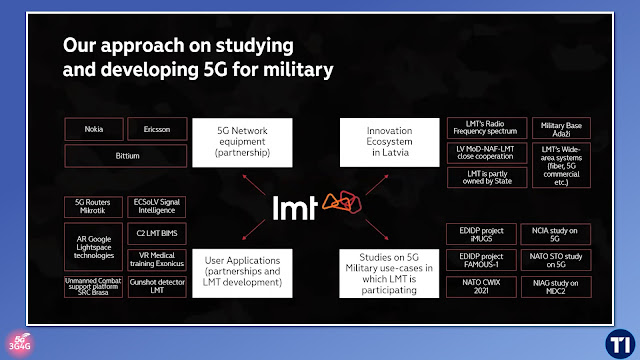
Integrated Modular Unmanned Ground Systems (iMUGS) consortium is a 13-party collaboration focused on standardising a European-wide ecosystem for aerial and ground platforms, command, control and communication equipment, sensors, payloads, and algorithms. The parties involved in the iMUGS project are Milrem Robotics, Latvijas Mobilais Telefons (LMT), Talgen Cybersecurity, Safran Electronics & Defense, NEXTER Systems, Krauss-Maffei Wegmann, Diehl Defence, Bittium, Insta DefSec, sol.one, dotOcean, GMV Aerospace and Defence, and Royal Military Academy of Belgium.

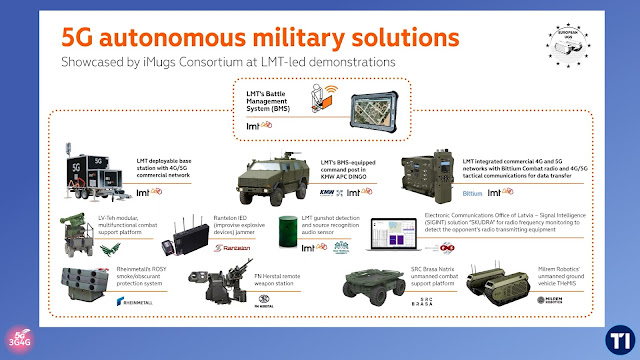
Within the iMUGS project, the Latvian MNO LMT is conducting a study on the potential use of 5G in autonomous military solutions. Back in September, the future role of 5G in autonomous military solutions was demonstrated by LMT in collaboration with the iMUGS Consortium. 

A press release said:

The demonstration, during which various scenarios were played out in battlefield-like conditions while showcasing specific use cases, took place today, on September 23rd, at the Ādaži military base in Latvia.

This was the second of a total of six demonstrations with the aim of showcasing the results of the iMUGS (Integrated Modular Unmanned Ground System) project – one of Europe’s leading defence industry development projects. The demonstration was organised by LMT, one of the members of the iMUGS consortium, with the support of the Latvian National Armed Forces and the project coordinator Milrem Robotics.

During the demonstration, the troops played out close-to-reality military scenarios in operational environments and relevant climatic conditions. Milrem Robotics’ unmanned ground vehicle THeMIS, was used, along with a number of other cutting-edge military technologies, such as:

  • LMT’s battle Information Management System for displaying the data of the payloads and as a command system for scenario execution
  • LMT’s Intelligence Surveillance Reconnaissance (IRS) system for performing aggressive fire detection and source recognition
  • The ISR system ‘Skudra’ for performing the signal intelligence mission
  • A highly protected wheeled vehicle DINGO 2 as a command post from which the mission was led

Alternative communication networks were used by the troop and an unmanned ground vehicle, in scenarios that included switching from a tactical network, provided by Bittium in collaboration with LMT, to 4G and 5G networks.

Some videos shared by LMT are embedded below:

At the 5G Techritory 2021, Armands Meirāns, Innovation Leader for Defence & Public Safety at LMT gave a presentation on 5G for Defense, as showcased by iMUGS Consortium. His talk is embedded below:

Related Posts:

Monday, 3 December 2018

Turin will be the first European city with a 'drone ready' 5G network


Last year I blogged about how TIM wants Turin to be the first 5G city in Italy. Since then I have also blogged about how TIM has rolled out "commercial" 5G across the whole of San Marino.

Turin (Torino) will be the first European city with a 'drone ready' network, thanks to the use of TIM's 5G technology. Last month measurement activities of the aerial coverage at high altitude was done in Piazza Vittorio Veneto and at the Parco del Valentino and Parco Dora. "The municipality of Turin will use the drones for security and we will experiment with the municipal police remotely piloted aircraft to control some areas most at risk of safety", explains Paola Pisano, councilor for innovation of the municipality of Turin. "Do not call it Big Brother, the goal is to support men in uniform operating on the territory" he continued. via La Repubblica (translated from Italian via Google translate)

The photos above are available on TIM Newsroom Flickr channel here.

According to Mobile World Live:

Telecom Italia and its partners flew remotely piloted aircrafts using 5G to measure mobile coverage in Turin in Italy, which the operator claimed will make the city the first in Europe with a drone-ready network.

The trial was coordinated with the support of the Turin Polytechnic University and enterprise drones solution provider Seikey.

Public safety, critical infrastructure monitoring and land protection are some examples TIM gave of drone applications that will benefit from a high quality connection to send data and videos in real time.

As can be seen in one of the pictures, the equipment used for measurements is PCTEL’s flagship IBflex® scanning receiver for sub-6 GHz bands that was announced at MWC Americas 2018. Here is a tweet from them with embedded video.

If for some reason you can't see the video, the direct link to YouTube video is here.

Tuesday, 2 August 2016

Small Cells: Best solution for rural coverage?

I drive around the UK a great deal. While I rely mostly on my phone to call and message/text, I also use it to check tweets, Facebook, emails and most important of all as a Satnav (I'm a big fan of Waze). I often end up in scenarios where I have no coverage so a wrong turn results in my Satnav route failure. This can mean I have to drive around for miles before I can get back on route.

In most countries (including UK) when an operator mentions its coverage, its means population based coverage. The problem is that one may have reasonable coverage in a big town/cities but not on small roads and villages but the operator would have still met their coverage obligation. However this will be changing, at least in UK, with the announcement by EE that they will do a 95% geographic coverage. Kudos to them!

Picture Source: Point-Topic

This map I came across recently shows the rural challenges in Europe for providing connectivity. Whilst not that detailed, I can definitely say from a UK point of view, there are many places outside big towns and cities that have coverage gaps.


As can be seen above, a similar problem is present in Africa and Carribean and Latin America (CALA). In these regions, in addition to the coverage gap, affordability and lack of relevant content are also major issues.

To put it simply in most countries, there is that last 10% of the population for whom coverage is not deemed feasible for the operator.  The problem is that the investment would generally outweigh the revenues. The installation (site, backhaul, etc.) and the maintenance cost would almost always outweigh the profits.


This is one of the challenges that Parallel Wireless* is trying to solve.

What if you can make the deployment very simple and reduce the installation cost and have minimal maintenance cost?

The operator would be far more willing to give it a try. There was an announcement between Parallel Wireless and Telefonica I+D for exactly this reason recently. The small communities wherein these small cells are deployed also have a vital role to play. Not only could they help by making sites available, they can have directly report any issues that would arise. An example of this can be seen in the picture above, demonstrating a small cell deployment in a community center.


An important thing to bear in mind is the support for different types of backhaul for small cells. While cellular/LTE backhaul can allow quick deployment, additional type of backhaul can become available much quicker than anticipated. The small cell deployment should be flexible enough to be able to handle this new change.


A real life example of the above statement can be seen in the picture from a recent site survey.

Finally, I would like to embed this video that explains the Parallel Wireless Rural Solution very well.


Please feel free to add your suggestions in the comments below.

*Full Disclosure: I work for Parallel Wireless as a Solutions Architect. This blog is maintained in my personal capacity and expresses my own views, not the views of my employer or anyone else. Anyone who knows me well would know this.