Showing posts with label Operator VMO2. Show all posts

Thursday, 3 July 2025

Transforming Poles into 5G Sites with Alpha Fusion Streetworks Solutions

During a recent visit to Glasgow for the SCONDA project showcase, a collaborative initiative focused on advancing urban connectivity, I was struck by how far street-level network infrastructure has come in combining functionality with aesthetics. Among the most visually discreet and technically advanced deployments were those featuring Alpha Wireless' wraparound antennas. The AW4032 antenna stood out for its innovative design, enabling mid-pole mounting in a configuration that blended effortlessly with the urban environment while delivering high-performance 5G coverage. 

Live tests on attendees’ devices showed 5G download speeds reaching up to 720 Mbps, with improved coverage and congestion relief across city-centre locations. One attendee reported that the deployment achieved average 5G download speeds of 520 Mbps, while also reducing low-speed hours by 89% and reaching peaks of over 1 Gbps on small cells in a live dense environment.

Alpha Wireless has developed its Fusion Streetworks solutions with a clear understanding of the challenges faced by operators in urban areas. As network densification accelerates, especially with the move towards 5G standalone architectures, securing new street-level sites is proving increasingly difficult. The Fusion Streetworks platform responds to this by making better use of existing infrastructure such as lamp posts and streetlights. The AW4032 antenna, which forms the centrepiece of this platform, is designed to mount mid-pole without requiring sidearms or external hardware that would increase wind loading or visual impact. As it is an antenna-only product, the AW4032 pairs with external small cell radios, offering operators flexibility in radio selection.

The AW4032 combines compact form with support for advanced radio capabilities. It supports 16 ports across dual bands — 1695 to 2690 MHz and 3300 to 4200 MHz — and enables 4x4 MIMO, delivering strong signal quality and throughput. When ports in adjacent sectors are connected, the antenna produces a pseudo-omnidirectional pattern, providing seamless 360-degree coverage suitable for dense urban environments, hotspots and high-traffic venues. It is also highly adaptable. Operators can configure the ports to suit different patterns: back-to-back for focused directional coverage, or four-way for broader area coverage, all using the same hardware.

This modularity means the same unit can serve single or dual-operator deployments, with each operator connecting to a separate set of ports. This enables shared infrastructure without interference and lowers total cost of ownership. For instance, the dual-operator setup divides the 16 ports between two MNOs while still offering pseudo-omni performance, which is particularly useful in areas where zoning permissions limit the number of separate installations.

What makes the solution especially effective in public spaces is the attention to detail in concealment. The Fusion platform includes options for radio shrouds and integrated cabling management to maintain a neat appearance. This has been instrumental in speeding up approvals in areas traditionally sensitive to new telecoms infrastructure.

Alpha Wireless has already seen its Fusion Streetworks solutions rolled out as part of a 5G standalone deployment in central Birmingham. Working with Ontix and Virgin Media O2, these antennas have been deployed on existing poles in busy city locations, demonstrating how legacy infrastructure can be revitalised to meet the demands of next-generation connectivity.

From an infrastructure perspective, the AW4032 exemplifies how antenna technology is evolving to match the operational and regulatory pressures of modern small cell deployment. It simplifies rollout, minimises street clutter, and offers a level of future readiness that is essential for long-term network planning. For cities looking to accelerate their 5G ambitions without compromising on design, Alpha Wireless’ Fusion Streetworks platform offers a proven and practical approach.

Sunday, 10 October 2021

Multi-sectorised sites and Small Cells help O2 UK handle Capacity in Busy Areas

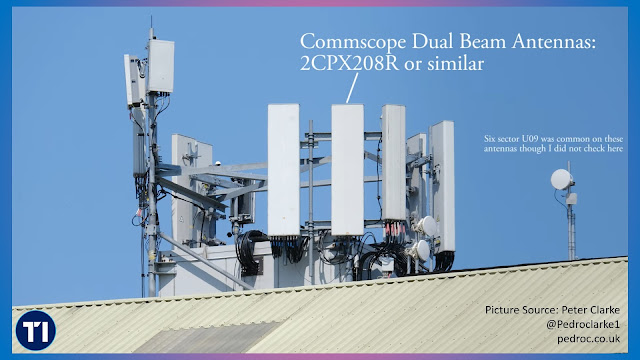
Radio planning becomes essential in dense urban areas where operators don't only have to serve the highly mobile users but also slow moving pedestrians and users indoors. One some location in London, UK, is O2 UK's highest capacity Nokia site with six-sector low-band LTE in 800 and 900MHz in addition to high-band 4T4R L18/L21, 8T8R L23 as well as standard n78 8T8R 5G.

The site also features numerous high-end Commscope antennas with dual-beam panels that are needed to create six-sector LTE 800 and 900 MHz and then 24 port antennas that carry all the other including 8T8R 2300 MHz, 1800 MHz, 2100 MHz as well as n78 8T8R.

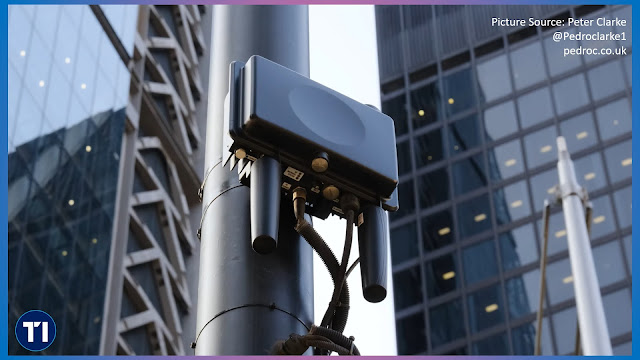
In addition, O2 has multitude of Nokia Small cells sprinkled across the City of London. While these come in all different shape and configurations. In many locations there are ones with directional antennas while there are others with omni-directional antennas as well.

The small cells are located on their own poles, rather than lamp posts and many of these also feature Wi-Fi access points as additional means to alleviate the capacity crunch. In fact they can also be mounted on-top of phone boxes, shops, side of buildings, etc. 

If this is an area of interest and you enjoyed reading the post above, you will no doubt enjoy watching this short video from Peter Clarke who has a great collection of infrastructure from UK and Ireland on his website here. Video as follows:

Related Posts: 

Monday, 28 May 2018

CCS MultiPoint-to-MultiPoint (MPtMP) mesh wins Small Cell Forum Award

Picture Source: Lightspeed via Twitter

CCS recently won Small Cell Forum award for "Excellence in Commercial Deployment (Urban) category" for  Ultra-Fast, Next-Generation Backhaul Network in London’s Square Mile.
David Chambers, ThinkSmallCell wrote an in-depth article on this topic last year (here) but since then lot more small cells and new WiFi points have come up. The picture on the top shows the CCS Metnet backhauling a Wi-Fi hotspot and a Nokia Flexizone small cell from O2. Only recently has CCS declared that the City of London project is up and running. As pointed out in the article:

  • CCS frames Metnet as the “world’s only self-organising 5G microwave backhaul”. Operating in the licensed 28GHz band, Metnet nodes are said to be unobtrusive and easy to install, with a wide field of view to minimise the need for radio unit installation.
  • The CCS launch declaration also indicated that Nokia Flexi Zone small cells are being used for 4G connectivity, which is then carried over Metnet. This appears to be the first time Nokia has been referenced in connection with the City contract, with previously identified partners including Cisco Systems as a provider of access points for the Wi-Fi network, and Virgin Media for delivering core fibre links.

While the London deployment is in 28GHz band, the solution is also available in other bands as follows:


A more detailed datasheet is available here.

Finally, here is a nice video of the London Square Mile Deployment


Saturday, 9 September 2017

Small Cells World Summit 2017 Summary


I realised that I never got round to writing a summary post for Small Cells World Summit 2017. In fact I was waiting for summaries for various publications before writing a post but there was much less coverage this year.

Having said that, there were reasonable number of operators and most major vendors present. Small cells have sort of gone mainstream from their niche as many operators are now talking of small cells for 5G (mainly higher frequencies).

Anyway, here are some links with what I found interesting that you can explore further.

Here are some things ThinkSmallCell reported. Full report here:

SCWS, now in its 9th year, remains a regular feature of the small cell calendar. Now a two day conference, attendance was lower than some years ago but stable with noticeably more system integrators/installers actively participating. There was a little more focus on business enablers rather than technology this year, addressing deployment issues and neutral host opportunities for enterprise, urban and rural sectors.
...
The scope of SCWS is intended to embrace all of Small Cells, DAS and (Public Access) Wi-Fi. We saw one or two more DAS vendors participate but there was relatively little public Wi-Fi content. Perhaps that reflects the limited interest for that in Europe, as we saw at the recent Wireless Broadband Congress. The program included a few keynote speakers from operators (EE, O2, ATT, KDDI, Softbank) and some industry verticals (AEG, which operates the O2 dome and other stadiums; Grange Hotels etc.)       

Many mature small cell products are available today for both 3G and LTE. Form factors continue to shrink, software is becoming further automated and refined. The backhaul conference stream has been dropped with CCS now the most prominent independent small cell backhaul vendor.
...
The event provides an excellent opportunity to meet and reconnect with industry players, both old and new. The emphasis and participation has evolved over the years, but it remains a key focal point to assess the current state of play for the industry.

Here are some things The Mobile Network reported. Full report here:

The day before the Summit started Nokia assembled a few journalists in a meeting room and gave them a portfolio update. Of note in this was the revelation that the company will be shipping tens of thousands, in fact more than 50 thousand, of its Mini Macro cell sites to Sprint. This is on top of another wide scale roll out of the boxes – which are 2x20W sites in a 5 litre box – in China and Japan where the vendor expects to ship another 40,000. There are 3,000 headed to Brazil, as well, to be deployed as an underlay under Ericsson macro cells.
...
One notable aspect of the event was the amount of talk about using small cells in rural, in dense indoor and in other hard to reach areas. Mansoor Hanif spoke of some of the work BT is looking at to enable it to spread coverage to hard to reach areas. There is a real range of work, best summed up in this picture.

Of note is its work with TIP, where it hopes to be able to plug in open base stations as part of its Kuha community-run small cells programme – as per its project on the island of Harris supported by Nokia at the moment. With Lime Microsystems it is delivering a software defined radio base to Open Source, and hopes to attract developers to build applications on top of the Lime SDR platform. Hanif wants to move the cycle for introducing a new feature into a network from months to weeks – but he added that he doesn’t think any operator has the skills to manage that internally – hence the move to Open Source.
...
KDDI’s Fumio Watanabe presented some findings from the operators trials of mobile mmWave systems. The operator’s field trial use 40GHz and 60GHz bands, with a user moving between different bands and being “handed over” between access points. This sort of mobility requires dual interband connectivity and multi-site CoMP to handle the mobility between different sites and bands as a user goes out of line of site of an access point.

It may also require some architecture shifts Watanabe said, including the likes of ICN and MEC.
...
Backhaul provider CCS has a couple of things going on. First, it is involved as the backhaul provider to Telefonica O2’s deployment of outdoor WiFi and cellular small cells in the City of London. Steve Greaves, CEO, said that the company will support 450 small cells and 150 WiFi access points by siting its backhaul nodes at 30 Virgin media fibre points – with each backhaul node supporting 3-5 WiFi access points. The backhaul nodes are providing 1.2Gbps capacities at 24/26/28 GHz bands.

Greaves is also enthused by an upcoming product launch from CCS, as the company enters the 60GHz band with a 10Gbps product. Greaves says that CCS will go beyond products from the likes of Siklu, by modifying the basic WiGig chip that providers currently use, to add tighter carrier grade SynchE 1588, and greater interference control. The product will not be available until early 2018, he added.

Another interesting aspect of the City of London deployment – the concession model between the City of London and Telefonica – means that Telefonica must host other operators’ small cells within the deployment if asked. But these may not be on the same pole as Telefonica’s small cells, given there is a limit of two boxes per pole. From a backhaul perspective – that obviously introduces more complexity – as Telefonica must introduce a V-LAN for each operator, with different QoS.

Virgin Media Business, by the way, has 100,000 cabinets in London alone, and wants to use them to act as potential hosts for small cells, by adding a small pole to the cabinet, said its adviser Paul Coffey. The company is also looking at enabling neutral host model using its street infrastructure. Its wholesale business supplying backhaul to the UK’s operators already runs to £150 million per year, Coffey said.

Related Posts:

Saturday, 3 June 2017

Temporary masts for festivals, events, etc.


I really enjoyed watching couple of video's from Peter Clarke of temporary masts that are installed at events like Glastonbury festival and other high profile events.  They are both embedded below:


If you enjoyed, check out more videos like these on his Youtube channel here.