Showing posts with label NFV. Show all posts

Friday, 27 February 2026

Samsung Brings AI Across Every Layer of the Network to Power Next Generation Telecom Infrastructure

Artificial intelligence is rapidly becoming a defining capability in modern telecom networks. As operators continue to expand 5G and prepare for the transition to 6G, the scale and complexity of networks are increasing significantly. In this environment, automation, efficiency and adaptability are becoming essential. Samsung is positioning artificial intelligence as a core technology that can operate across every layer of the network to help operators manage this complexity while unlocking new capabilities.

Much of the industry conversation around AI integration in telecom networks has recently focused on the concept of AI-RAN. Within the AI-RAN Alliance, this is commonly described through three dimensions: AI for RAN, AI on RAN and AI with RAN. These categories describe how artificial intelligence can enhance radio network performance, support new edge-based services and enable the coexistence of AI workloads and network functions on shared infrastructure.

Samsung is actively involved in this industry effort, but its strategy extends beyond the radio layer alone. The company is promoting a broader approach to AI-powered networks that combines end-to-end software-based architecture with distributed computing capabilities. In this model, artificial intelligence is not limited to a specific part of the network. Instead, it is embedded across the entire infrastructure, from the radio access network to the core network and operational management systems.

A key element of this approach is Samsung’s focus on software-based and virtualised network architectures. Virtualised RAN deployments running on commercial off-the-shelf servers provide a flexible platform where both network workloads and AI functions can operate together. This allows operators to introduce AI capabilities without needing to completely redesign their infrastructure.

Through its network automation platform, Samsung is applying AI to a wide range of operational tasks. These include predicting traffic patterns, identifying anomalies in network performance, optimising radio parameters and balancing loads across spectrum bands. By analysing large volumes of operational data, AI systems can automatically adjust network behaviour to maintain performance and improve efficiency.

Energy optimisation is another area where AI-driven techniques are being applied. As mobile networks expand and traffic patterns fluctuate throughout the day, intelligent algorithms can determine when certain network features can be adjusted or scaled down to reduce power consumption without affecting user experience. These types of capabilities are becoming increasingly important as operators focus on both operational efficiency and sustainability.

Samsung is also exploring how artificial intelligence can improve radio performance directly within the protocol stack. Machine learning techniques can enhance channel estimation at the physical layer, allowing the network to reconstruct radio signals more accurately even in challenging environments. At higher layers, AI can support link adaptation by identifying optimal modulation and coding schemes for each user based on real time radio conditions. Even connection management processes can benefit from AI driven optimisation, improving both device battery efficiency and network resource utilisation.

Beyond improving the network itself, Samsung is also examining how telecom infrastructure can support AI workloads. Modern base stations and edge compute platforms contain significant computing resources. When network traffic demand is low, some of this capacity can remain unused. By running AI inference tasks on the same infrastructure, operators can make better use of these resources while supporting new services.

Edge based AI applications are particularly relevant in industrial environments. Real time video analytics, safety monitoring and automated quality inspection are examples of workloads that benefit from processing close to the data source. Running these applications on infrastructure that already supports radio functions reduces latency and avoids sending large volumes of data to central cloud platforms.

Samsung describes this convergence between communications infrastructure and computing capabilities as a shift towards networks functioning as distributed data centres. In this model, the network becomes both a connectivity platform and a processing environment capable of supporting AI driven applications. The concept combines two complementary perspectives: building networks that support AI workloads and using AI to improve how networks operate.

This architectural shift also has implications for the hardware layer of telecom infrastructure. Traditional mobile network equipment has relied heavily on specialised system-on-chip designs. However, the rapid development cycle of general purpose processors and accelerators is encouraging a more flexible approach. Samsung’s virtualised infrastructure strategy allows operators to deploy workloads on a mix of CPUs and GPUs, drawing on technologies from companies such as Intel, NVIDIA and Arm Ltd.. This enables operators to scale AI capabilities across different parts of the network depending on where computing power is needed.

As telecom networks evolve towards cloud native and software driven architectures, the role of artificial intelligence will continue to expand. By embedding AI across radio, core and operational layers, Samsung is highlighting how networks can move beyond traditional connectivity and become intelligent platforms capable of continuous optimisation.

With 5G Advanced deployments underway and early discussions around 6G gathering momentum, the integration of AI into telecom infrastructure is likely to accelerate. Samsung’s strategy suggests that the future network will not simply transport data, but will increasingly analyse, optimise and process it within the network itself, transforming the way operators design and operate their infrastructure.

Related Posts: 

Tuesday, 30 September 2025

O-Cloud Driving the Future of Open RAN

For mobile operators, O-Cloud provides the cloud-native platform needed to automate RAN functions, integrate multi-vendor solutions, and optimise network performance at scale.

The Open Cloud, or O-Cloud, is the physical and software foundation that lets operators deploy open RAN in a cloud-native way. At its core an O-Cloud node bundles CPUs, memory, storage, network interfaces, board management controllers and optionally accelerators such as FPGAs to offload computationally heavy tasks. An O-Cloud is not a single machine but a set of resource pools that may be distributed across a centralised site and multiple edge locations. Together those pools provide the compute, storage and timing environments required to host O-RAN central units and distributed units, the management and orchestration layers, and observability and lifecycle services that keep everything running reliably.

Technically oriented operators will want to think of O-Cloud as an integrated stack of requirements rather than a single product. It must support bare metal deployment and tight integration with container orchestration for cloud-native network functions. It needs multi-cluster lifecycle management with automated scaling, network isolation primitives and deterministic CPU and memory control for real-time workloads. Features such as SR-IOV, PCI pass-through, DPDK support, huge pages and device plugins for FPGA or GPU enable low-latency packet I/O and hardware acceleration where needed. Time synchronisation is another non-negotiable; GNSS, PTP and SyncE support are all necessary for distributed scenarios that demand precise phase and timing alignment. On the management side the O-Cloud must provide board and host management, configuration and fault management, secure software update mechanisms and an infrastructure inventory that reports capabilities and resource availability to the orchestrator.

Why O-Cloud matters is best understood by mapping those technical building blocks to operational problems that operators face today. Mobile networks are now a mesh of legacy architectures, virtualised elements and new cloud-native components. Manual processes and basic automation are no longer sufficient to optimise service quality, scale to demand, or keep costs under control. The O-RAN Service Management and Orchestration framework, coupled with the O-Cloud, enables standards-based infrastructure management and cross-organisational data collection. That combination is the prerequisite for sophisticated automation and the application of AI techniques across the RAN.

A concrete operational capability driven by O-Cloud is application homing. When the orchestrator has an accurate inventory of O-Cloud resources and real-time telemetry, it can place workloads on the cloud instance that best meets the latency, throughput and cost profile required by an application. In practice this means low-latency services can be hosted on edge clusters with real-time OS and hardware acceleration while less-sensitive workloads run in centralised clusters that maximise cost efficiency. The O2 interface between the SMO and O-Cloud is what makes this possible by allowing registration and continuous inventory updates so the orchestrator always has an up-to-date picture of available resources.

Multi-cloud orchestration is another operational lever. In a disaggregated ecosystem operators can choose cloud providers or on-prem platforms based on geography, performance, pricing or regulatory requirements. Effective orchestration distributes workloads across these environments to optimise resource usage and resilience. For example, automatic lifecycle management and rolling updates let operators patch and upgrade clusters with minimal service disruption, while integrated observability ensures fast detection and remediation of performance degradations. These capabilities not only improve quality of experience for subscribers but also reduce operational effort and human error.

Security, isolation and regulatory compliance are built into the O-Cloud requirements. A Zero Trust approach that hardens host operating systems, enforces strict service-to-service authentication and integrates automated security testing into CI/CD pipelines is essential. Multi-tenancy and isolation at compute, network and storage layers are critical where regulators demand separation for emergency services, hospitals or public safety. Managing hardware accelerators and firmware securely is also part of the platform responsibilities.

Deutsche Telekom’s independent O-Cloud proof of concept demonstrates how these technical concepts translate into reality. Working with Red Hat and IBM, Deutsche Telekom used Red Hat OpenShift as the CaaS (container-as-a-service) layer to provide the container runtime, cluster lifecycle tools and GitOps-based operations. Red Hat’s automation tooling was used to implement zero-touch provisioning so hardware could be rapidly onboarded and configured. IBM Consulting supported the integration, system design and lifecycle automation that enabled rapid deployment, monitoring and observability across the lab environment. The trial, completed within six months, validated automated lifecycle management, observability and the integration of hardware and software with open interfaces.

The trial’s outcomes reinforce the argument that a properly engineered O-Cloud enables multi-vendor interoperability and operational freedom. Automation and monitoring requirements were met with minimal human intervention. Flexible infrastructure and vendor independence give operators choice and the ability to continuously select best-in-class components. Crucially, the PoC showed that inventory and capability reporting combined with orchestration can enable application homing and cross-cloud resource optimisation in practice, not just in theory.

Looking ahead, real-world O-Cloud deployments will need to balance competing priorities. Operators must plan migration paths that preserve legacy services while incrementally introducing cloud-native elements. They must invest in platform automation, observability and security, and build operational processes that exploit rather than fight cloud-native lifecycle paradigms. Energy and cost management must be considered at the infrastructure layer so that scaling decisions also reflect carbon and capex/opex objectives. Finally, industry collaboration and lab-to-field testing will remain important to refine standards, validate interoperability and mature the tooling around SMO, the O2 interface and multi-cluster management.

O-Cloud is therefore both a technical specification set and an operational philosophy. It ties precise platform requirements to the automation, orchestration and vendor independence that open RAN promises. Deutsche Telekom’s PoC shows that the blueprint works in practice and that the path to cloudified, multi-vendor RANs is feasible when infrastructure, orchestration and automation are designed together. For operators seeking to deliver programmable, resilient and cost-effective 5G and beyond, investing in O-Cloud capabilities will be a defining step on the road to modern RAN operations.

Related Posts: 

Friday, 10 December 2021

Telefonica on the Impact of 5G so far

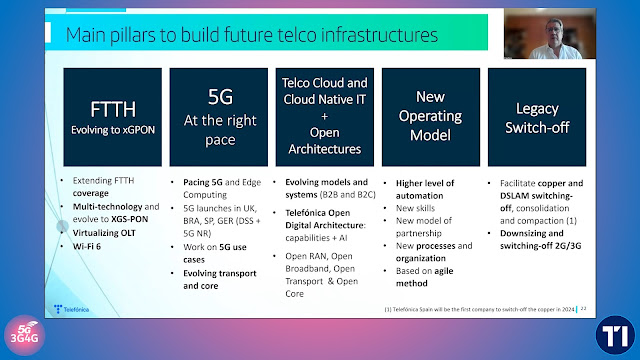
Enrique Blanco, Global CTIO, Telefónica presented a Keynote at Telecoms Europe 5G 2021 virtual event on 9 Nov 2021. The title of his presentation was What’s the impact of 5G so far? and it discussed how the unprecedented speed is just the start of how 5G is changing the face of connectivity. What has been the impact so far on how people live, work, and play, all over the world? 

The video of his talk is embedded below.

Related Posts:

Friday, 11 June 2021

AWS for Public and Private 5G Networks

I wrote about AWS Edge being used to power Private Networks and Industry 4.0 back in March. Since then we had this big announcement from DISH and AWS about formation of 'Strategic Collaboration to Reinvent 5G Connectivity and Innovation'.

It talks about how the new US operator, DISH, will leverage AWS infrastructure and services to build a cloud-based, 5G Open Radio Access Network (O-RAN) that delivers consistent, cost-effective performance from core to the edge. 

Netmanias has done an awesome job of explaining how AWS will be used in the Dish network and compares it with the Rakuten Virtualised network. Reproducing the original from them below.


In addition, they have also done a fantastic job of explaining how different operators are planning to use AWS in their Networks. 


You can read more details for each of the operators below:

  • AWS and Verizon Expand 5G Collaboration with Private MEC Solution
  • AWS and Vodafone Business Bring Edge Computing Closer to Organizations in Europe
  • Announcing the first AWS Wavelength Zone in South Korea on SK Telecom (SKT)’s 5G network
  • KDDI To Launch "AWS Wavelength" On December 16, Offering Ultra Low Latency on the 5G Network Edge
  • Singtel and Optus expand 5G ecosystems with AWS for 5G edge computing
  • Telefónica Germany / O2 builds new 5G core network in the cloud
  • DISH and AWS Form Strategic Collaboration to Reinvent 5G Connectivity and Innovation
  • Bell Canada teams up with AWS for edge computing

Let us know what you think about the operator strategy of moving to AWS for something or other.

Related Posts: 

Saturday, 3 April 2021

Transition to Infrastructure 2.0

Infrastructure can mean different things to different people in different industries. We tried to explain what it means in the telecoms industry in one of our tutorials here.

When it comes to Infrastructure 2.0, there are articles dating back years. Couple of examples here and here. Back in those days we were talking more about virtualization while today we are talking about containerization and cloudification. We have some introductory presentations on Cloud Native here.

I have heard Qualcomm speakers talk about Infrastructure 2.0 but what does it mean from their point of view? Here is what Cristiano R. Amon, President & CEO-Elect of Qualcomm meant according to RCR Wireless: 

Infrastructure 2.0 seeks to address the fact that existing core network infrastructure is limited in its ability to handle the highly virtualized network models that the industry is moving toward.

For instance, there has been some concern for awhile now around how data center virtualization will impact existing enterprise networking models.

At the CTIA event, Amon explained that 5G will be revolutionary, creating new industries, use cases, services and network models. However, a network capable of doing all that 5G promises requires “infrastructure like we’ve never seen.”

“It needs to be dense, high-performance, cost-effective and power-efficient for both indoors and outdoors, and support public and private networks with a scalable and flexible networking equipment for diverse deployments across multiple industries and use cases,” he continued. “This modern 5G network is driving a shift towards virtualized radio access solutions or vRAN.”

For further context, in a previous conversation with RCR Wireless News, Amon discussed how this push towards virtualization and openness is a potential vector of disruption to traditional network equipment providers, and this disruption is what will lead to Infrastructure 2.0.

“I believe that vRAN and Open RAN creates a huge opportunity for some of the network equipment providers that will lead the transition in what Infrastructure 2.0 is,” he said, adding that incumbents could “take a leading role in the software that will run in those networks and will provide feature parity between the existing systems and the new systems.”

With the announcement of Qualcomm 5G RAN platforms, we will probably seem them talking a lot more about Infrastructure 2.0

Related Posts:

Thursday, 3 December 2020

Samsung Talks about TCO Optimization to Accelerate 5G Network Evolution


At IEEE Wireless Communications and Networking Conference (WCNC) 2020, Young Lee, Head of Network Architecture, Samsung Networks gave a keynote entitled “5G Network Evolution: Next Steps and Challenges.” The keynote emphasized the unbelievable rate of 5G deployment and coverage expansion, the 5G market status in Korea, the economic aspects of 5G deployment, and key technology drivers for 5G evolution. Some of the slides from that event is available here.

Young also wrote a couple of blog posts on "How to optimize total cost of ownership (TCO) to accelerate 5G network evolution". Part 1 is here and Part 2 is here.

The picture at the top of this post is a fantastic summary of the posts as it shows what contributes to the increase of cost and what helps in reducing the network costs. Before proceeding further, if you do not understand TCO then please check out tutorial out.


Part 1 looks at the different RAN deployment architectures as can be seen in the picture above. Quoting from the blog:

In D-RAN (Distributed RAN), the baseband is co-located with radio. All the baseband functions such as PHY, MAC, RLC, PDCP, and RRC/SDAP are done in the cell site. As basebands are centralized at Edge Cloud/DC, there is gain with simplified radio operation and site leasing cost reduction. In this sense, C-RAN is clearly a cost optimizer.

C-RAN (Centralized RAN) comes with a higher transport cost. As all baseband processing functions are moved to a central hub site, this creates a large amount of data overhead between radio and baseband. Thus, C-RAN requires a very high capacity fronthaul transport network where you may need more fibers and efficient packet switching that supports stringent synchronization. To maintain the gain by centralized architecture, C-RAN requires a fronthaul solution that is economical and technically viable to remain as a cost-optimizer.

Having addressed all these drawbacks of C-RAN, vRAN (Virtualized RAN), the new architecture, is receiving strong interest within the industry. It further enhances the flexibility by virtualizing the functions of basebands in a common resource pool made up of the COTS (Commercial Off-the-Shelf) servers, allocating resources in a flexible manner according to traffic conditions. There is resource pooling gain with vRAN.

  • Resource Pooling gain comes from the programmable S/W control of total cell capacity allocation that can be dynamically changed per traffic conditions: for instance, when more traffic comes from some cell sites measured as the active number of UEs, then the UE allocation capacity for such cells can be dynamically increased. Likewise, when less traffic comes from some cell sites, the UE allocation capacity for such cells can be dynamically decreased.

On the other hand, O-RAN (Open RAN) can also provide cost efficiency and serve as one of the cost optimizers.

  • O-RAN function split is another opportunity to reduce the transport cost by off-loading some centralized Baseband L1 functions to the radio side. Option 7-2x is one of the standardized options by O-RAN and they are discussing other options such as Option 6.
  • O-RAN Function Split helps to reduce transport cost significantly.

Part 2 looks at reducing OPEX to make TCO lower. Four technology pillars are discussed in the blog post as can be seen from the picture above: automation, virtualization, cloudification and network slicing. Success in these four pillars, will accelerate the 5G evolution.

I am not providing the details here, best to check the Samsung blog post.

It is worth mentioning that every region, country and operator is different. While at the high level this makes complete sense, other operators may face completely different challenges. The main challenge all operators face is how to make more money as they have to continuously keep pumping money in network upgrades and new services. Nobody has an answer to the killer application and the killer use case.

Related Posts:

Sunday, 24 January 2016

Wireless densification via HetNet orchestration


According to a whitepaper that was published late last year by ThinkSmallCell:

There are commonly thought to be three ways to densify wireless traffic capacity:
1. More spectrum (expensive, limited)
2. More spectrally efficiency (e.g. LTE rather than 2G)
3. More spatial reuse (i.e. small cells)
But there is also a fourth aspect which can deliver significant additional benefit
4. Orchestration and tighter control. (e.g. SON (Self Organising Networks), traffic steering/shaping across and between all available wireless resources)

This has been a key factor driving replacement of outdated macrocells with “Single RAN” basestation equipment that supports all generations of radio interface. These specifically address (1) and (2) above. What’s needed next is investment in tools and equipment that provides similar flexibility for (3) and (4), scaling to cope with an influx of small cells and introducing real-time management and co-ordination across all available wireless technologies, both cellular and Wi-Fi.

While we dont generally hear a lot about SON nowadays, I know most of the vendors have implemented some or the other aspects of SON in their equipment. Orchestration can definitely have a much bigger impact than SON by itself on the densification.

In 5G, we talk about 'edgeless cells', 'no-edge networks', etc. Orchestration of the network will have a big part to play in this too.

Anyway, here is the whitepaper embedded below and available to download from Slideshare


Wednesday, 23 July 2014

SDN and Distributed NFV for Small Cell Mobile Backhaul


An interesting presentation on how Distributed NFV can be used for Small Cell backhaul. The calculations show that 80% TCO savings. The presentation is embedded below and the video is available for viewing here.


Wednesday, 14 May 2014

Small Cells as a Service (SCaaS) using NFV


If you have not read my earlier post on SCaaS, then check this out. If you have no idea what Network Function Virtualization (NFV) is, check this out.

In a recent presentation in CW, Interdigital suggested that they are working on some ideas where they can virtualize the small cells network in such a way to have multi-tenancy (multiple operators sharing pool of small cells resources). Here is the complete presentation embedded. Let me know what you think.