Showing posts with label Mobile World Congress. Show all posts

Tuesday, 2 June 2026

MatSing Brings Lens Antenna Innovation to High-Density Wi-Fi Networks

As wireless connectivity demands continue to grow in stadiums, arenas and large public venues, network designers face an increasingly difficult balancing act. Fans expect seamless access to video streaming, social media, mobile ticketing, digital payments and a growing range of digital services, yet delivering the required capacity often means deploying hundreds or even thousands of antennas and access points throughout a venue. At MWC Barcelona 2026, MatSing unveiled a new approach to this challenge with the introduction of its MS-16.16W45 Wi-Fi 6E lens antenna.

MatSing is already well known within the wireless industry for its distinctive spherical lens antennas that have been deployed in major sports and entertainment venues around the world. Unlike conventional antenna designs that rely on reflection or electronic beam steering, MatSing's patented RF lens technology uses refraction to focus and direct radio signals. The concept is often compared to the way an optical lens focuses light, allowing multiple highly focused beams to be generated from a single antenna structure.

According to the company, the new MS-16.16W45 supports 16 independent beams and 4x4 MIMO operation across the Wi-Fi 6E spectrum from 5.125 GHz to 7.125 GHz. It is designed to provide coverage for thousands of simultaneous users from a single mounting location, reducing the amount of infrastructure required while simplifying deployment and maintenance.

What makes this announcement particularly interesting is that it applies a proven cellular deployment model to Wi-Fi networks. Over the past decade, MatSing's lens antennas have been used to address capacity challenges in large venues and outdoor events where traditional antenna architectures can struggle to scale efficiently. One of the company's early successes came at the Coachella music festival, where extremely high user density and heavy data usage created significant connectivity challenges. By using its lens antenna technology, MatSing was able to create dozens of sectors from a single installation point, providing the capacity required to support large numbers of connected users.

The same principle is now being applied to Wi-Fi. Large venues often require extensive Wi-Fi infrastructure, with antennas and access points distributed throughout seating areas, concourses and hospitality spaces. While this approach can deliver the required coverage and capacity, it also increases complexity, installation costs and ongoing maintenance requirements. MatSing argues that a small number of centralised lens antennas can create multiple high-capacity sectors while reducing antenna clutter and simplifying the overall network architecture.

Another interesting aspect of the technology is its ability to support multiple frequency bands and deployment scenarios. The company's lens antenna portfolio already supports cellular technologies including LTE, 5G and C-band deployments. The addition of a dedicated Wi-Fi 6E solution reflects the increasingly converged nature of venue connectivity, where cellular and Wi-Fi networks work together to provide a seamless user experience.

The announcement also highlights an area of wireless innovation that often receives less attention than advances in software, artificial intelligence and radio algorithms. Much of the industry's recent focus has been on improving network intelligence and optimisation, while the physical infrastructure used to focus and distribute radio signals has changed relatively little. MatSing's approach demonstrates that significant gains can still be achieved through innovation at the antenna level, particularly in environments where capacity and coverage requirements continue to grow year after year.

As venues prepare for increasingly connected fan experiences and the transition towards Wi-Fi 7 and future wireless technologies, infrastructure efficiency will become even more important. Whether MatSing's Wi-Fi lens antenna achieves the same level of success as its cellular counterparts remains to be seen, but its debut at MWC Barcelona 2026 offers an interesting glimpse into how high-density wireless networks may evolve in the years ahead.

Here is a good video from RCRTech's Principal Analyst, Sean Kinney, talking to Leo Matytsine, EVP and Cofounder of MatSing at MWC Barcelona 2026:

Related Posts: 

Tuesday, 17 September 2024

High-Speed FWA Using mmWave With the Help of Li-Fi

On a regular basis I keep reading about how Fixed Wireless Access (FWA) continues to gain ground at the expense of cable operators, especially in the USA (see articles by Ookla, OpenSignal). One of the challenges with FWA is the need to (generally) install external antennas, especially when higher frequencies like mmWaves is involved.

One of the approach would be to use transparent antennas that I have explained here. This would be difficult for residential consumers. The other approach, championed by pureLiFi is to use Light Based Communications to let the signal pass from outside to inside. Both these approaches were my wow moments at MWC 2024.

TelecomTV has a nice write-up on the pureLiFi/Solace solution from the conference here. Quoting from that:

This week, pureLiFi announced the LINXC Bridge, a self-installable double limpet that attaches itself to both sides of a window (see picture, above). 

“The idea is to help the signal get through glass,” explained pureLiFi CEO, Alistair Banham. The device transmits an optical version of the incoming radio signal through the glass window so the data can then be distributed to a router or other device once inside the room.

According to Banham, “getting outside signals in” has become ever more difficult as radio technologies have climbed the frequency range and adopted complex encodings, such as orthogonal frequency division multiplexing (OFDM), while the materials used to construct buildings have become less  permeable to radio signals. This is a looming problem, he says, because telcos will increasingly rely on millimetre wave (mmWave) fixed 5G radio links to extend broadband services, especially to those hard-to-reach homes and businesses in remote locations, and mmWave doesn’t like walls or windows.

The pureLiFi LINXC Bridge, developed in partnership with Canadian company Solace Power, is designed to overcome some of those problems. “A top priority is the avoidance of truck roll, so a key attraction for our telco customers is the system’s ease of installation – there’s no requirement to for an outside antenna or hole-boring through the side of the customer’s building, as the LINXC is designed to be self-installed, which eliminates installation costs and shortens the time to market for telco-delivered wireless broadband,” said Banham.

But the real Li-Fi breakthrough came about halfway through 2023 when the IEEE (Institute of Electrical and Electronics Engineers) took the wraps off 802.11bb, the optical variant of the Wi-Fi standard and, as a result, Li-Fi and Wi-Fi should be able to interwork within a customer’s premises. 

“Last year,” Banham explained, “we developed the light antenna so a Wi-Fi network can see it as just another antenna, so now we have full interoperability and that means we can demonstrate a complete ecosystem so that customers can see, touch, feel and understand its benefits.”

Perhaps the biggest benefit, and most attractive niche for Li-Fi, is within so-called radio sensitive environments which, thanks to the interoperability with Wi-Fi,  will enable it to selectively reach and connect things like critical medical equipment, for instance (a large and growing application area).

The new mmWave bridge product isn’t pureLiFi’s only offering –  there’s SkyLite, a “whole-room Li-Fi access point” and the Cube, described as a simple, secure working from home, gaming, streaming and on-the-move connectivity device.  

Banham says the ambition doesn’t stop there, as the company has plans to have Li-Fi “augment and extend other wireless and wireless technologies, ushering in a new era of bandwidth, speed and reliable communications."

The press release from Solace Power also includes the video of the solution and is available here.

Related Posts: 

Friday, 10 June 2022

Omniflow Smart Street Lighting for 5G and IoT

I wrote about Omniflow back in 2017 so it was nice to see it in reality at MWC 2022 at Deutsche Telekom stand. A blog post on Telekom's website throws more light on the partnership:

Omniflow’s smart IoT lamp pole provides light, WiFi access, measures traffic flows, and many other services, all powered by sun and wind and using Telekom’s 5G technology.

Conventional street lights provide light, consuming a considerable amount of energy. Generating this energy releases up to 1.3 tonnes of CO2 per year. Not so with the smart IoT lamp pole manufactured by a Portuguese company, Omniflow. Omniflow’s state-of-the-art Smart Pole supports all kinds of practical uses such as traffic monitoring, smart parking, WiFi access, 5G small cells and many more. And thanks to solar modules, a wind turbine and integrated energy storage the smart pole can operate even during power network fails, being resilient and very energy-efficient. Compared with conventional street lighting, that enables operators to reduce their energy costs by over 90 percent.

A further reason for the growing global success of Omniflow smart poles is that the lights can be equipped with a wide range of IoT functions. Telekom supports this sustainable Smart City solution with LTE and 5G small cell modules for functions such as WiFi reception and data transmission to the cloud. Omniflow already has more than 2,000 smart poles in use around the world.

Digital Catapult has a case study on Omniflow here:

A graduate in material engineering, Pedro Ruão is the company founder and CEO of Omniflow. He started his career in product design, developing 3D prototypes. 

In 2009, a magazine article caught Pedro’s attention – a feature on Richard Branson and his search for cleantech innovators. Although Pedro did not work directly with energy at the time, the article inspired him to start formulating ideas. 

Pedro’s original idea was to generate and sell energy using a hybrid turbine and solar energy device. However, he soon realised this would be difficult to scale, let alone compete with the megawatts produced by giant wind farms and solar parks. 

Instead, Pedro saw the potential of using edge computing and IoT technologies to transform the turbine into a multi-purpose device, designing the Omniflow Smart Pole. 

Powered by wind and solar with integrated battery storage, the Omniflow Smart Pole transforms a regular streetlight into a sustainable smart infrastructure. One unit can provide WiFi, IoT sensors, computer vision, traffic management and charging points for electric vehicles or phones, among many possible services, to drive additional revenue for cities.

In 2021, Omniflow joined the 5PRING Green Innovation accelerator programme, designed to help small businesses develop cutting-edge technologies that reduce carbon emissions using 5G connectivity. 

5PRING is part of a programme of strategic projects led by West Midlands 5G (WM5G) to accelerate the benefits of 5G throughout the region.

As the technical lead for the 5PRING Green Innovation accelerator programme, Digital Catapult supported Omniflow to validate its 5G use case and access 5G testbed facilities.

Refining the technical configuration setup to use the 5G testbed, Digital Catapult installed the Omniflow test equipment and remotely performed tests using a private 5G network. 

By reporting latency of 17ms – compared to 125ms with public 4G – Digital Catapult confirmed that Omniflow’s unit would allow the delivery of a real-time surveillance solution and process video analytics through 5G.

Omniflow installations now span all continents, from Asia, to Europe and the United States. In Dubai Internet City, Omniflow is in partnership with Hewlett Packard Enterprise, showcasing 5G capabilities and innovation with an Omniflow Smart Pole equipped with computer vision, public WiFi and edge computing services. 

As a key market for green innovation, California has adopted a wide range of Omniflow solutions and 5G-enabled services across the state, including airport infrastructure, university campus security, city-wide smart lampposts and onboard technology for boats, used for Alcatraz Cruises. 

As cities across the UK commit to net zero targets, an Omniflow installation in Manchester recently reported energy savings of more than 90%, simply by replacing two-year-old LED streetlights.

Omniflow is also seeing a growing interest in drone charging stations, beneficial for managing solar parks, wind farms or surveillance for areas with a large perimeter. Powered by the smart pole, drones can also be used for logistics or medical emergencies, deploying defibrillators on demand.

With the expansion of its 5G offering and solutions, Omniflow plans to increase the battery capacity of its units, which could collectively generate megawatts of power.

Recently, Omniflow was selected as one of the 12 startups for AWS Sustainable Cities Accelerator. You can read the details on Pedro Ruão's LinkedIn post here.

Related Posts: 

Sunday, 13 March 2022

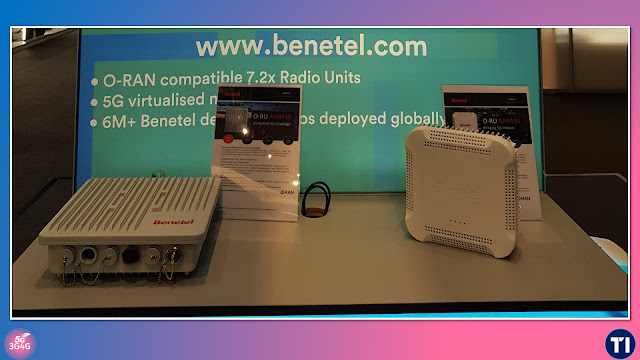
Benetel shows their Open RAN RU Progress

Benetel, headquartered in Dublin, Ireland, has a 20 year history with over 6 million Benetel designed radios deployed around the world. We caught up with them at Mobile World Congress 2022 to find out what they have been up to. 

We first heard of Benetel when they announced the launch of its flagship BNTL-RAN550 High-Performance 5G O-RAN radio unit (O-RU) back in 2020. Their MWC 2022 press release provides details on their latest RAN650 RU :

This is intended to bring 5G capacity to private, campus and industrial networks, as well as rural networks and public hotspots. A 4T4R antenna arrangement is featured with up to 5W of output power being delivered per antenna port (equating to 20W in total). The 7.2x functional split employed will help minimize the costs associated with fronthaul network implementations, while support for 100MHz of instantaneous bandwidth will allow maximum coverage to be attained.

Benetel’s new RAN650 RU can be deployed in either a Cat A or Cat B based configuration (using selected distributed units), thereby providing flexibility to address radio access network architectures. Key to its elevated performance and versatility is the cutting-edge semiconductor technology that has been designed into it. Each RU incorporates an Intel Arria 10 FPGA along with an Analog Devices’ ADRV9029 4T4R transceiver with integrated Digital Pre-Distortion (DPD). The initial version of the RAN650 covers the n77u (3.7GHz to 4.2GHz) frequency range. An n78 variant (3.3GHz to 3.8GHz) will be made available in the second quarter of 2022.

The RAN650 RU runs off a 48V supply. It has a maximum power consumption of 110W. The robust IP65-rated enclosure use means that even the most challenging of outdoor conditions can be coped with. An operational temperature range spanning from -33°C to +45°C is supported.

The RAN650 complements Benetel’s existing OpenRAN portfolio, including the RAN550 indoor 5G RU that the company announced back in late 2020. Active network trials are already being conducted on the Benetel RAN650 by several pilot customers.

TMN reported last year that, Benetel said it has integrated its Radio Unit (RU) with Radisys’ 5G NR Open RAN CU-DU software and has also licensed Radisys’ LTE software for its eNodeB radio platforms. The official announcement comes after Benetel told TMN last month that it was working with both Radisys and Altran on DU-CU integration.

If you are interested in learning more about Benetel then watch Olli Andersson, Benetel's senior VP for the Americas, discussing the O-RAN architecture's climb into market relevance here.

Related Posts: