Showing posts with label Operator Vodafone. Show all posts

Tuesday, 4 August 2026

Vodafone’s Robotic Antenna Trial Brings Physical AI to the Mobile Mast

In Tirana, Albania, Vodafone is testing an approach to mobile network optimisation that goes beyond software: physically rotating and tilting a mobile mast antenna using an AI-controlled mechanical positioning unit supplied by HUMAX Networks.

Vodafone describes the trial as an early example of “Physical AI” in telecoms. Its algorithm analyses network demand and local conditions, decides where coverage is most needed and instructs the mechanism to reposition the antenna. The company says the system can also consider factors such as the weather when determining where to focus the strongest signal.

The trial site overlooks a busy shopping centre. Vodafone’s example is that the antenna can focus capacity towards shoppers during the day and then redirect coverage towards a nearby residential area as evening internet usage increases. Repositioning currently takes around 20 to 30 minutes. Vodafone says it could technically happen faster, but the movement has been deliberately slowed to reduce energy consumption.

The mechanism is not the large industrial robotic arm that the announcement’s headline might bring to mind. It is a compact antenna-positioning system installed between the panel and its supporting structure.

How the HUMAX OCRA system works

The equipment comes from HUMAX Networks and forms part of its OCRA solution, short for Optical Compass Robot Arm. The Optical Compass measures the antenna’s azimuth to establish its physical orientation, while the Robot Arm makes fine-grained rotation and tilt adjustments. An optional OC Controller can provide communication between OCRA and the operator’s server.

For the Vodafone trial, HUMAX says Vodafone’s AI-based system analysed real-time network conditions at the site, identified the preferred antenna orientation and instructed the Robot Arm to adjust the panel accordingly. HUMAX positions the technology as a way of responding more flexibly to changing traffic conditions while reducing the need to dispatch engineers to sites.

OCRA itself is not entirely new. HUMAX has previously described deployments associated with stadiums, major public events and Urban Air Mobility trials in South Korea. Its broader system can incorporate optical azimuth measurement, a controller and physical antenna alignment.

But remote antenna adjustment is not new

It is important to distinguish Vodafone’s trial from the remote antenna-control capabilities already used in mobile networks.

Operators have been using Remote Electrical Tilt, or RET, controlled through Antenna Interface Standards Group (AISG) interfaces, for many years. RET changes the vertical direction of the radio beam by adjusting components inside the antenna. The antenna panel, its mounting brackets and its physical bearing on the mast remain fixed.

AISG specifications also cover antenna functions such as Remote Azimuth Steering and Remote Azimuth Beamwidth. These can alter aspects of horizontal coverage in suitably designed antennas without mechanically rotating the complete antenna panel. The current AISG standards catalogue includes RET under AISG 3.0, while RAS and RAB remain listed among the AISG 2 extension specifications.

The difference is therefore not simply remote adjustment versus manual adjustment. It is electrical adjustment within a fixed antenna installation versus physical repositioning of the complete antenna panel.

The publicly available descriptions of Vodafone’s trial do not indicate that AISG is controlling the OCRA mechanism. Vodafone’s AI system appears to instruct the HUMAX positioning system through its own control arrangement. The antenna may separately support RET, but Vodafone does not identify this as part of the trial.

This also means that OCRA should not necessarily be considered a replacement for RET. The two approaches address different ranges and types of change.

Electrical tilt is well suited to fine-grained optimisation within the adjustment range designed into an antenna. Physical repositioning can change the antenna’s mechanical boresight and potentially redirect the sector towards a substantially different area.

Why physically move the antenna?

The most obvious advantage is the ability to redirect a sector without sending an engineer to realign the antenna manually.

Vodafone notes that a conventional physical adjustment may involve more than an engineer climbing a mast. Depending on the site, it can require access agreements, road closures, lifting equipment, planning permission and suitable weather conditions. Installing another antenna can take even longer.

A remotely controlled mechanical system could therefore be useful where the geographical distribution of demand changes significantly over time. Possible examples include:

  • Daily demand shifts: Shopping, business and residential districts with contrasting traffic patterns.
  • High-density events: Stadiums, festivals and other large temporary gatherings.
  • Seasonal demand: Coastal towns, ski resorts and other destinations with large seasonal variations.
  • Infrastructure disruption: Temporary coverage changes during major construction or transport disruption.
  • Aerial coverage: Urban Air Mobility corridors and drone routes requiring coverage above ground level.

These are not all use cases demonstrated in Vodafone’s Albania trial, but they follow from HUMAX’s previous work around high-density events and Urban Air Mobility, as well as the system’s ability to change physical azimuth and tilt.

There are also practical questions that would need to be considered before wider deployment. Moving equipment introduces mechanical components that must withstand wind, rain, temperature changes and repeated operation over many years. Operators would need to understand maintenance requirements, energy consumption, movement accuracy and the consequences of a mechanism becoming stuck in an unsuitable position.

Any significant sector redirection would also need to be coordinated with neighbouring cells. Moving one antenna can change interference patterns, coverage overlaps, handover boundaries and traffic distribution across the surrounding network. The AI decision cannot therefore be based only on demand at an individual site. It needs visibility of the wider RAN and suitable performance guardrails.

The bigger story is closed-loop network automation

The robotic mechanism is visually interesting, but the more important development is the closed loop connecting network intelligence with physical infrastructure.

Vodafone’s algorithm observes conditions, determines the preferred orientation and instructs the antenna system to act without waiting for a human decision. That moves network automation beyond changing software parameters and into controlling the physical configuration of the site.

Vodafone says the project is also intended to feed into its wider open, standards-based platform for automating RAN components. This could allow internal teams and third-party developers to create optimisation algorithms that treat antennas as active elements of an adaptive RAN.

In future, an autonomous system could potentially select between several optimisation options. A small coverage correction might be achieved using electrical tilt. A change in beam shape or horizontal steering might be possible within the antenna. A more substantial redirection could justify physically repositioning the panel.

Vodafone has not said that the Tirana system currently selects between all these methods. However, the trial points towards networks in which AI has a growing range of electrical and physical controls available to it.

Whether robotic antenna positioning becomes common will depend on the operational and commercial results. Operators will need to determine how often large physical changes are genuinely required, whether the performance gains justify the additional hardware and how reliably the mechanism operates over the full life of a mobile site.

Nevertheless, the trial is a useful reminder that autonomous networks will not be limited to software running in a data centre. Increasingly, intelligence may also control what happens at the top of the mast.

Related Posts: 

Tuesday, 13 January 2026

Powering Vodafone’s Mobile Network with Solar Energy in Germany

Iberdrola has brought its first solar park in Germany into operation, with the renewable electricity generated at the site now supplying Vodafone’s mobile network nationwide. The project represents a growing convergence between energy and telecom infrastructure, as mobile operators look to secure reliable and sustainable power sources to support expanding network demands.

The solar park is located in Boldekow in the state of Mecklenburg-Western Pomerania and marks Iberdrola’s entry into onshore photovoltaic generation in the German market. The site covers an area equivalent to more than 65 football pitches and is equipped with around 80,000 solar panels. Once fully operational, the installation is expected to generate up to 53 gigawatt hours of electricity each year, with the entire output dedicated to Vodafone under a long-term power purchase agreement.

For Vodafone, the project provides a direct and predictable supply of renewable electricity for its mobile infrastructure across Germany. The annual energy output is sufficient to power around 3,000 mobile base stations, supporting the radio access network and associated systems that underpin nationwide mobile coverage. As networks continue to evolve to handle higher traffic volumes and increased densification, access to stable and locally generated energy is becoming a strategic consideration alongside spectrum, sites and backhaul.

The environmental impact of the solar park is significant. By replacing conventional grid electricity with solar generation, the project is expected to reduce carbon dioxide emissions by approximately 20,000 tonnes per year. Over an anticipated operational lifetime of around 30 years, this contributes meaningfully to emissions reduction targets while aligning network operations with wider sustainability objectives.

From an infrastructure perspective, the project illustrates a shift in how telecom operators source energy. Rather than relying solely on indirect mechanisms, such as renewable energy certificates, operators are increasingly entering direct supply agreements linked to specific generation assets. This approach improves transparency, strengthens energy security and creates a clearer relationship between network growth and renewable energy investment.

For Iberdrola, the Boldekow solar park complements its existing presence in Germany, where the company already operates offshore wind assets in the Baltic Sea. Expanding into onshore solar generation allows for a more diversified renewable portfolio and demonstrates how utility-scale energy infrastructure can be closely aligned with the needs of digital networks.

The project has also delivered local benefits, including regional investment during construction and long-term contributions to municipal revenues. This underlines how renewable energy developments tied to telecom infrastructure can support local economies while addressing national connectivity and sustainability goals.

As mobile networks progress towards higher capacity, lower latency and greater automation, their energy requirements will continue to grow. Projects such as Iberdrola’s solar park supplying Vodafone’s mobile network show how renewable energy is becoming a foundational element of modern telecom infrastructure, rather than a parallel or secondary consideration.

Related Posts: 

Tuesday, 11 November 2025

Vodafone’s 5G Advertising Pillars Bring Connectivity to Urban Streets

Vodafone Germany is giving a new lease of life to an old part of the cityscape. The familiar advertising pillars found across German cities are being transformed into 5G mobile base stations, delivering high-speed connectivity in areas where traditional masts are difficult to install.

In Düsseldorf, more than 100 such columns are already operational, providing 5G coverage across the city. Each pillar houses three compact antennas and all the equipment normally found on large masts, integrated neatly within the structure’s roof and concrete body. The design, developed in partnership with Ilg Outdoor Advertising, allows each pillar to cover an area of about 400 metres. The system is connected via fibre optics, ensuring low latency and data speeds of up to 1 Gbps.

This approach offers a practical solution to one of the biggest challenges of urban network expansion: finding new sites for antennas. Rooftop locations are often limited and subject to complex planning processes. By reusing existing structures, Vodafone has found a way to speed up deployment while blending infrastructure discreetly into the urban environment. The entire installation process for a 5G pillar takes less than half the time required for a conventional mobile base station.

The benefits of the project are already clear. In Düsseldorf, each 5G advertising pillar supports around 6,000 connections per day and handles roughly 200 gigabytes of data every week. The network, built with Ericsson’s equipment and operating on Vodafone’s standalone 5G+ technology, offers minimal latency and improved reliability. These compact sites helped strengthen coverage ahead of the European Football Championship, ensuring stable service in and around the stadium, fan zones and transport hubs.

Following the success in Düsseldorf, Vodafone is now extending the concept to other cities. Stuttgart recently became the first city in Baden-Württemberg to host a 5G advertising pillar, with five more due to follow by the end of the year. In total, up to 100 of Stuttgart’s 600 advertising columns could eventually be upgraded to 5G, enhancing coverage across busy streets, squares and landmarks such as the Mercedes-Benz Museum and the MHP Arena.

Each Stuttgart pillar uses Ericsson’s antenna technology and can deliver download speeds of up to 500 Mbps. The initiative is supported by local authorities who view it as a sustainable and space-efficient way to boost digital infrastructure. The combination of heritage and high technology brings a modern function to an iconic feature of German cities that dates back to the 19th century.

Vodafone’s 5G advertising pillars represent a clever mix of innovation, design and practicality. By making use of existing street furniture, the company is not only accelerating the rollout of next-generation connectivity but also showing how urban infrastructure can evolve to meet the digital needs of modern life.

Related Posts: 

Tuesday, 14 October 2025

The Subsea Cables Infrastructure Keeping the World Connected

The internet may feel wireless, but most of the world’s connectivity depends on cables running deep beneath the ocean. Vodafone’s short documentary 'Making Connections: Subsea cables' takes viewers beneath the surface, exploring the complex world of subsea cables that carry almost all of the world’s data traffic.

The film highlights how this invisible infrastructure keeps everything from social media and cloud computing to financial systems and video calls running smoothly. Despite the rise of satellites, fibre-optic cables laid across the seabed remain the backbone of international communication. Vodafone operates or partners on more than 70 subsea cable systems spanning over 100 countries, connecting more than 700 million people worldwide.

At Vodafone’s cable stations in Cornwall, engineers monitor and maintain multiple systems that land on the UK’s southern coast. Each cable carries vast amounts of data at the speed of light through glass fibres thinner than a human hair. The documentary shows how these operations combine technology, precision and resilience. When a cable is damaged, locating and repairing it can be an immense challenge, involving ships that cost tens of thousands of dollars a day to operate and weeks of work at sea.

Subsea cables have a long heritage in the UK. The first transatlantic telegraph cable was laid in the 1800s, connecting Ireland and Newfoundland. The same site in Cornwall where Vodafone operates today once belonged to the Eastern Telegraph Company, later Cable & Wireless, and now forms part of Vodafone’s global network. The industry has evolved from transmitting a handful of words per minute to streaming millions of 4K videos simultaneously across continents.

The film also features partners such as Alcatel Submarine Networks and Ciena, whose technologies underpin and scale Vodafone’s subsea systems. Modern cables use optical amplifiers and repeaters to boost signals across thousands of kilometres, while intelligent monitoring systems detect issues before they disrupt service. Recent advances, such as spectrum sharing and higher-capacity modems, are extending both performance and flexibility.

The documentary pays particular attention to the 2Africa project, a monumental cable system encircling the African continent and landing in dozens of countries. Led by Vodafone and its partners, it represents one of the longest and most ambitious subsea builds ever undertaken, designed to bring affordable and reliable connectivity to hundreds of millions of people.

Maintaining such systems comes with real challenges. Natural events such as mudslides and turbidity currents, as well as human activity like fishing and anchoring, can threaten cables. Engineers describe how they bury and armour cables near shore and collaborate globally to ensure resilience and quick restoration when damage occurs. They also work with researchers to study environmental effects and improve sustainability, including using sensors embedded in cables to monitor ocean conditions and detect seismic activity.

Beyond technology, Making Connections highlights the people behind this critical infrastructure. Vodafone’s engineers, apprentices and early-career professionals are shown learning and innovating together. With a small but highly skilled global workforce, the subsea industry is investing in developing the next generation of talent to sustain and grow this essential network for decades to come.

Subsea cables may be out of sight, but their impact touches every aspect of modern life. Vodafone’s documentary is a reminder that the strength of our digital world depends on the cables stretching quietly beneath the oceans—connecting continents, economies and people around the globe.

Related Posts: 

Tuesday, 2 September 2025

Conical Antennas Boost Vodafone Germany’s Tunnel Coverage

Mobile coverage in tunnels has always been one of the most difficult challenges for network operators. Concrete walls, restricted space and the constant movement of air caused by passing vehicles all interfere with signal stability. Vodafone Germany has now taken a major step forward in overcoming these barriers with the deployment of a new generation of conical antennas. Designed by Ericsson, these antennas are engineered specifically for tunnel environments and have been introduced in the 1,400 metre Arlinger Tunnel near Pforzheim.

The new solution is based on a conical multi-band antenna that combines wide frequency support with a form factor able to withstand tunnel-specific conditions. Traditional antennas in tunnels often struggle with vibrations and pressure changes that occur whenever trains or cars move large volumes of air. These effects can cause instability in reception and transmission performance. The conical design offers superior resistance to these forces. Its aerodynamic shape reduces the impact of airflow and turbulence, which results in more stable signal propagation and higher reliability.

Ericsson’s antenna, known as the Antenna 9011 1LM (KRE 101 2571/1), operates across the 617 to 4200 MHz range. This wide frequency coverage ensures compatibility with all major mobile technologies from legacy 2G through to 5G mid-band and even C-band. The antenna achieves a gain of around 10 dBi and uses cross polarisation to support advanced features such as MIMO. It has been tested under demanding tunnel conditions, including alternating pressure cycles that simulate the effect of trains passing at high speed. These design elements make it particularly suitable for deployment in both road and rail tunnels.

In the Arlinger Tunnel, five of these antennas have been installed. Together they provide seamless coverage along the full tunnel length, ensuring that drivers and passengers can stay connected without interruptions. For commuters this means fewer dropped calls and more consistent data performance, while for Vodafone it represents a significant step in eliminating dead spots in challenging locations. The project also demonstrates how antenna engineering is evolving to meet the requirements of complex environments.

Delivering mobile coverage in tunnels is more complicated than simply placing antennas inside the structure. In shorter tunnels, antennas positioned at the entrance and exit can often suffice. In longer tunnels, however, operators must deploy signal repeaters and distribute the signal along the length of the tunnel using multiple antennas. This requires the installation of cabling and associated equipment, usually during periods when tunnels are closed for maintenance. To avoid duplication, one operator typically provides the infrastructure and others connect their networks to it.

Germany has a particularly extensive tunnel network with more than 270 tunnels on federal highways, over 400 on district and urban roads, and 761 railway tunnels. Collectively these extend for more than 1,200 kilometres. The introduction of conical antennas marks a practical response to the specific difficulties these environments present. Vodafone has already announced that it intends to use the new antenna type in 20 further tunnel projects across the country.

From an infrastructure perspective, the Arlinger Tunnel deployment highlights a broader trend towards highly specialised antenna systems. Rather than adapting generic equipment, manufacturers such as Ericsson are now producing models tailored for environments where airflow, vibration and space constraints dominate. The Antenna 9011 1LM shows how much progress has been made. Its mechanical robustness, compact size and wideband capability make it a versatile component for future-proof tunnel deployments.

Vodafone Germany’s network already reaches more than 93 percent of the population with 5G and the addition of tunnel coverage strengthens this footprint. For the growing number of travellers who depend on uninterrupted connectivity, solutions like the conical antenna are not just a technical achievement but also a practical improvement to everyday digital life. They also underline the importance of collaboration between operators and equipment vendors in tackling some of the toughest remaining infrastructure gaps.

Related Posts: 

Tuesday, 6 May 2025

How Vodafone UK Prepares its Network for Storms and Heatwaves

Extreme weather is a growing concern for mobile network operators, and Vodafone is no exception. Storms and heatwaves can damage infrastructure, interrupt power supply, and delay repair work. To keep people connected during such events, Vodafone has developed a range of technical measures and operational strategies that help it prepare for and respond to disruption.

The most exposed part of the network is the mast, which is usually above ground and can be up to 25 metres tall. While it is not possible to make these completely immune to bad weather, Vodafone designs them with resilience in mind. Many mast sites are equipped with backup batteries and generator connection points, provided there is space to install them safely.

Vodafone operates around 18,000 masts across the UK. Each one is part of the wider Radio Access Network, with traffic routed through dedicated signalling controllers hosted in secure data centres. These centres are equipped to maintain at least one mobile service, even in the event of a power outage, by prioritising the use of backup power.

In rural areas, some masts rely on microwave links instead of fibre or copper connections. These links require a clear line of sight between masts, so engineers carry out preventative maintenance to remove any vegetation that might interfere with signal transmission.

The Network Operations Centre (NOC) monitors the network and directs field engineers. During weather alerts, Vodafone increases staffing levels to improve response times and ensure the right resources are in place. Temperature sensors at mast sites detect heat-related issues and automatically alert the NOC if thresholds are exceeded. This can lead to quick interventions, such as cleaning or replacing clogged air filters in cooling systems.

If a mast repeatedly shows signs of overheating, the NOC flags it for further investigation. Possible solutions include enhanced maintenance schedules or upgrading the cooling technology. Despite all these precautions, access and repair work after storms or floods can still be complicated by damaged roads or infrastructure. Engineers may need to assess fibre cables, antennas or even the structural integrity of masts.

Where power supply is disrupted for extended periods, Vodafone’s network planners must carefully manage the use of batteries and generators. Coordination with external bodies such as the National Grid is often essential.

By investing in resilient infrastructure and ensuring rapid response capabilities, Vodafone aims to keep its mobile network running reliably, even in the face of increasingly unpredictable weather.

Related Posts: 

Thursday, 6 June 2024

Vodafone UK Takes COWs to the Fields

Like every operator, Vodafone UK has a variety of Cell On Wheels (COWs) that they take to special events where there may be a need for extra coverage and/or capacity. While we have a good number of posts looking at COWs (see related posts 👇), here is their short video explaining it:

Quoting from their news article earlier this year: 

Some of the UK’s best known and largest events, from music festivals and agricultural shows to leading events in the sporting calendar, will see the masts. Known as ‘Cells on Wheels’ (COWs), they will be wheeled onto site to deliver an outstanding network experience and to cope with the extra demand expected on the network.

With over 120 deployments planned, Vodafone’s fleet of COWs will be kept very busy throughout the year. Some events will receive more than one unit, depending on terrain, the size of the event area and estimated number of attendees.

The season started at Cheltenham Race Festival in March. Compared to last year, overall data usage at Cheltenham increased by nearly 10%, with 35% of all data carried over 5G.

In September 2023, Vodafone revealed that 5G data usage at special events was rapidly increasing, with customers using 80% more 5G data in 2023 compared to 2022. One of the busiest was Glastonbury 2023 where Vodafone deployed nine COWs. Over 168 terabytes of data was consumed across the event. Elsewhere, the King’s Coronation saw COWs being placed around Hyde Park and Buckingham Palace. Data usage increased by around 90% compared to a typical Saturday in the capital.

A slightly more detailed video is ☝️ here while this detailed article from last year talks about the process:

Vodafone’s planning for any given event starts long before the organisers open their doors to the public; up to a year in advance for some city-sized. Surveying the site in question, requesting access from landowners and working out how to get lorry loads of equipment up narrow country roads – these are are serious logistical issues that can’t be left to chance.

Mobile signal at an event will be provided by one or more ‘cells on wheels’, or COWs. A COW is effectively a mobile mast – and its associated equipment – mounted on a trailer manned by a crew of three or four engineers. Setting up a COW can not only require a hoist, crane and/or cherry picker, but also the usual data links, power and a suitable location. This trifecta is tricky enough to secure under everyday circumstances in the UK’s villages, towns and cities – never mind the stadia, fields, valleys, shorelines and other unusual venues that host festivals and other such special events.

For festivals and shows that take place in remote rural locations, short-range microwave radios may be needed. These link the COW to the rest of Vodafone’s network as the usual fibre optic or copper cables often aren’t available or can’t be laid.

But such radio links need to be within line-of-sight of the next mast along to work, so locations need to be reasonably clear of obstructions such as trees and hills – obstructions that can also block the mobile signal from the mast once it’s operational.

While Vodafone may have the pick of locations at events that it has partnered with, that’s not always the case, with space at any given event in high demand for stages, retailers and of course the room needed for audiences and tents.

Powering the COW takes more than running a mere extension lead. If grid power isn’t available, then diesel generators are used. The generators then need to be carefully tended and guarded to ensure they continue working properly and aren’t ‘borrowed’ by either desperate or opportunistic third parties.

Getting a COW up-and-running in a surveyed location can take at least a day, often two to three days. But the work doesn’t stop once it’s powered on. Engineers carefully monitor and adjust the COW’s antennas and other equipment to ensure that it delivers the speeds and capacity that the public expect.

Frederic Sundin, Vodafone’s Head of Network Connectivity and Deployment explains: “You have stages in the way, depending on where the special event is, or it can be hilly, it can be trees. That can block the signal. And you need to predict where the crowds will be, because they move around.”

Vodafone’s engineers can draw upon analyses of traffic patterns in previous years when providing coverage at events that the company has been to before. But for new events or those that have relocated to new venues, responding quickly to unexpected events can be crucial.

For example, if there is a massive shift of people up a hill because they’re all watching and snapping/livestreaming the sunset, then engineers must be able to spot this and then actively optimise the network for such a sudden concentration of people in a small space.

The demands expectations of the public lie at the heart of why Vodafone provides mobile coverage at special events. “Festivals, summer events – the UK audience just love it. They flock to them. And, rightly so, they demand good coverage, a good experience,” Andrea, Vodafone’s Chief Network Officer in the UK said.

There is, of course, the other crowd at any given event – the organisers and the retailers. From ticketing to contactless payments, a variety of business processes now rely on mobile connectivity, not to mention first responders from the emergency services and event security.

If you spot a COW in a field near you, snap a picture and send it to us.

Related Posts: 

Saturday, 16 December 2023

Testing Vodafone UK's Open RAN Deployment Performance

It's been a while since Vodafone selected their UK Open RAN partners. The good news is that according to the press release from Samsung as well as Vodafone UK the rollout has already started. According to the press release, the following partners are involved:

  • Samsung: 4G and 5G radio, including 64T64R Massive MIMO, as well as the software platform.
  • Intel: General Purpose Processor (GPP), acceleration hardware and network interface cards.
  • Keysight: Drive test services using Keysight Nemo Solutions to assure the OpenRAN end-to-end live network performance. Pre-deployment OpenRAN functional and interoperability testing using Keysight Open RAN Architect (KORA) solutions.
  • Dell Technologies: Dell PowerEdge servers designed for cloud-based OpenRAN workloads.
  • Capgemini: Testing partner in Vodafone labs.
  • Wind River: Cloud network platforms (also known as abstraction layer software).

Dr. Peter Clarke, who is an actual medical doctor rather than a PhD, and also a mobile network infrastructure hobbyist, has been featured across our blogs on a regular basis. Recently he took a trip to the coastal town of Torquay, Devon, to see for himself how these Samsung Open RAN networks were performing. Quoting from his LinkedIn post: 

Vodafone UK's Samsung Networks based Open RAN 5G delivers capability and performance to the coastal town of Torquay, Devon, providing a compelling window into the future of radio access architecture. 

The Vodafone spectrum deployed is impressive, illustrating the capability of the Samsung Radios and serving the town well: 90MHz n78 with Massive MIMO on Samsung Active Antenna Units and quad 4G band through Commscope passives.

Throughputs with EN-DC utilising 50MHz n78 carrier were consistently around 500mbps, which for an umbrella site serving a town was pleasing. Field testing video below, in comments, please watch for on the scene testing.

Here is a video from his testing:

I am looking forward to the official results that will hopefully be shared around MWC 2024.

Related Posts: 

Thursday, 21 September 2023

Vodafone's 5G+ Street Lights in Cologne, Germany

Last year Vodafone Germany announced that they have collaborated with the City of Cologne, RheinEnergie AG and 5g Synergiewerk to bring into operation the first 5G+ street lights in Germany. The first 5G+ street lights in Europe are located in the heart of Cologne city centre in the immediate vicinity of the lively squares at Heumarkt and Domplatte. 

The press release said (Google translated in English from German): 

Vodafone has equipped the two street lights with its own mobile communications technology - this includes the antennas, the active technology and the cable guides. The technology for the 5G network is housed in the lantern base (podium) of the nine meter high lanterns, the antennas are mounted six meters above the ground. The connection to the landline network is via fiber optic lines. RheinEnergie supplies the electricity for the street lights of the future. The antennas have a range of up to 400 meters and offer a speed of up to one gigabit in the 3.5 GHz band of the 5G+ network.

The so-called small cells are small radio cells that supplement the actual base stations of the mobile phone networks. They cannot replace a cell phone location on a roof or mast, but they provide additional capacity or increase the range in smaller areas within the cell phone cell. They are used primarily where there are a particularly large number of people in a small space. Small cells will play a particularly important role in the future for the 5G+ real-time network: in networked mobility offerings, for mobile augmented reality applications or for the social networks of tomorrow.

As part of its 'Gigabit Masterplan Cologne 2025', the city of Cologne is aiming for a comprehensive gigabit network with fiber optics in the ground and 5G in the air by 2025. The city of Cologne's goal is to facilitate network expansion in the cathedral city. Therefore, antenna locations of the city of Cologne and the Cologne public utilities as well as fiber optics and electricity are bundled and rented to the network operators or respective radio tower companies. The commissioning of the innovative street lights is part of the strategy for the comprehensive rollout of 5G+ throughout Cologne. Vodafone and its infrastructure subsidiary Vantage Towers are responsible for thisUse antenna locations in combination with fiber optic and power connections from the city and RheinEnergie. Vodafone is the first user of this 'Cologne model' of combined infrastructure provision. In principle, this model is open to all network operators.

A more detailed video is available in the post here.

In a post that no longer exists, LIGMAN Evolve provided their involvement:

LIGMAN Evolve worked closely with partners 5G Synergiewerk and Stadtsysteme to deliver a bespoke solution for the deployment of the 5G+ network which would blend in with the existing street lighting infrastructure.

The LIGMAN Evolve solution has provided Vodafone with the ability to conceal and thermally manage the radios within the base section of the pole. This podium section also incorporates the power and fibre connections.

The poles incorporate hatches with bracket arms designed for the passive antennas. These provide the ability to accurately align the antennas to the required sector to maximise coverage in the streets.

The Extended podium has been designed with separate compartments for the MNO’s and the local electricity company – ESB. Both have a locked enclosure and neither has access to the others enclosure.

Related Posts: 

Sunday, 26 June 2022

Vodafone UK Switches-on First Live 'Self-Powering' Mobile Phone Mast

In a press release last year, Vodafone UK had announced that they have developed self-powered mobile towers and will deploy them across the UK, supporting the company’s target of achieving net zero for its UK operations by 2027. 

Vodafone and Crossflow Energy have been collaborating over the last couple of years on the development of Crossflow Energy’s innovative wind turbine technology, combined with the latest in solar and battery technologies, to create a self-powered mobile network tower. In addition, Vodafone's network partner, Cornerstone, had signed up to run a proof of concept to install Crossflow Turbine technology on rural mobile sites.

These ground-breaking Eco-Towers are expected to enable the deployment of new mobile sites in the most remote locations, without the major challenge and cost of connecting to the electricity grid.

In a press release earlier this month, Vodafone announced that it has switched on the the first live wind- and solar-powered mobile phone mast in Pembrokeshire, Wales. The mast will provide 4G coverage to the community of Eglwyswrw. The PR further says:

The specially designed mast, which potentially removes the need for a connection to the national electricity grid, could provide connectivity to ‘not-spots’ in the UK’s most remote and inaccessible locations – helping the industry achieve 95% of UK landmass coverage by 20253. It will also help Vodafone reduce carbon emissions and support its target of reaching net zero UK operations by 2027.

The ‘self-powering’ mast incorporates a unique Crossflow Energy wind turbine that can generate power even in light winds. The mast can be installed without the need to dig trenches and lay electricity cables, making it faster and easier to install and reducing the impact on the local environment.

It is also extremely quiet, making it viable for sensitive sites such as Areas of Outstanding Natural Beauty. It can also be ‘filtered out’ as a solid object by radar, birds and bats, so it is easily avoided, making it less harmful to wildlife.

The trial, in partnership with wind turbine technology specialists Crossflow Energy and mobile infrastructure partner Cornerstone, is at Home Farm in the village of Eglwyswrw. It will run for two years and data gathered will help Vodafone optimise the technology and determine which sites are most suitable for ‘self-powering’ masts.

Bringing mobile and internet services to rural communities helps boost the local economy, tackle isolation and close the rural digital divide. To date, building masts in coverage ‘not spots’ without an existing electricity connection has been a significant financial and logistical challenge.

The following video has also been shared:

Related Posts: 

Friday, 20 May 2022

Vodafone Explains Mobile Phone Mast

Questions related to what does a mobile phone mast consist of keeps popping up time and again. I looked at it some years back but it doesn't stop people asking additional questions. 

When the UK MNOs started their Shared Rural Network journey, Vodafone put together a nice primer on what does a mobile network mast consist of. Here is an extract from the article:

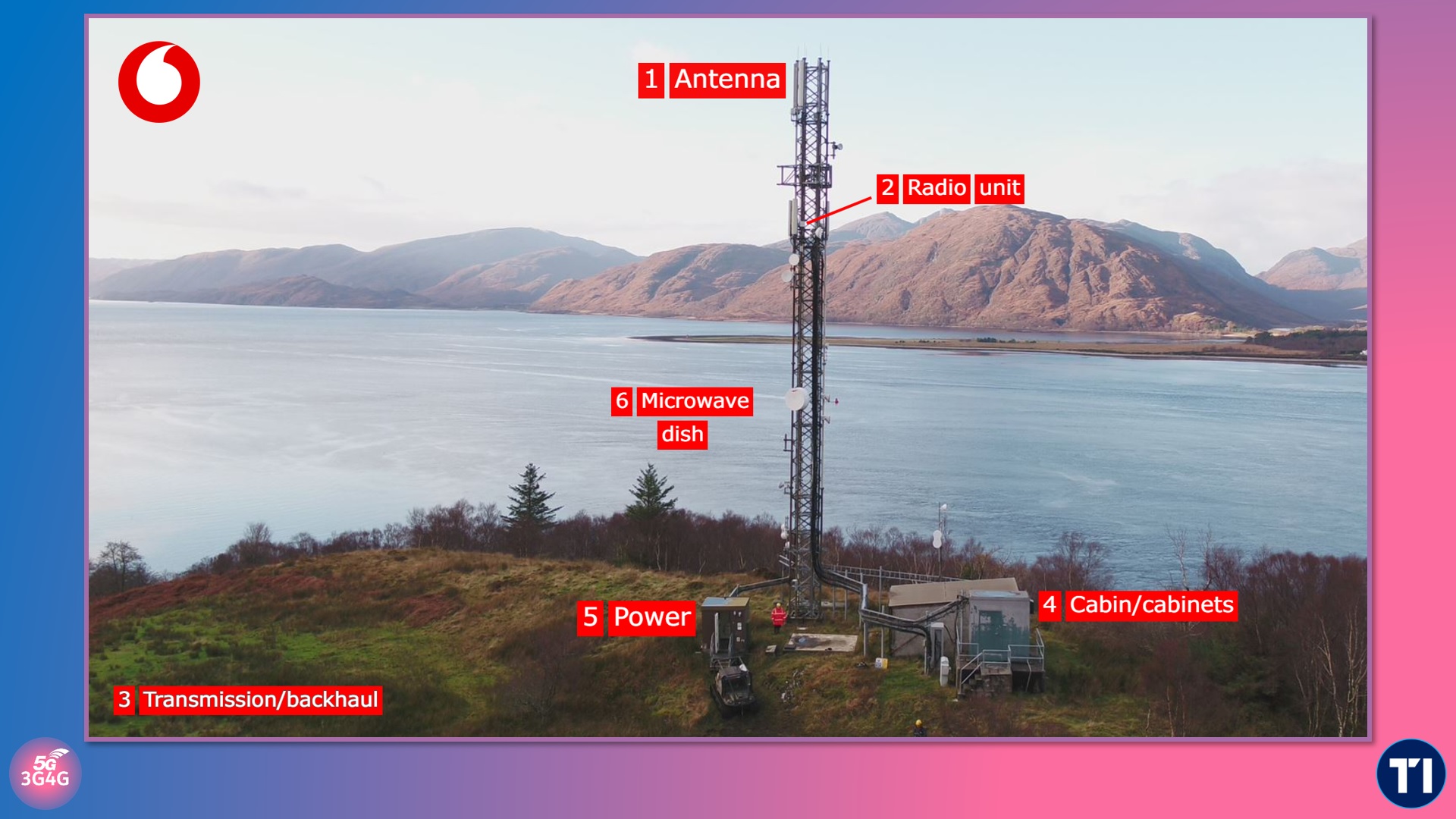
What do all the bits of a mast actually do?

  1. Antenna: Antennas send calls, texts and internet data to your smartphone using radio waves and in turn receive radio waves from it. The higher up an antenna is, the more likely it is that you’ll get a strong and reliable mobile signal from it. Most masts will have at least three antennas to provide coverage in every direction. Masts that need to serve more people, because they’re located in more heavily populated areas, will have more antennas.
  2. Radio unit: The radio unit generates the radio waves transmitted by the antennas. Traditionally, the radio unit was installed at ground level. Nowadays, they’re more likely to be installed higher up the mast closer to the antenna to help improve performance.
  3. Transmission/backhaul: Cables, traditionally copper but now far more likely to be fibre optic, are used to connect the mast with other masts and the rest of the Vodafone network in the UK. These are usually buried in the ground. In a few cases, a microwave dish is used instead.
  4. Cabin/cabinets: Located at ground level, these contain computers which communicate with other masts in the network. Additional equipment, such as a battery backup in case of power failure and connectors for the transmission/backhaul, are also stored here.
  5. Power: Most masts will draw their power from the National Grid; some will have their own renewable power source on-site. In a handful of cases, such as with temporary masts, power will instead be provided by a diesel generator.
  6. Microwave dish: In some locations, such as remote rural areas, a microwave satellite dish is used instead of fibre optic cables to act as transmission/backhaul, connecting the mast to the rest of Vodafone’s network. To do so, the dish must be within line of sight of a dish on another mast.

Why can’t you build it somewhere else?

Not all sites are suitable. To provide the strongest mobile signal to as wide an area as possible, there can’t be too many neighbouring buildings, trees or other geographical features in the way. These tend to block the mast’s signal.

Masts also need their own power and what’s known as “backhaul” – data connections to the rest of the network. To meet soaring demand for faster speeds, that backhaul often consists of fibre optic cables under the ground – it’s a common misconception that most of Vodafone UK’s masts communicate wirelessly with the rest of the network.

And to run these power and data lines to a mast, we have to negotiate with the owners of the land, and quite often, with the owners of land adjacent to it. Those negotiations aren’t just about how much rent we will pay, but how easily we can access those sites for construction, maintenance and repairs.

These so-called “wayleave” negotiations can take time – and sometimes break down completely – setting back mast construction by several months.

Why can’t you just build a shorter, less conspicuous mast?

The taller the mast, the wider the area it can cover and the more people it can provide with a fast and reliable mobile signal. Under current rules, most UK masts are around 25m (82ft) tall. But in fact 50m masts would provide a better, more far-reaching signal in many areas.

Update April 2021 – the UK Government has proposed rule changes that would allow new and existing masts to be up to five metres taller and two metres wider than they currently can be. This would not only help increase the range of their wireless signal, it would also make it easier for masts to be potentially shared with other mobile network operators, as more equipment can be fitted onto taller masts.

Who decides where masts are built?

Our engineers pick sites that best meet the technical, logistical and economic requirements for hosting a mast, but the local council has to grant planning permission for the building works to go ahead. So councils hold public consultations before making their decision and residents can have their say.

You can read the complete article here.

The old video of cell tower construction site is worth a watch and is embedded below:

Related Posts: 

Saturday, 26 June 2021

Vodafone UK's 5G Infrastructure


Ker Anderson, Head of Radio and Performance, Vodafone UK did an IET presentation looking at Vodafone's infrastructure, especially 5G infrastructure. The video from that has been publicly shared so it is embedded below.

Related Posts:

Friday, 28 May 2021

Nokia Smart Node Modular 4G/5G Femtocell

We wrote about Nokia's 5G Small Cells late last year and about AirScale indoor Radio (ASiR) Small Cells back in July. Now they have just announced the launch of the Nokia Smart Node, a unique indoor mobile module solution delivering high-quality 4G and 5G indoor mobile coverage for residential and small-medium enterprise use. In simple words, a modular 4G/5G femtocell.

The press release said:

The compact, ‘plug and play’ modular design can be deployed readily in any environment to support evolving consumer applications. It is future-proofed to support 4G now and 5G networks when required and both non-stand-alone and stand-alone 5G applications through a software upgrade. Nokia Smart Node is available from Q4 2021.

Stylish, durable and smart, Nokia Smart Node is a dedicated indoor mobile solution with superior coverage and capacity and can be easily scaled from single to multiple units to meet total indoor coverage requirements. Its high-quality coverage, latency and reliability delivers ubiquitous 5G connectivity for specific use cases such as immersive entertainment. The ‘plug and play’ capabilities also make it easy to set up, which keeps installation costs to a minimum. It can be wall, ceiling or desktop mounted.

Nokia Smart Node supports traffic management by reducing core network load and optimizing macro resource allocation. It delivers uncongested high throughput network performance with existing secure authentication and provides a secure connection and SIM-based authentication to assure the quality required in mobile networks.

Mobile World Live added:

Nokia is marketing the solution to both enterprises and carrier customers. For enterprise customers, the vendor promotes the femto as part of a mobile network that can offer “hack proof” security, without requiring IT managers to understand and install complex security solutions. The Smart Node security solutions include digital certificates, IPSec for encryption with IKEv2, and firewall and tamper alarms.

For network operators, a 5G femto can provide local breakout and reduce operating costs, according to Nokia.  Whereas an outdoor small cell near an enterprise will require power, backhaul and real estate, an indoor solution lets the enterprise itself cover these expenses. The downside, of course, is that indoor solutions typically support just one enterprise customer while outdoor small cells could support several.

More information on Nokia Smart Node Femtocells is available here.

It is worth pointing out that many operators are choosing to phase out their indoor femtocell offerings in favour of Wi-Fi calling (VoWiFi). One such example is Vodafone UK who have announced that their Sure Signal femtocells will be switched off by September 2021. 

In addition, Wireless Wireline Convergence (WWC) in 5G is also expected to make access connectivity independent of the core services by allowing connectivity over Wi-Fi. This will accelerate phasing out of femtocells in future.

Related Posts:

Wednesday, 23 September 2020

Award Winning Ericsson Radio Dot Provides 5G Coverage on China Subway

It's been over 2 years since we last talked about the Ericsson's 5G Radio Dot. Earlier this year, Radio Dot 4475 scooped a Red Dot Design Award for the product’s high design quality.


In a press release earlier this month, Ericsson announced:

Commuters and travelers on Shenyang’s subway Line 9 can access China Mobile 5G connectivity across all 22 stations on the line, powered by the Ericsson 5G Radio Dot. The 5G network has been operational for several months.

More than 900,000 passengers use the subway system in Shenyang, north east China, every day. The Ericsson 5G Radio Dot deployment on Line 9 is helping China Mobile to meet the increasing data needs from its customers - particularly in high-quality uninterrupted video and streaming traffic - in subway stations as passengers wait for, or change, traveling connections.

The Ericsson 5G Radio Dot System on Line 9 operates on various China Mobile frequencies. It provides a stable downlink of 1Gbps and a maximum transmission rate of up to 1.4Gbps. A 1GB high-definition movie could therefore be downloaded within 10 seconds.

The compact and easily deployable nature of the solution meant that Ericsson was able to install more than 500 5G Radio Dots across the 22 stations in just 20 days - 40 days ahead of schedule.

Ericsson and China Mobile continue to work in partnership on subway 5G connectivity in Shenyang as part of the city’s digitalization ambitions.

Back in July, Vodafone was showcasing Standalone 5G. One of the components if this network was the 5G Radio Dot.

To support the university’s 5G ambitions further, Vodafone has also installed Ericsson’s 5G Radio Dot System in the university’s Disruptive Media Learning Lab and National Transport Design Centre. The indoor technology will deliver fast, high-capacity 5G in key buildings to support its innovative teaching and learning.

Last year, Ericsson and Elisa piloted private networks in Finland at Elisa’s facilities in the first of half of 2019 using a prepackaged Ericsson Private Network solution that included Ericsson Enterprise Core, Router 6000 and Radio Dot System for indoor coverage. 

Again last year, Ericsson and Swisscom deployed the 5G Radio Dots in the Swiss service provider’s live 5G commercial network and simultaneously made the first 5G data call in Europe between two offices over the 5G Radio Dot System during a Joint Mobile Day event in Bern, Switzerland. The call, made on July 1 2019 between Ericsson’s office in central Bern and Swisscom’s office in the nearby town of Liebefeld, was a tech milestone for the Swiss service provider’s 5G network rollout since it became the first in Europe to switch on a commercial 5G network – fully powered by Ericsson – in April 2019.

Related Posts: