Showing posts with label Operator T-Mobile USA. Show all posts

Thursday, 20 July 2023

T-Mobile USA's Disaster Response Satellite Vehicles, Drones and COWs

The United States of America (USA) is a huge country. With such a vast area it is no surprise that it experiences a relatively high number of natural hazards and disasters. It is prone to hurricanes along the Atlantic and Gulf coasts, tornadoes in the central region known as Tornado Alley, earthquakes along the West Coast, wildfires in dry areas, and floods in various regions.

It is for this reason that all US operators have to be prepared for any emergency at a very short notice. In earlier posts we looked at AT&T’s Flying COWs (Cell on Wings) and Verizon's Disaster Response COW, THOR. In this post we will look at T-Mobile's COWs.

In a recent news article, T-Mobile detailed their disaster preparedness. Quoting from the article:

Since 2021, T-Mobile has made strategic investments to increase its network hardening footprint by more than 30%, placing fixed backup generators at even more towers, cell sites, network switches, data centers and other critical sites nationwide. These investments also enable the Un-carrier’s emergency response teams to leverage the network in innovative ways. For example, technicians and engineers who monitor weather in the field can remotely adjust sites in real-time to concentrate the signal in impacted areas, providing first responders with more bandwidth for data-intensive activities such as orchestrating rescues. This saves critical time and has minimal impact on customers due to T-Mobile’s network resiliency.

T-Mobile is increasing its inventory of heavy-duty network disaster response vehicles—Satellite Cell-On-Wheels (SatCOWs) and Satellite Cell-On-Light-Trucks (SatCOLTs)—by over 50%. And this year, the Un-carrier is also rolling out new Class Super C RV Command Centers for on-site operations management and new heavy-duty community support trucks that provide device charging, charging supplies and Wi-Fi for anyone who needs it.

The Un-carrier’s fleet already includes Network Emergency Operation Centers, Rough Terrain Dual Mast COLTs (which provide coverage for up to two miles, two-way radio communications, Wi-Fi and emergency lighting), Jeep COLTs, network and community Command Centers, Wi-Fi charging trailers, tow response vehicles and more.

The emergency response team also stages agile solutions like COWs, VSATs (small satellite terminals) and microwave/long-range microwave kits to quickly restore service in impacted areas.

The Un-carrier is looking ahead and innovating on the next wave of natural disaster prevention and response technology. Through an award-winning partnership, Pano AI leverages T-Mobile’s 5G network, ultra-high-definition cameras and a proprietary AI platform to scan and locate early-stage wildfires. With this technology, utility companies, fire authorities, forestry companies and private landowners can detect and respond to wildfires in rural areas faster than ever before.

Earlier this month, T-Mobile and Valmont announced the longest ever beyond visual line of site (BVLOS) drone flight for infrastructure inspection—77 miles—enabled by T-Mobile’s 5G network. During the flight, Valmont demonstrated the capability of a 5G-enabled technology to preemptively monitor infrastructure such as power lines, railroads and bridges in Texas with greater accuracy, helping to prevent malfunctions and infrastructure-related emergencies.

When disasters strike, T-Mobile deploys cutting-edge 5G Search and Rescue (SAR) drones and tethered drones to aid in disaster response efforts. SAR drones can fly up to 75 miles per mission to provide coverage and use infrared and thermal imaging to locate people, especially in unfavorable conditions. And with a 55-pound payload capacity, they can also deliver lifesaving supplies. Connected to power and backhaul resources, tethered drones can fly up to 400 feet to provide nearly continuously coverage to surrounding areas.

You can read the complete article here which contains a lot of pictures of their disaster response vehicles.

Related Posts: 

Monday, 31 January 2022

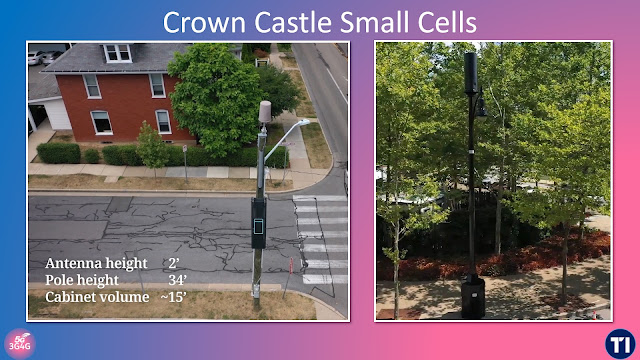
Crown Castle bringing more Small Cells to the USA

Crown Castle owns, operates and leases more than 40,000 cell towers and approximately 80,000 route miles of fiber supporting small cells and fiber solutions across every major U.S. market.

Earlier this month, T-Mobile US, Inc. and Crown Castle announced that the companies have signed a new 12-year agreement to support the continued build-out of T-Mobile's nationwide 5G network with increased access to Crown Castle's towers and small cell locations. The agreement enables the Un-carrier to further expand and deepen the reach of its industry-leading 5G network to serve consumers across the U.S. while also realizing financial synergies following its merger. The agreement also helps Crown Castle generate long-term tower and small cell revenue growth.

An RCR Wireless News article said:

Crown Castle secured commitments for over 50,000 new small cell nodes during the last twelve months, which equates to approximately 70% of the total small cells the booked in its history prior to 2021, the company’s CEO Jay Brown said in a release.

“As a result, we now have approximately 55,000 small cell nodes on-air and more than 60,000 committed or under construction in our backlog. Our customers are already planning for the next phase of the 5G buildout that will require small cells at scale, and this inflection in our small cells business reflects how well-positioned we are to support their wireless network needs for years to come, with our more than 80,000 route miles of fiber concentrated in the top U.S. markets,” the executive said.

“I believe 2022 will be an important transition year for our small cells and fiber business, as we prepare to accelerate our deployment of small cells from approximately 5,000 this year to what we expect will be more than 10,000 per year starting in 2023,” Brown added.

A Light Reading article from last year talked about a new report from Altman Solon. 

Altman Solon said it derived its findings from a database it constructed of small cells across more than 70 US markets. "Leveraging analysis of this database and augmenting with other primary and secondary research and our deep experience and knowledge base in the space for all small cell ecosystem players, Altman Solon has developed preliminary critical insights about the competitive landscape in the US small cell market," the firm boasted.

Among its findings:

  • "Small cell growth has been much slower historically than what industry reports have projected due to the regulatory climate, lack of neutral hosts, and limited backhaul," the firm wrote
  • Roughly 70% of the small cells it identified are located in dense urban and urban areas.
  • Crown Castle operates about 50% of all small cells identified, while mobile network operators like Verizon account for around 35%. Crown Castle operates about 50,000 commercially available small cells today, with another 30,000 on order. ExteNet Systems operates roughly 32,000 small cells across the country, while Mobilitie – recently acquired by Canada's BAI Communications – counts around 10,000 small cells.
  • Altman Solon identified very few neutral host small cells, which are small cells that transmit signals for more than one network operator. Such devices are considered critical to the growth of the industry considering neutral host small cells can generate significant revenues for the companies that operate them.

Here is a short video from Crown Castle explaining their view of small cells

Related Posts:

Sunday, 8 March 2020

Super Bowl 2020 Infrastructure in Miami, Florida, USA


Superbowl is a big thing in the US and is catching on in other parts of the world. My favorite part is all the trailers for the upcoming movies that gets dropped in the half time. All the US operators spend months getting ready with the infrastructure in the city and the stadium. After all, as an operator, you expect a fantastic feedback from your existing customers and show off the speeds after the game.

Quoting from Verizon news:

Verizon is on the ground in Miami working hand-in-hand with first responders, local and state government agencies to help keep everyone connected during the big game. 

Our work in Miami has been focused on three key areas: network investment, our state-of-the-art Command Center and being embedded at Florida’s Emergency Operations center.

Verizon's network engineers have been hard at work for more than two years to ensure that our network is ready for the big game and all the festivities that go along with it. As part of the preparations, Verizon has invested over $80 million dollars to enhance our to support the Super Bowl in and around the stadium and the greater Miami area.

Other investments include laying more than 230 miles of fiber throughout Miami, adding existing capacity to over 280 existing cell sites, installing 5G nodes to support NFL Super Bowl venues and events, installing close to 30 in-building solutions to enhance performance around the city (i.e. popular hotels and shopping centers), installing 5G at both the Miami and Fort Lauderdale Airports and more.

These are permanent network enhancements that will benefit the Miami residents and visitors for years to come.

In their announcement, AT&T said:

We’ve been working for more than a year – and have invested more than $85 million – to boost our network through a series of both permanent and temporary upgrades in the city. All this is designed to help residents, first responders and fans stay connected wherever they are.

And to keep fans safe at one of the year’s biggest sporting events, the FirstNet team at AT&T and the First Responder Network Authority (FirstNet Authority) are working hand-in-hand with dozens of public safety agencies to prepare. This advance work helps ensure first responders have the coverage, capacity and capabilities – network priority and preemption included – that they need to stay connected throughout the festivities.

We’ve upgraded our portion of the in-stadium Distributed Antenna System (DAS) and other network enhancements – like adding 5G+ and Band 14 spectrum – to provide over 300% more LTE capacity than what was available at the start of the football season. That means we’re utilizing the most LTE capacity currently available on any AT&T DAS in the state of Florida.

The DAS, a system of strategically-placed antennas that distribute and actively manage wireless network coverage throughout the stadium, help evenly distribute coverage, creating a better fan experience. This capacity boost helps manage heavy wireless traffic and gives fans and first responders strong wireless coverage throughout game day – from early tailgating to the final trophy presentation.  

We didn’t stop with in-stadium enhancements. Fans and first responders will be able to enjoy improved coverage in hotels, arenas, airports and convention centers, among other venues through a series of network enhancements:

  • We now offer extra speed and capacity over 5G+ in parts of 35 cities, including Miami and Miami Gardens.
  • We’ve upgraded or installed a new DAS at 29 additional locations throughout the Miami area.
  • We’re deploying 6 Cell on Wheels (COWs) to handle expected increased wireless network demands. They will improve reliability and data speeds during the week leading up to and during the Big Game.
  • We’re also enhancing network coverage for the 10th annual AT&T TV Super Saturday Night. The deployments will include a Super COW capable of 5G+ at Meridian Island Gardens to enhance coverage for all the fans headed to see Lady Gaga perform the night before the Big Game.
These investments will allow Florida residents, businesses, visitors and attendees at the festivities to celebrate the Big Game over the AT&T network at home, at work or on the go.
  
In addition to these network enhancements, we’ve been making public safety-specific preparations to ensure the FirstNet communications platform is ready for the Big Game:
  • We deployed high-quality Band 14 spectrum across the area to provide optimal coverage and capacity for first responders. We look at Band 14 as public safety’s VIP lane. In an emergency, it can be cleared and locked just for FirstNet subscribers, further elevating public safety’s connected experience and emergency response.
  • We’ve installed metro cells at numerous local and federal public safety agency centers. These enhancements provide agencies with a direct network connection to the critical information they need.
  • We’ll place three FirstNet Satellite Cell on Light Trucks (SatCOLTs) outside of the stadium for extra redundancy and to provide additional coverage to first responders, if needed.
  • We’re equipping first responders with FirstNet Ready™ devices to help ensure they have communications across the highly secure FirstNet network core.
Plus, members of the FirstNet team will staff the public safety command posts to support local, state and federal agencies in the week leading up to and through the day of the Big Game. This will help ensure communication needs for public safety officials are met.

In their announcement, T-Mobile said:

Over the last year, T-Mobile permanently boosted network capacity at venues throughout Miami so customers can share their game day moments in real time. T-Mobile and Metro by T-Mobile customers already have the biggest 5G network in Miami.  And now, customers with capable 5G smartphones can get a speed boost from millimeter wave 5G in places like Hard Rock Stadium and Bayfront Park.

With 150,000 people predicted to travel to Miami for Super Bowl LIV events, T-Mobile focused network enhancements where the biggest crowds will be, including Hard Rock Stadium, Miami Beach Convention Center, Bayfront Park, Miami Beach and Miami and Fort Lauderdale airports. And almost all the updates are permanent, so Miami residents and visitors can enjoy the improvements long after the Super Bowl is over.

T-Mobile more than doubled LTE capacity at Hard Rock Stadium so customers can stream, tweet, post and chat about every big moment from the game. To enhance indoor capacity at key venues throughout Miami, T-Mobile built new distributed antenna systems (DAS) and deployed small cells throughout the city to provide additional performance boosts in places that can be difficult for towers to reach.

Almost all of Miami is covered with T-Mobile’s far reaching low-band 5G and fast LTE, so whether customers watch the game from the couch or the beach they’ll be ready to share the action.  In addition to launching broad 5G coverage last month, T-Mobile has newly deployed millimeter wave 5G for customers with capable smartphones in parts of Miami, including nearly all of Bayfront Park and at Hard Rock Stadium in the lower bowl, parking lot and main entrances.

To ensure customers with compatible smartphones know where they can access 5G in Miami, T-Mobile has an interactive map of its nationwide low-band 5G to show where coverage is available down to the neighborhood level and created new millimeter wave maps for the city.

Finally, Sprint, who is the only one to share it's deployment pictures and equipment (shown on the top) said:

As part of our Next-Gen Network build, over the last two years we’ve invested millions of dollars in network infrastructure and upgrades to improve our customers’ wireless experience across Miami.

For the second year in a row, Sprint’s Big Game MVP for increased capacity and faster speeds than before is our innovative Massive MIMO technology. And this year, we’re not only bringing customers a better LTE experience, but we’ve lit up Sprint True Mobile 5G service in some areas of Miami including the stadium, in preparation for this exciting event!

Those who live, work or visit Miami should be fired up because these aren’t temporary fixes. These permanent solutions will benefit Sprint customers for a long time to come.

Based on the huge increase in customers’ data usage last year and in 2018, we’re using two different technologies this year to help meet fans’ demands to stream, download, video chat, text and connect on social.
  • In and around the stadium, Sprint’s Massive MIMO radios using our fast 2.5 GHz spectrum and breakthrough “split-mode” feature will enable us to simultaneously deliver our most-advanced LTE service and Sprint 5G for customers attending the showdown in person.
  • In addition, we will be providing 4G/5G dual connectivity within the stadium, transmitting 4G over a state-of-the-art distributed antenna system (DAS) with more than 1,800 antennas and 5G through Massive MIMO radios.
Together, these solutions will provide the equivalent of 10 macro cell towers at the stadium. That will give fans the coverage and capacity they need whether they’re in their seats, at the concession stand or tailgating in the parking lot.

With massive crowds expected throughout Miami and the surrounding areas, we extended our network upgrades in Downtown and Midtown Miami and Miami Beach, as well as areas in West Palm Beach and Ft. Lauderdale.
  • Several dozen new Massive MIMO radios in high-traffic areas such as Downtown Miami, Midtown Miami, Miami Beach, Fort Lauderdale Beach and the Palm Beach Convention Center will provide improved capacity and faster LTE speeds than before. Customers on Sprint 5G devices in these areas will automatically connect to even faster speeds on our next-generation wireless network. Sprint’s average 5G download speed of 215 Mbps is over 5X faster than our LTE.*
  • Hundreds of new small cells have been installed across the urban and dense areas of the city to “fill in” the network with our 2.5 GHz spectrum. This will result in more capacity in that area and a boost in speed for customers.
  • Nearly 300 cell sites throughout the area have been upgraded to use all three of Sprint’s spectrum bands - 800 MHz, 1.9 GHz and 2.5 GHz - for faster, more reliable service than before.
  • Dozens of new macro cell sites have also been built in areas including Delray Beach, Doral, Hialeah, Homestead, Miami, Palm Beach Gardens, and Pompano Beach to further expand wireless coverage in the Southeastern, Florida market.

So who won? Well, that depends on who you ask.

On the Speedtest blog, they said:

Sprint’s home team might have won the game, but Verizon triumphed when it came to mobile download speeds, coming in 143.7% faster than second-place T-Mobile when considering Speedtest® results over all technologies. Sprint had the third fastest mean download speed in this category and AT&T came in fourth.

Focusing on their 5G game really helped Verizon take the day when considering overall speeds as T-Mobile had the fastest mean download speed (66.35 Mbps) on LTE. Sprint was second on LTE with a mean download speed of 56.16 Mbps, AT&T third at 39.18 Mbps and Verizon fourth at 30.67 Mbps. We break out 5G speeds for each operator below.

T-Mobile’s mean upload speed over all technologies was far better than competitors’. Upload speed is especially important at big events like this as fans try to share their game day experience with those not in the stadium.

T-Mobile also had the lowest latency, coming in 26.0% faster than second-place AT&T. Sprint was third for latency and Verizon fourth.

For comparison, the mean download speed over mobile in the U.S. in January 2020 was 41.23 Mbps, upload was 10.55 Mbps and latency was 46 ms.

Verizon easily beat T-Mobile and Sprint when it came to mean download speed over 5G during the big game. Verizon came in last, however, for both mean upload speed over 5G and latency. T-Mobile showed the fastest mean upload speed over 5G and Sprint had the best latency on 5G. While we did see 5G Speedtest results for AT&T during the game, there were fewer than 10, the minimum threshold we set for this event.

In 2019, fans at Mercedes-Benz Stadium in Atlanta used over 24 TB of data on the stadium Wi-Fi network on game day with an average Wi-Fi download speed of 30.98 Mbps. To get a baseline on the Miami experience, we looked at Wi-Fi performance during the Bengals v. Dolphins matchup on December 22, 2019.

Wi-Fi at the stadium did show some game day stresses yesterday, with a mean download speed 33.7% slower than the December 22 game. Mean upload speed dropped 25.7% and latency was up 28.6%.

Verizon also provided Wi-Fi for their customers during the big game yesterday, and the mean download speed was comparable to that on the stadium’s SSID. Mean upload speed on Verizon’s SSID was 12.1% slower than on the stadium’s, but Verizon’s Wi-Fi latency was also lower, showing a 22.2% improvement over stadium Wi-Fi.

It’s worth noting that mean upload speed in all cases was faster than that on download. This is impressive and helpful to fans trying to livestream their experience for friends back home.

This does not mean that it has stopped T-Mobile in claiming that they were winners.

You can say that based on the 5G coverage, this was justifiable

Hopefully in the next Superbowl, we will see some more concrete deployment pictures along with the marketing spin.

Related Posts:

Tuesday, 14 May 2019

T-Mobile USA's Indoor CellSpot (a.k.a. Femtocells)

Sometime back I saw this tweet by T-Mobile CTO Neville Ray


I started wondering if T-Mo had femtocells and voila!

Pic Source: Dane Powell

According to the T-Mobile website, there are 4 types of devices:

  1. 4G LTE CellSpot V1 
  2. 4G LTE CellSpot V2 
  3. 4G LTE Signal Booster 
  4. 4G LTE Signal Booster Duo
The product comparison chart can be seen below
Now let's look at the Functionality comparison chart
As you can see, the cellspots require an ethernet connection as they create a small coverage bubble while the Signal boosters are just repeaters.

You can get detailed specifications here on 4G LTE CellSpot V1 and 4G LTE CellSpot V2.

Detailed specifications here on 4G LTE Signal Booster and 4G LTE Signal Booster Duo.

In Addition, T-Mobile also supports Wi-Fi calling and also sells T-Mobile 'Wi-Fi CellSpot AC1900 Gigabit Router'

Monday, 4 March 2019

T-Mobile USA: Anatomy of A Mobile Wireless Network


T-Mobile has a nice educational video on what makes a network looking at backhaul, small cells, etc. I have posted about T-Mo small cells here and here before. I have also pointed out that the definition of Small cells varies from country to country and USA is no exception. In the USA, RRH's are often referred to as small cells due to their small form factor but I disagree. You can see this earlier post on Macrocells, Small Cells & Hetnets Tutorial.

Here is the video on the anatomy of a mobile wireless network.

Wireless: Anatomy of A Network from T-Mobile National Development on Vimeo.

Wednesday, 18 July 2018

T-Mobile USA is deploying 25K small cells with LAA

Source: PCmag

T-Mobile keeps talking up its small cells and 5G deployments. ICYMI, I recently wrote about the 5G rollout in 600MHz on 3G4G blog here. In a recent interview in Fierce Wireless, T-Mobile’s SVP of radio network engineering and development, Mark McDiarmid reminded everyone that the company plans to deploy up to 25,000 small cells this year, some just a few hundred yards away from one another.

This is all following on from the announcement last year that T-Mobile has contracted to deploy 28,000 small cells. Since then T-Mo has quietly changed its strategy from LTE-U to 3GPP standards based LAA. This was on back of a successful trial with Ericsson where they achieved speeds of 1.1 Gbps using 12-layer Licensed Assisted Access (LAA) technology – the first in the world to hit speeds beyond the 1 Gbps threshold on unlicensed spectrum.
For the PCMag article, Milan Milanovic, Technical Evangelist for Ookla did some tests and the article had the following to say:

At a cell site at 45th St. and Third Avenue in Manhattan, T-Mobile is combining 20MHz of its Band 4 spectrum with 60MHz of LAA spectrum. Phones connect to the cell site and send data up using the 1700MHz/2100Mhz Band 4 spectrum, and then get downloaded data via a combination of Band 4 and LAA.

Those speeds are insane. In 13 tests, we got an average of 503Mbps down and 42.7Mbps up. Just to compare, in Ookla's Speedtest Intelligence database, the top 10 percent of T-Mobile download speeds in that ZIP code are only around 70Mbps down.

LAA-capable phones can get up to ten 100Mbps download streams on this cell site, with four on the licensed spectrum (4x4 MIMO) and two on each of three channels of LAA spectrum, Milanovic said.

Other users on this cell site will do well, but not as well as LAA users, Milanovic notes. The site is also equipped with T-Mobile's workhorse Band 2 and the low-frequency Band 12, which penetrates inside buildings.

LAA is only a solution for dense urban areas, though. This cell site has a coverage diameter of about four blocks (a bit over 1,000 feet), which is considered pretty good for LAA. That's a little better than what the coverage probably would be if the site was sending down 5GHz Wi-Fi, and it's a little better than New York's LinkNYC public Wi-Fi posts.

A nearby LinkNYC post doesn't appear to be interfering with the T-Mobile signal, Milanovic said. That's good news, because one of the concerns about LAA is whether or not it will coexist well with powerful public Wi-Fi.

You'll need the right phone to hit these speeds, and that's not an iPhone. Currently, LAA is supported by T-Mobile's Samsung Galaxy S8, Note 8, Galaxy S8 Active, Galaxy S9/S9+, LG V30, and the unlocked Huawei Mate 10 Pro £399.00 at Amazon. We'll make sure to test LAA when we go on the road with our Fastest Mobile Networks drive tests this spring.

Here is latest on the LAA speed front from Milan Milanović:
Not everyone agrees that LAA has a long term potential or performs well where 5GHz Wi-Fi channels are very busy. Others (mainly vendors) disagree.

You may also enjoy reading Juny Song's article on LinkedIn!

Note: I should point out here that what T-Mobile refers to as Small cells are actually RRU's and not complete base stations. You may want to refer to my tutorial here to understand this better. The bottom picture on this post will help too.

Saturday, 10 March 2018

Some pictures of Small Cells from California (USA)

I came across them on various LinkedIn/Twitter posts

Two Small Cells on adjacent light poles in SF (signs used to somewhat shroud mRRU) - Source: Omar Masry

The comment mentions that One is Verizon. Other is likely ATT
I would argue that if this is an RRU (Remote Radio Unit) then its probably not a small cell but let's leave that one for another day.

Small Cell. Financial District. San Francisco - Source: Omar Masry


Comment mentions: Either T-Mobile or Verizon.  Likely done by Modus. Might be worth checking out this earlier post here too.

The next one is from Steve Blum's Blog of T-Mobile Small cell in Gage Canal, Riverside, California


The final one is from Santa Rosa, California. From a PressDemocrat article titled 'New Verizon antennas generate unwelcome buzz in Santa Rosa'


From the article (more pictures of this installation in the article):
A city-sanctioned bid to improve wireless connectivity for internet and cellphone users in Santa Rosa has run into opposition from some residents and generated concern among city officials after the first round of “small-cell” antennas went up on utility poles in recent weeks. 
The equipment — including large metal in-ground utility boxes about 5 feet tall — varies greatly in design from anything the city was previously shown by Verizon, the wireless provider installing the antennas, said Eric McHenry, director of Santa Rosa’s Information Technology Department. 
While the city had no role in the equipment design, Santa Rosa officials went through a significant amount of back-and-forth with representatives of the wireless carrier on what the units would look like on city-owned streetlights, McHenry said. Officials took pains to make sure the antennas would be as unobtrusive as possible, he said. 
“We frankly as a city were also surprised by what these first ones looked like,” he said, referring to the units Verizon is installing on utility poles. “They look nothing like what we had discussed with Verizon for our city streetlights or even the pictures that we shared with the council (of the installations) on wooden poles.”
Definitely a scope for improvement out there.

Related Article:

Monday, 14 August 2017

T-Mobile USA Small Cells - backhauled via dark fiber

Picture Source: Reddit

Picked this one up from Wireless Week (emphasis mine):
Speaking at the Wells Fargo 5G Forum this week, T-Mobile VP of Radio Network Technology and Strategy Karri Kuoppamaki said the Un-carrier carefully considered its options before settling on a small cell strategy that utilizes dark fiber for densification. Kuoppamaki explained T-Mobile works with a number of partners who provide the fiber, real estate, and manpower for the build outs while the Un-carrier supplies the equipment and facilitates municipal dialogs. The result is an overall cost structure that has been whittled down to a “manageable level,” he said. 
“We work together in deploying those small cells. This strategy has worked for us really, really well,” Kuoppamaki commented. “Ultimately small cell deployments, or successful small cell deployments, depend on the cost structure, especially the backhaul piece. If you can do that by partnering up with the right people, and bring that cost down a fraction of the cost of a macro then it makes sense.” 
According to Kuoppamaki, T-Mobile currently has about 15,000 small cells today, including 13,000 DAS nodes. The Un-carrier is on track to add “several thousand” more by the end of 2017, and has another 25,000 in the pipeline for the next few years, he added.
While fiber is a great strategy in the long run, especially for densification and 5G, it drives the initial cost up. Its not a great strategy for operators who may be more interested in deploying small cells for coverage mainly.

In earlier posts, I have argued for in-band backhauling (IBBH). A similar concept by the name of self-backhauling is used in 5G. In another post we also looked at Sprint MagicBox which uses similar approach to improve coverage and capacity. The main advantage of this approach is quicker deployment at a far lower cost. Backhaul can always be improved after initial deployments once coverage obligations are met.


Anyway, finally coming back to the T-Mobile small cells, here is a much more detailed picture from Omar Masry's slide-deck.