Established in 2012, EDOTCO Group is the first regional and integrated telecommunications infrastructure services company in Asia, providing end-to-end solutions in the tower services sector from tower leasing, colocations, build-to-suit, energy, transmission and operations and maintenance (O&M).
EDOTCO Group operates and manages a regional portfolio of over 58,000 towers across Malaysia, Indonesia, Bangladesh, Cambodia, Sri Lanka, Pakistan, Philippines, Myanmar, and Laos. EDOTCO strives to deliver outstanding performance in telecommunications infrastructure services and solutions. Its state-of-the-art real-time monitoring service, echo, has driven significant improvements in field operations while maximising operational efficiencies in terms of battery, energy and fuel consumption for telecommunications infrastructure.
In Bangladesh, with a portfolio of over 18,000 towers and managed sites, EDOTCO have developed their built-to-suit and co-location offerings to enable telecommunications providers to efficiently meet their growing infrastructure requirements.
In a LinkedIn post last year, Sunil Issac, Country Managing Director of EDOTCO Bangladesh Co. Ltd talked about deploying telecom towers across Gazipur. Quoting from the post:
Gazipur, the bustling hub of ready-made garment factories in Bangladesh, is witnessing remarkable growth. Readymade garment exports from Bangladesh have surged by 12.17% to $35.252 billion in the first nine months of fiscal 2022-23, reflecting the industry's incredible potential (Data released by the Export Promotion Bureau)
At EDOTCO Group we understand the crucial need for reliable network connectivity in this industrial zone. That's why we've strategically deployed a significant number of telecom towers throughout Gazipur. This unique tower in Gazipur showcases ingenious space utilization and steel craftsmanship, enabling it to accommodate three tenants.
By leveraging this inhouse innovative approach, we maximize efficiency and minimize costs, creating a win-win situation for all stakeholders involved. We believe Gazipur's factories have the potential to be the pioneering use case for Private Networks in Bangladesh.
In another post an employee shared their recent aesthetic Street Furniture pole installed at Nabisco Morh, Dhaka, designed specifically for mobile operators. Such poles not only blend seamlessly into the cityscape but also provide robust support for enhanced mobile connectivity.
Here is a slightly old but relevant video of EDOTCO infrastructure from Bangladesh:
Hajj, the annual Islamic pilgrimage to Mecca/Makkah in Saudi Arabia is a fantastic example of how to handle huge amounts of people and data. With over 1.8 million pilgrims this year, many of whom go to the holy mosque every day (generally more than once) during the Hajj days, providing reliable connectivity and reasonable data rates is a huge challenge.
The press release post Hajj, provided some more details on the number of sites and data usage:
CST Governor stated that the unlimited support from the leadership resulted in the recording of exceptional network performance levels across more than (6200) telecom towers, with 5G towers surpassing 4,000 towers, reflecting an impressive 37% increase compared to 2023, while the Wi-Fi points exceeded 10500 points in Makkah Al-Mukarramah and Al-Madina Al-Munawarah and the Holy Sites.
— هيئة الاتصالات والفضاء والتقنية (@CST_KSA) June 12, 2024
H.E. the Governor also added that the total data consumption reached 65.47 thousand TB, equivalent to watching 26.82millionhours of 1080p HD video clips, with internet download speeds exceeded 341.6 Mbit/s, while the voice calls total exceeded 337 million calls with a success increase of 99%, as a result of the developed network infrastructure and the availability of WiFi networks.
Here are some high resolutions pictures that show how much infrastructure is needed. Most of these sites in the Haram provided coverage for something like 100 metres as there were other similar sites nearby, some shared for all operators while others were specific to one operator.
Ecotelligent is on a mission to enable telecommunication in a more human environment by applying the science of wood construction into building of communication towers and masts. This allows them to significantly reduce the CO2 emissions of building the towers and make the landscape more pleasant for people.
Last year, Vantage Towers announced that it has installed the first wooden structured telecommunication mast in cooperation with the Finnish start-up Ecotelligent:
The Ecopol tower was erected as one of two wooden masts in Rhineland-Palatinate as part of a pilot project, as announced by Vantage Towers in October 2022. The installation of the second Ecopol tower is expected to take place in Leiwen, Germany, in the third quarter of 2023; further locations in Germany are being considered. With the construction of wooden structured telecommunication infrastructure, Vantage Towers, together with Ecotelligent, is marking the beginning of a more sustainable mobile communications industry and digitalisation. According to the manufacturer, the Ecopol towers, which are built from recyclable wood, have a significantly lower carbon footprint than comparable masts made of steel or concrete. In addition, they have an attractive, modern design and blend in better with their surroundings - which increases the acceptance of telecommunication infrastructure among the population.
The use of sustainable materials for Vantage Towers' infrastructure is another component of the company’s sustainability strategy, complementing efforts to make its own infrastructure more energy efficient and reduce resource consumption. For example, the company already reached its first major green milestone in 2021: since then, all the electricity Vantage Towers uses to operate its infrastructure has been procured from renewable energy sources such as wind, solar or hydro power. In addition, pilots are underway to produce renewable energy directly at the sites with wind turbines and solar panels, and to replace diesel generators with hydrogen engines.
You can see some more details of wooden telecommunication masts in the video below:
Glad to see that other countries are also considering deploying these environmentally friendly masts in the near future.
Like every operator, Vodafone UK has a variety of Cell On Wheels (COWs) that they take to special events where there may be a need for extra coverage and/or capacity. While we have a good number of posts looking at COWs (see related posts 👇), here is their short video explaining it:
Quoting from their news article earlier this year:
Some of the UK’s best known and largest events, from music festivals and agricultural shows to leading events in the sporting calendar, will see the masts. Known as ‘Cells on Wheels’ (COWs), they will be wheeled onto site to deliver an outstanding network experience and to cope with the extra demand expected on the network.
With over 120 deployments planned, Vodafone’s fleet of COWs will be kept very busy throughout the year. Some events will receive more than one unit, depending on terrain, the size of the event area and estimated number of attendees.
The season started at Cheltenham Race Festival in March. Compared to last year, overall data usage at Cheltenham increased by nearly 10%, with 35% of all data carried over 5G.
In September 2023, Vodafone revealed that 5G data usage at special events was rapidly increasing, with customers using 80% more 5G data in 2023 compared to 2022. One of the busiest was Glastonbury 2023 where Vodafone deployed nine COWs. Over 168 terabytes of data was consumed across the event. Elsewhere, the King’s Coronation saw COWs being placed around Hyde Park and Buckingham Palace. Data usage increased by around 90% compared to a typical Saturday in the capital.
A slightly more detailed video is ☝️ here while this detailed article from last year talks about the process:
Vodafone’s planning for any given event starts long before the organisers open their doors to the public; up to a year in advance for some city-sized. Surveying the site in question, requesting access from landowners and working out how to get lorry loads of equipment up narrow country roads – these are are serious logistical issues that can’t be left to chance.
Mobile signal at an event will be provided by one or more ‘cells on wheels’, or COWs. A COW is effectively a mobile mast – and its associated equipment – mounted on a trailer manned by a crew of three or four engineers. Setting up a COW can not only require a hoist, crane and/or cherry picker, but also the usual data links, power and a suitable location. This trifecta is tricky enough to secure under everyday circumstances in the UK’s villages, towns and cities – never mind the stadia, fields, valleys, shorelines and other unusual venues that host festivals and other such special events.
For festivals and shows that take place in remote rural locations, short-range microwave radios may be needed. These link the COW to the rest of Vodafone’s network as the usual fibre optic or copper cables often aren’t available or can’t be laid.
But such radio links need to be within line-of-sight of the next mast along to work, so locations need to be reasonably clear of obstructions such as trees and hills – obstructions that can also block the mobile signal from the mast once it’s operational.
While Vodafone may have the pick of locations at events that it has partnered with, that’s not always the case, with space at any given event in high demand for stages, retailers and of course the room needed for audiences and tents.
Powering the COW takes more than running a mere extension lead. If grid power isn’t available, then diesel generators are used. The generators then need to be carefully tended and guarded to ensure they continue working properly and aren’t ‘borrowed’ by either desperate or opportunistic third parties.
Getting a COW up-and-running in a surveyed location can take at least a day, often two to three days. But the work doesn’t stop once it’s powered on. Engineers carefully monitor and adjust the COW’s antennas and other equipment to ensure that it delivers the speeds and capacity that the public expect.
Frederic Sundin, Vodafone’s Head of Network Connectivity and Deployment explains: “You have stages in the way, depending on where the special event is, or it can be hilly, it can be trees. That can block the signal. And you need to predict where the crowds will be, because they move around.”
Vodafone’s engineers can draw upon analyses of traffic patterns in previous years when providing coverage at events that the company has been to before. But for new events or those that have relocated to new venues, responding quickly to unexpected events can be crucial.
For example, if there is a massive shift of people up a hill because they’re all watching and snapping/livestreaming the sunset, then engineers must be able to spot this and then actively optimise the network for such a sudden concentration of people in a small space.
The demands expectations of the public lie at the heart of why Vodafone provides mobile coverage at special events. “Festivals, summer events – the UK audience just love it. They flock to them. And, rightly so, they demand good coverage, a good experience,” Andrea, Vodafone’s Chief Network Officer in the UK said.
There is, of course, the other crowd at any given event – the organisers and the retailers. From ticketing to contactless payments, a variety of business processes now rely on mobile connectivity, not to mention first responders from the emergency services and event security.
If you spot a COW in a field near you, snap a picture and send it to us.
Over the last few years you might have read multiple blog posts on our blogs (see related posts below) about how KDDI is preparing for disasters by having all kinds of backup solutions. In the last six months they have taken this even further by taking about their bendable solar cells and lighter backup batteries.
In some situations the base stations have to be installed at locations where it is not possible to deploy solar cells for power. In these locations, KDDI is working with partners to use next generation "perovskite" solar cells which are thin, light and flexible so it can be wrapped around the poles and generate a reasonable power all day long.
Another innovation being tested by KDDI is the use of zinc secondary batteries to strengthen power outage countermeasures during disasters. While backup power supply equipment is effective as a countermeasure against long-term power outages during disasters, the problem is that it cannot be installed or expanded due to the load capacity of the building.
Zinc secondary batteries are approximately 50% lighter than the lead-acid batteries used in many base stations, allowing for more space to be installed, while having twice the capacity for the same size, extending base station operating time. This can be extended up to 72 hours.
At base stations, there is an urgent need to install or expand large-capacity backup power supply equipment as a countermeasure against long-term power outages such as during disasters. Zinc secondary batteries are lightweight, allowing more space for installation, and are the same size as lead-acid batteries, allowing base stations to operate for long periods of time, so they are expected to contribute to maintaining communications during disasters. In addition, since it does not contain harmful lead and there is no risk of heat generation, installation work can be simplified, and it is expected to contribute to the acceleration of the expansion of 5G areas.
In this demonstration, we plan to operate a base station that uses zinc secondary batteries as backup power supply equipment in a real environment for one year, confirming its operation through seasonal changes in temperature and humidity, and conducting power outage tests.
Looking forward to hearing about the results of both these initiatives.
When it comes to deploying outdoor small cells and infrastructure on streetlights and lamp posts, Germany is at the forefront. Check out the related posts at the bottom of this post to see all that's going on there.
In a recent press release, Telefónica Deutschland announced (Google translated from German):
The telecommunications provider O2 Telefónica and the infrastructure provider 5G Synergiewerk, together with the Würzburg public utilities, have put the first 5G street light into operation in Bavaria as part of a pilot project. The 5G lighting tower combines street lights and cell phone sites. In doing so, it fulfills two central utility tasks: to provide lighting at night and at the same time to offer the city's citizens a high-performance 5G mobile network.
The aim is to use the existing urban infrastructure as efficiently as possible for an improved mobile network and new digital applications - and thus increase the quality of life for city residents.
CU Phosco Lighting, which supplied the smart pole solution, announced on its website:
CU Phosco Lighting is thrilled to announce the successful deployment of Connected Urban, its pioneering new smart pole solution designed to enhance mobile network capacities. As part of a Pilot project with our German partner, 5G Synergiewerk, the first 5G streetlight was recently installed in Würzburg, Bavaria, in collaboration with telecommunications provider O2 Telefónica and the Würzburg public utilities.
A smart city, modular, and fully customisable lighting and small cell high-performance mobile network solution within a single, compact footprint, Connected Urban is a break away from more traditional rooftop or cell phone mast locations, and so the installation marks a significant milestone in the evolution of street-level mobile network densification.
Replacing a conventional lamp post, the innovative solution efficiently utilises existing infrastructure and grid connections, to provide citizens with both night-time lighting and advanced telecommunications capabilities, setting a new standard for high-performance 4G and 5G mobile connectivity.
With digital infrastructure facing increasing demands, including music and video streaming, the Metaverse, AI-based programmes, augmented and virtual reality, as well as connected driving and autonomous logistics, Connected Urban is poised to significantly improve the quality of life for city residents and businesses.
5G Synergiewerk has a time-lapse video of the installation of 5G mast system on their website. A video of that embedded below:
Quoting again from Telefónica's press release:
The location on Versbacher Straße is the first active 5G street light in Bavaria . Another location will follow shortly on Schweinfurter Straße, which will conclude a successful pilot project . Coordination discussions are currently being held with all those involved for additional locations. The 5G street light offers smartphone users high bandwidths with 5G and 4G/LTE for mobile telephony and data use in the O2 network. The densification of the mobile network via such small radio cells, which are known in technical jargon as “small cells” , is particularly helpful with regard to the increasing data usage of O2 customers as well as future digital applications in the private and business customer sector. In addition to everyday music and video streaming, this will also include the Metaverse, AI-based programs, augmented and virtual reality, connected driving and autonomous logistics . In Würzburg, more than 40 mobile phone locations are already operating in the O2 network . They ensure comprehensive network coverage with 2G (GSM), 4G (LTE) and the modern 5G standard. Rooftop locations or cell phone masts are usually used for this extensively developed city network.
Street lights are widely used as part of any urban infrastructure and are also suitable as radio cells. They have a power connection, so only a powerful fiber optic connection needs to be added to transport the mobile phone signals. In addition, the 5G light fits harmoniously into the cityscape with its light distribution. The replacement of the conventional street light was carried out in collaboration with the Würzburg public utilities. The infrastructure provider 5G Synergiewerk supplied the special intelligent light pole , a so-called “Smart Pole”. O2 Telefónica then installed the energy-efficient 4G/5G mobile communications technology in the light and ensures a seamless connection to the nationwide O2 mobile network .
Helsiki's radio network currently in use in the metro is being renewed in order to support the future train traffic control system. A cellular network pilot was carried out in 2022/23 with results published in April last year. Based on that it was decided that the new radio network will be implemented with mobile network technology, as it was seen as best suited to the needs of the new train traffic control system and the metro.
The metro is still using many original (dating back over 40 years) systems that are nearing the end of their life-cycle. The current traffic control system, in particular, needs to be updated to ensure the reliable and safe operation of the metro in the future as well. Parts of the system that are now being updated include the train control system and track circuits.
The updating of the train control system will make it possible to increase the number of passengers of the metro by enabling shorter headways between trains than are currently possible. Shortening the headway between trains and other capacity-increasing measures are important, as transport forecasts indicate that the metro’s number of passengers will continue to increase. The current capacity of the metro is simply not enough to meet the increasing demand.
Metro systems have long service lives and their updates have far-reaching impacts. The updates to be implemented now will make it possible to operate the metro safely for another 40 years.
The results and observations from the 'Cellular Network Pilot' is available here. Quoting from that:
This innovative pilot demonstrated that a cellular based communication subsystem is suitable for train control as well as other metro systems applications. The pilot outcomes provided insights into the deployment of such systems and also confirmed the expectation that in order to meet the strict radio communication availability requirements necessary to support safety critical applications, at least two radio network layers should be present. These layers can be presented via implementation combinations of private and public networks including 5G SA slicing, depending on the current and future user requirements.
Ability to support signalling: The pilot test results showed that both the private network (4G or 5G) and the public network are suitable to support ATC performance requirements. In high public network load scenarios, it is advised that QoS is implemented to ensure the reliability of any safety critical streams.
Ability to support current systems: The pilot tests showed that the public network is suitable to support metro’s onboard existing systems. It was observed that when the public network was capacity stressed, with all applications present, the Wi-Fi stream could not reach its maximum intended capacity of 250Mbps. This was due to bandwidth limitations experienced during the Pilot tests and is re-lated to end-to-end connectivity restrictions and by the number of hops between end devices and the Mobile Network Operator’s core. Troubleshooting during the tests revealed that a considerable increase in capacity could be realistically achieved by addressing these limitations.
Ability to support future systems: The pilot tests showed that the private network could not reliably service the critical CCTV stream due to the bandwidth limit of that network and the fact that the CCTV stream was duplicated over the two private routers. At the same time the VoIP stream could be reliably serviced indicating that if there was more capacity the issue with CCTV could be resolved.
Private network deployment observations: In normal operation mode, the band used (2300 MHz) and the density of the radio units was demonstrated to fulfil the requirements for ATC and critical voice communication. For the private network, there was degradation of latency in the coverage area of three out of the four radio positions when these were offline. Most of the service degradation was affecting the Uplink and it was observed in areas were changes in radiating cable topology (changing positions/heights etc.) were occurring. Due to the private nature of the network, lack of external interference caused the system to perform better than expected in low signal situations. The two rooftop macro sites were able to provide good coverage and good handovers to the open track area when the radiating cable radio units in the same area were off. In the 5G SA mode all failures noted for the individual routers occur in areas where the radiating cable is on the opposite side of the respective router’s antennas.
Public network deployment observations: Signal quality and signal levels were good to excellent throughout the tunnel during all degraded mode scenarios. At the same time there were a few occurrences of longer than average delays in a certain handover area within the tunnel. This could be attributed to the geometry of the track, the size of the tunnel and the relevant positions of the directional anten-nas providing the coverage in this area which are lower than antennas on the roof of the train. These observations reveal that the radio design within the tunnel could be rationalised (less density but better located cells). Other results showed that the radio design needs to also consider that sufficient coverage is provided to allow handovers between tunnel and macro layers. An overarching observation was that for maximum redundancy the radio design should avoid designing private network cell edge areas at the same location as public network cell edge areas. By overlapping the network design, the reliability of the dual layer network can be maximised. A final observation is that routers/mobile gateways working in high availability mode and/or application devices that can manage packet duplication via multiple routers are recommended in order to increase data communication reliability.
WSP UK Transport & Infrastructure worked with Metropolitan Area Transport Ltd and its suppliers, providing technical leadership and assurance in the deployment of a pioneering 4G and 5G pilot in a brownfield metro environment. Digital connectivity and rail systems experts at WSP developed testing procedures and carried out an assessment of the most suitable technology and network layer combination using a range of key decision indicators.
Last year Deutsche Telekom developed a mini-mast (or as they call it, ultra-mobile mast) prototype called "cell-tower-to-go". Think of this as Cell On Wheel (COW) with no wheels. In a recent press release they indicated that it has already become a customer favourite within a short space of time.
Around a dozen companies are testing the flexible solution so far. "With our call to test our ultra-mobile cell tower, we have raised great interest among companies from a wide range of industries. This high demand shows: The need for a flexible mobile communications solution is there - also among business customers. This has strengthened our decision to offer this innovation 'made by Telekom' commercially in the future," says Klaus Werner, Managing Director Business Customers at Telekom Deutschland.
One of the first testers is the leading Swiss construction and real estate service provider Implenia. The company will provide its bridge construction site in Bad Lobenstein (Thuringia, Germany) with 5G and 4G/LTE during the two-year construction phase. The construction site in the valley could not be reached by the conventional mobile phone masts in the surrounding area. However, due to the high degree of digitalization of the construction site, a fast and reliable mobile network connection is essential.
Telekom's cell-tower-to-go provides high-performance coverage at the construction site. Smartphones and computers then use fast mobile connections via frequencies in the 2.6 and 3.6 gigahertz range. For Implenia, this basic mobile communications coverage is also an ideal basis for IoT applications. The company uses them to optimize processes and material flows on the construction site. The easy-to-connect mast is linked to the network on the bridge construction site via fiber optics. However, the connection via satellite will also be tested in a next step. This will provide additional flexibility and an even faster connection to the network.
The micro-container is also making a big impact at the delivery service flaschenpost SE. The food and beverage delivery service from Münster, Germany, uses the additional 5G supply within a logistics hall. This speeds up its operational processes.
The special feature of the ultra-mobile mast is that it is significantly smaller, lighter and more flexible than previous solutions. The entire radio technology fits into a compact micro-container (length: 1.6 meters, width: 2 meters, height: 2.6 meters). This makes the mobile mast space-saving and easy to transport. It can be set up by one person in less than an hour - and is immediately ready for use. The micro container can be connected to a local power supply or operated using any other mobile power source. It can be connected to the data network via fiber optics or radio relay.
These advantages make the mobile “dwarf” not only the first choice for fast or temporary coverage for business customers. The use of mobile masts also provides rapid assistance in disaster areas thanks to their enormous flexibility.
Deutsche Telekom will launch a commercial offer for the use of ultra-mobile transmission masts in spring 2024.
Between May and June, test release of water is done to check that the emergency spillway gate is working fine. On these occasions, many tourists visit to experience this. There may be mobile coverage there but there isn't capacity to support large number of people.
To alleviate the network congestion, many Japanese networks send their Cell On Wheels' (COWs) to handle the traffic. NTT Docomo's COW is as shown above.
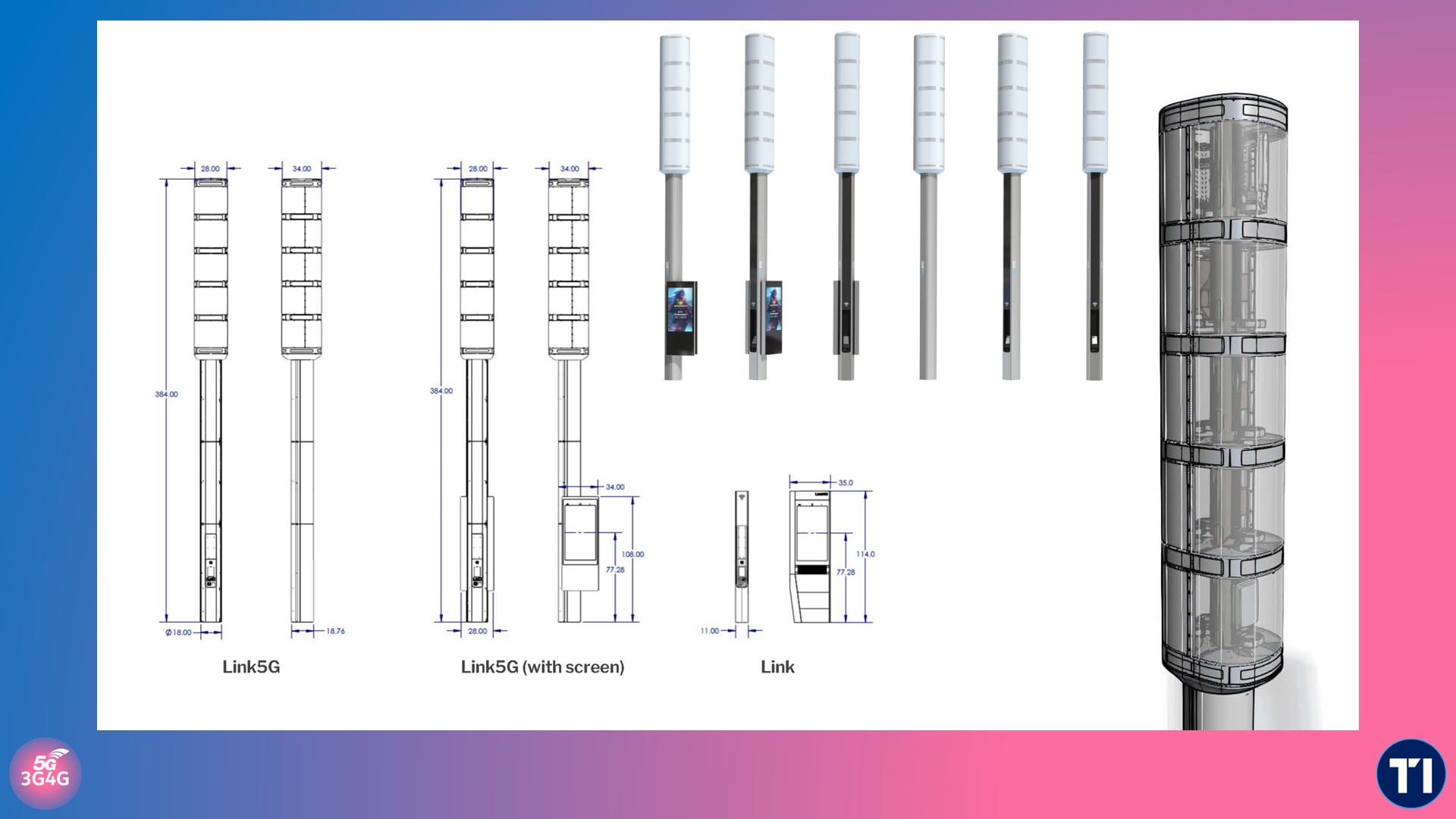
Link5G is LinkNYC’s second generation offering that aims to improve the digital connectivity in New York City. The official website says:
Conceived in 2021 (the Year of 5G), Link5G enables the equitable deployment of both 5G cellular coverage and Wi-Fi connectivity across the five boroughs. Using multi-tenant structures, transmitters for telecommunication service providers will be housed within Link5G kiosks, expanding 5G options and enhancing coverage in underserved areas.
Link5G kiosks will bring better cellular service, increased opportunities to connect to free Wi-Fi, and improved options for in-home broadband internet access.
90% of the new Link5G kiosks, which are enabled for 5G and feature the same free services as the original Link kiosks, will be deployed in The Bronx, Queens, Brooklyn, Staten Island and above 96th Street in Manhattan. Additionally, 13 Community Districts have been specifically chosen by New York City to receive a minimum number of kiosks. Link5G will enhance neighborhoods’ cellular connections and provide businesses and pedestrians with improved high-speed Wi-Fi coverage. Link5G’s 32 foot height ensures that a 5G signal is effectively broadcast from optimal height for all carriers to reach New Yorkers' mobile devices.
Up to three times taller than the original LinkNYC kiosks, hundreds of new Link5G towers are set to crop up in neighborhoods with uneven internet access. But is super-fast cell service really the answer to the city's pressing digital inequities? https://t.co/b6x5sSlukKpic.twitter.com/haLJNYAnSc
Urban Omnibus has a good explainer of the issue and the infrastructure here. Quoting from the article:
CityBridge largely failed to accomplish its goal of helping to bridge the digital divide in the six years after kiosk installation began. The company put the majority of its more than 1,800 LinkNYC units in Manhattan but relatively few in the Bronx, Brooklyn, Queens and Staten Island, where neighborhoods lack at-home and mobile broadband at a higher rate. As THE CITY, the state comptroller and other news outlets have documented, the company fell short of ad revenue projections and was unable to pay $60 million it owed the city. The revenue shortfall resulted in an abrupt halt to kiosk installation, leaving many areas outside Manhattan without the access they were promised. The company faced bankruptcy in 2019. The city contemplated terminating the deal in 2020.
But despite the LinkNYC program’s history of delinquency, city officials are giving CityBridge another chance to bolster digital equity citywide: The company is now preparing to install hundreds of 32-foot-tall Link5G towers, beginning this summer. The city’s Public Design Commission approved the Link5G design for commercial and manufacturing areas at a meeting in December. Members postponed a vote on a residential rollout in order to review data on the service and infrastructural impacts of the towers’ first wave.
The new structures will be more than three times as tall as the original LinkNYC design. Like their predecessors, the lower part of the new structures will have a 911 button, USB ports, a tablet, calling capabilities and advertising displays. The structures will also provide free Wi-Fi. But the new designs will be topped by fifth-generation cellular network technology, or 5G, which will radiate from their upper chambers to enabled devices at street level. Multiple telecom companies could pay CityBridge to house their 5G equipment inside the chambers of a single structure. Their payments would bring in a new revenue stream to CityBridge, funding the company’s operations and expanded footprint.
The structures’ signals will supplement existing 5G networks that currently provide consumers speedy wireless internet service. City officials and CityBridge insist that more cell sites are necessary given the technical specifications of 5G, which require a “line of sight” to work: 5G is carried on millimeter waves that, unlike 4G frequencies, cannot penetrate most surfaces, whether a building or a bus.
I saw one of the new Link5G towers today and 32 feet (3 stories) is extremely tall! pic.twitter.com/42wkz10CkV
Not everyone agrees that these look good or they will help in the future but there is a lot of support behind their installation. This article in NY Daily News for example argues:
Reliable wireless service requires the deployment of new infrastructure that supplements existing technology, such as rooftop antennas and underground fiber cable — or Link5G kiosks, which have space for up to five wireless carriers’ equipment. That means they can provide better, faster, and cheaper service for more people and small businesses nearby.
Bronx residents are not the only New Yorkers who could benefit from Link5G. Across New York City, approximately two-in-five households lack either a home broadband connection or mobile broadband through cell service. More than 1.3 million New Yorkers lack both. For these people, the social, educational, economic, and public safety consequences can be catastrophic. Here in the Bronx, nearly one in five teens cannot finish their homework because they live on the wrong side of the digital divide.
Link5G will eventually roll out to 2,000 locations, with 90% installed in the Bronx, Queens, Brooklyn, and Staten Island and above 96th St. in Manhattan. The need for these kiosks in underserved areas is illustrated by the fact that Link5G’s predecessor, LinkNYC, has provided more than 13 million New Yorkers with free, high-speed wireless internet since 2016 and is used to make around 425,000 phone calls monthly. It also offers access to 911 emergency services and valuable community-oriented public service announcements.
Even in districts with historic or commercial corridors, where locals have questioned the need for these kiosks, it’s unwise to assume every person who lives in the neighborhood, commutes there for work or is visiting has the same access to connectivity. My constituents often commute to other boroughs for work; their ability to stay connected is a necessity — not a luxury.
Still, many critics see the kiosks — which stand only as tall as traditional light posts — and attack their location, size, or ad screens without acknowledging the benefits of the kiosks to the city at large.
Failing Up: First Link5G ‘Smart Pole’ Stands Quietly in Queens from @THECITYNY
CityBridge is poised to install ultrafast internet-transmitting structures...earlier LinkNYC program was a debacle, ending in debt and unfulfilled promises.https://t.co/kykEjavwnW